


The IMF said on Tuesday there is no clear evidence that China's yuan is substantially undervalued, countering claims by US exporters that the currency has been kept artificially low to give Chinese exports an advantage.
US officials have been pressing China, the world's sixth-largest economy, to loosen its yuan peg to the dollar that would ease the trade distortion with the US that lies heavily in favor of China.
But in a review of the Chinese economy, the IMF said a currency revaluation would not by itself have a major impact on global current account imbalances, particularly given China's relatively small share in world trade.
It said more flexibility of the yuan would be in China's own interest. It would allow China more room to pursue an independent monetary policy, help cushion the economy against external shocks and help with adjustments to the structure of the economy, the fund added.
"Directors considered that China could, in a phased manner, introduce more flexibility to its exchange rate without causing major disruptions to its economy," the IMF said.
The timing of such a move should, however, be left to Beijing and its assessment of the market, said Steven Dunaway, senior advisor in the IMF's Asia-Pacific Department.
"We're not advocating a floating of the currency. What we're talking about is some increased movement in the exchange rate," Dunaway said on a conference call.
Such movement could take place by widening the band in which the yuan trades, or changing the peg from a single currency to a basket of different currencies, he said.
The fund said loosening the grip of the yuan peg to the dollar should be carefully planned and sequenced with key changes in the economy.
It said some members of its executive board felt China should take advantage of its strong external position, particularly the current account surplus, to begin initial steps toward greater exchange rate flexibility.
Dunaway said a small first adjustment in the yuan might cause the currency to rise initially before investors began to speculate on the next move. A more significant move should be accompanied by a firm government statement of its intentions, he added.
In the review, the IMF said China should beware of imbalances in its economy as the country rapidly becomes a global manufacturing hub showered with money and credit growth.
"Continued strong credit growth could affect overall quality of the loan portfolio of state banks, adding to the non-performing loan problems these institutions already face," the IMF said.
Some economists have warned that a more flexible yuan could hurt China's fragile financial sector, burdened with bad loans, but Dunaway said as long as capital controls were in place, there would be no major risk to the banking sector.
The Washington-based lender said that, overall, the Chinese economy had rebounded from the SARS epidemic earlier this year and picked up in the second half. Growth was now projected to hit 8.5 percent this year.
Next year, China's economic activity should remain strong and the IMF forecast the economy would grow at about 8 percent.

Among the rows of vibrators, rubber torsos and leather harnesses at a Chinese sex toys exhibition in Shanghai this weekend, the beginnings of an artificial intelligence (AI)-driven shift in the industry quietly pulsed. China manufactures about 70 percent of the world’s sex toys, most of it the “hardware” on display at the fair — whether that be technicolor tentacled dildos or hyper-realistic personalized silicone dolls. Yet smart toys have been rising in popularity for some time. Many major European and US brands already offer tech-enhanced products that can enable long-distance love, monitor well-being and even bring people one step closer to

Malaysia’s leader yesterday announced plans to build a massive semiconductor design park, aiming to boost the Southeast Asian nation’s role in the global chip industry. A prominent player in the semiconductor industry for decades, Malaysia accounts for an estimated 13 percent of global back-end manufacturing, according to German tech giant Bosch. Now it wants to go beyond production and emerge as a chip design powerhouse too, Malaysian Prime Minister Anwar Ibrahim said. “I am pleased to announce the largest IC (integrated circuit) Design Park in Southeast Asia, that will house world-class anchor tenants and collaborate with global companies such as Arm [Holdings PLC],”

Sales in the retail, and food and beverage sectors last month continued to rise, increasing 0.7 percent and 13.6 percent respectively from a year earlier, setting record highs for the month of March, the Ministry of Economic Affairs said yesterday. Sales in the wholesale sector also grew last month by 4.6 annually, mainly due to the business opportunities for emerging applications related to artificial intelligence (AI) and high-performance computing technologies, the ministry said in a report. The ministry forecast that retail, and food and beverage sales this month would retain their growth momentum as the former would benefit from Tomb Sweeping Day
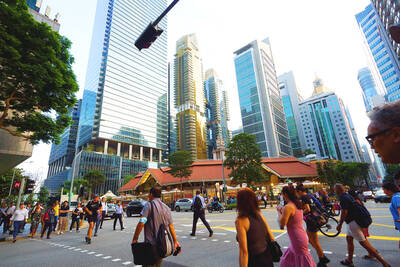
Thousands of parents in Singapore are furious after a Cordlife Group Ltd (康盛人生集團), a major operator of cord blood banks in Asia, irreparably damaged their children’s samples through improper handling, with some now pursuing legal action. The ongoing case, one of the worst to hit the largely untested industry, has renewed concerns over companies marketing themselves to anxious parents with mostly unproven assurances. This has implications across the region, given Cordlife’s operations in Hong Kong, Macau, Indonesia, the Philippines and India. The parents paid for years to have their infants’ cord blood stored, with the understanding that the stem cells they contained


 RSS
RSS