


The battle between President Vladimir Putin and a Russian oil tycoon has spread fears that Western companies will shy away from investing in the country's vast energy industry.
The good news for the industry is, that probably won't happen. Analysts, economists and investors who follow Russia and its energy sector, the world's largest, say they are not worried that the arrest of Mikhail Khodorkovsky and the state seizure of his multibillion-dollar stake in Yukos Oil herald an eventual renationalization of the oil industry and a withdrawal of civil liberties and property rights.
But, they add, there may well be a cost. The interests of foreign oil companies, and ultimately their shareholders and customers, may be harmed in less obvious ways, like through more aggressive taxation.
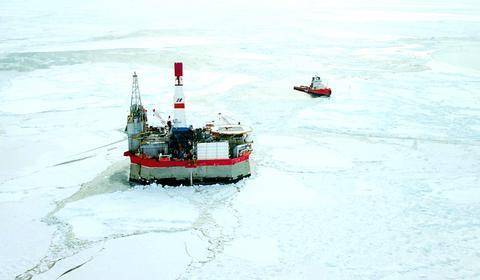
PHOTO: NY TIMES
Foreign involvement in Russian oil is nearly as old as the industry itself -- one Shell project dates to the 19th century -- but most of the big investments have been made in the last few years, or even months.
Three global oil companies, BP, Royal Dutch/Shell and ExxonMobil, have invested billions in Russian projects and have committed to investing billions more -- close to US$20 billion over all. They have the most to lose from any government attempt to reverse the policies that have opened post-Soviet Russia to outside investment.
BP, of Britain, became the largest foreign investor in oil with the creation in June of TNK-BP, a 50-50 venture with a consortium of Russian participants, including Mikhail Fridman, another of the oligarchs who made vast fortunes after the chaotic privatization of the oil industry in the mid-1990s. BP has spent US$2.6 billion so far on TNK-BP and is due to pay US$1.35 billion more in this quarter and an additional US$1.25 billion in shares in each of the next three years.
ExxonMobil owns 30 percent of the US$12 billion Sakhalin I project at Sakhalin Island, north of Japan. Shell has pledged US$5.5 billion as the majority investor in a second project at the island, in partnership with two Japanese companies. Shell, a British-Dutch company, also owns half of the US$1 billion Salym oil field in Siberia. So far, ExxonMobil has spent US$1.8 billion and Shell about US$1 billion.
Officials of the three companies declined to comment explicitly about developments in Russia but said they foresaw no changes to their operations there.
Russia is important to global energy companies because of the huge scale of its reserves -- and the fact that oil in much of the Western world is running out or is in places that make it risky or politically difficult to extract.
"These companies need to find very material opportunities to maintain growth to replace mature asset bases," said Jonathan Wright, an energy analyst at Citigroup Smith Barney in London. "Where can they go? The Middle East or Russia. Much of the Middle East has been off limits to Americans. Iran has been slow to open up as well. When you look at Russia, they've got to be there, really."
And Russia has to have them, which may ultimately ensure that no drastic action is taken.
"The government has control over oil companies, but at the same time the government and Putin himself have realized the country needs growth, so he depends on the oligarchs as well," said Diana Choyleva, senior economist at Lombard Street Research in London and a Russia specialist. "For foreign companies, it does introduce a great deal of uncertainty, but these are companies that are used to dealing in emerging and risky countries. That's where the oil is."
Russia analysts say that Khodorkovsky's arrest, on fraud and tax evasion charges, was precipitated by his financing of political opponents of Putin. That would violate an agreement the president made with the oligarchs when he came to power: They could keep their wealth, earned from buying oil assets at pennies on the dollar, as long as they refrained from politics. Russia has scheduled elections for the lower house of the legislature, the Duma, for December, and Putin is running for re-election in March.
Many authorities on Russian politics have said that the Putin-Khodorkovsky dispute reflects the president's attitude toward the oilman, not the oil business. "There aren't any more Khodorkovskys out there," said Jerome Booth, research director at Ashmore Investment Management, a London firm that is a longtime investor in Russia. "He's the only guy daft enough to take Putin on. I think the whole thing has been overreacted to."
The fact that the dispute has intensified still creates unease.
"Clearly, there are worries that we're starting to see a side of Russia we thought we had gotten rid of," Wright said. "Progress is going to be slow. It's going to take time to change historic attitudes there."
Any leader who wants to get a firm grip on political and economic life in Russia is bound to devote attention to the energy sector, and Choyleva said that even before the flare-up between Russia's president and its richest man, there was a tug of war between the government and oil businesses. The two camps have fought to a standoff because each controls an element of the industry on which the other depends. Production is in private hands, but the pipeline network, the cheapest mode of transport for oil, is under government ownership, through an entity called Transneft.
"Having this bipolar structure does not necessarily promote cooperation," Choyleva said. "Cooperation that has existed has been buttressed by high oil prices. If prices were to fall substantially, there could be confrontation between oil firms and the government. The government could go after more revenue. It could raise fees for transporting oil or increase taxes. Whatever form it takes is not so important. Things won't run as smoothly, and it won't be beneficial for the economy."

Among the rows of vibrators, rubber torsos and leather harnesses at a Chinese sex toys exhibition in Shanghai this weekend, the beginnings of an artificial intelligence (AI)-driven shift in the industry quietly pulsed. China manufactures about 70 percent of the world’s sex toys, most of it the “hardware” on display at the fair — whether that be technicolor tentacled dildos or hyper-realistic personalized silicone dolls. Yet smart toys have been rising in popularity for some time. Many major European and US brands already offer tech-enhanced products that can enable long-distance love, monitor well-being and even bring people one step closer to

TRANSFORMATION: Taiwan is now home to the largest Google hardware research and development center outside of the US, thanks to the nation’s economic policies President Tsai Ing-wen (蔡英文) yesterday attended an event marking the opening of Google’s second hardware research and development (R&D) office in Taiwan, which was held at New Taipei City’s Banciao District (板橋). This signals Taiwan’s transformation into the world’s largest Google hardware research and development center outside of the US, validating the nation’s economic policy in the past eight years, she said. The “five plus two” innovative industries policy, “six core strategic industries” initiative and infrastructure projects have grown the national industry and established resilient supply chains that withstood the COVID-19 pandemic, Tsai said. Taiwan has improved investment conditions of the domestic economy

Malaysia’s leader yesterday announced plans to build a massive semiconductor design park, aiming to boost the Southeast Asian nation’s role in the global chip industry. A prominent player in the semiconductor industry for decades, Malaysia accounts for an estimated 13 percent of global back-end manufacturing, according to German tech giant Bosch. Now it wants to go beyond production and emerge as a chip design powerhouse too, Malaysian Prime Minister Anwar Ibrahim said. “I am pleased to announce the largest IC (integrated circuit) Design Park in Southeast Asia, that will house world-class anchor tenants and collaborate with global companies such as Arm [Holdings PLC],”

MAJOR BENEFICIARY: The company benefits from TSMC’s advanced packaging scarcity, given robust demand for Nvidia AI chips, analysts said ASE Technology Holding Co (ASE, 日月光投控), the world’s biggest chip packaging and testing service provider, yesterday said it is raising its equipment capital expenditure budget by 10 percent this year to expand leading-edge and advanced packing and testing capacity amid strong artificial intelligence (AI) and high-performance computing chip demand. This is on top of the 40 to 50 percent annual increase in its capital spending budget to more than the US$1.7 billion to announced in February. About half of the equipment capital expenditure would be spent on leading-edge and advanced packaging and testing technology, the company said. ASE is considered by analysts


 RSS
RSS