


Taipei Times: What lessons can Taiwan learn from your experience of bailing out problem banks?
Jean Pierre Sabourin: One of the big changes that have occurred around the world is that there's a recognition that, in any country at any time, banks will fail. What we've seen around the world is the push towards preventives ? how to make sure this doesn't happen -- and what to do when it does happen because supervisors and deposit insurers don't make loans. They don't manage the bank. That's up to the board of directors. Therefore, if an institution gets into trouble, they should be taken out of the system. They should be forced to close down.
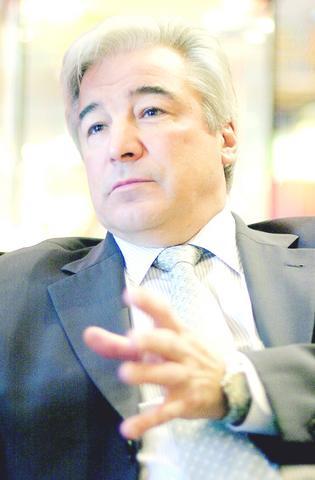
PHOTO: GEORGE TSORNG, TAIPEI TIMES
I've seen annual reports from the Central Deposit Insurance Corp, Taiwan. They are certainly pro-active in failure resolution and there's no question that they are doing their job well. Still, there are always lessons to be learned. If you don't liberalize your system, you have to have a strong supervisory system and a strong deposit insurer.
In case a bank does get in trouble, the primary responsibility for the deposit insurer is to protect depositors. There are different ways of doing it, depending on the mandate of the deposit insurer. The mandate in Canada is not just dealing with troubled institutions, but to find a way to minimize exposures to our corporation, so we have a lot of interventionist powers to ensure we are minimizing exposures.
We're very interventionist. If institutions are not following rules, we will take steps either to rectify the situation immediately, working with the supervisors, or we'll close them down.
TT: In other words, Canada is very pro-active in taking prompt corrective actions against failing banks. But when do you decide to step in?
Sabourin: There are a number of criteria for an early-warning system in use around the world. You can use capital adequacy ratios and differential premiums.
In Canada, we've gone a step forward, which we call standards of sound business and financial practices.
Standards have been put in place, because we realized from our 43 failures that banks usually failed because of mismanagement. It's not because they don't have a strong governance system to identify, assess and manage risks. So, what we are really saying is that if you manage your risks, you should have a well-rounded institution which has strong governance that set the rules for whatever responsibilities the board and management have.
We require that banks have sound risk management systems so that if a bank understands its risks, it can assess whether to accept the risks or not. In that regard, that's an early warning system. If they are not following our standards, then we're concerned. These are not solvency tests, they are issues of "do you have sound risk management systems?" And we coupled that with [the concept that] if you can't follow our standards, you cannot get the best score in our differential premiums system. It's not a risk-based system, but basically we've set both quantitative and qualitative criteria to assess the risk portfolio of various institutions so that we can differentiate one institution from another for differential premiums.
The institutions that have a higher risk factor pay higher premiums, just like in Taiwan. We all recognize today that if you wait until banks are insolvent, it's too late. So you have to move forward to an early-warning system. We cannot stop failures, but we can manage them and help banks not to get into trouble at the beginning. And we can put strong compliance requirements on them that reduce the risk of failure.
TT: So the deposit insurer has to transcend its role of being a pay-box to being a preventive risk-minimizer, as you have preached?
Sabourin: I preach the view that you have to look at the public policy objectives that you've set for the deposit insurer. What are the public policy objectives ? whether to protect the depositors, or the deposit insurance fund. If you are going to minimize the exposure to risks, you've got to have power. If you don't, you're a dysfunctional organization that'll never meet the expectations of the public.
In Canada, our job is to minimize the risk of loss, so we control entry. So it's not automatic that you become a member of the CDIC. After you get a bank charter, you have to apply for [CDIC membership] before opening a bank. We have powers to intervene if there's a problem, such as through our standards, charging higher premiums, we can send the supervisors in and do special examinations. We have a number of powers to be able to mitigate our risk. I refer to the life cycle of institutions.
We control birth, and by working with supervisors, we watch the bank through its life. If it has to die, we'll make sure it dies early.
Before 1987, we were a pay-box, which means that all we do is pay depositors when the bank fails. Canada had a lot of failures and the government later accepted recommendations that the CDIC did not have adequate powers. The CDIC should mitigate the loss and have the power to control risk to minimize the losses, and so we became interventionist.
The difference is that, prior to 1987, our losses were about 50 cents on the dollar. After we became a risk minimizer, our losses were about 17 cents on the dollar. That's a big swing, because we closed down failed institutions earlier and had forced sales and mergers, which ended up costing us nothing, before they became insolvent.
TT: The legislative failure to approve the Financial Restructuring Fund (金融重建基金) has delayed the progress of financial reforms in Taiwan. In lieu of the public fund, what else would you recommend the government should do to help the banking sector return to health?
Sabourin: There are a number of countries that have found themselves in a situation where they have to protect the financial system. What happened is they had a few bank failures, then you find it affects the stability of the financial system and public confidence. So the government must give a blanket guarantee, which is done here. That's also happened in Korea, Japan, Mexico and Sweden. No country can allow its financial institutions to fail. The financial system is the basis for all economic strength.
There are different ways to clean up banking systems, which are always in relation to a country's capabilities of being able to deal with the problem. Take the US government as an example: they want to clean up a bank crisis within three years. And the cost was huge, but they did it because the US economic system could afford to do it.
In Canada, we had failures and we set up asset management companies and positioned strategies to sell off non-performing loans, which has taken us 12 years. So it depends on the market, [outside] interest in buying a bank to liquidate it or break out what we call good, bad and ugly [assets]. There are different recipes for different situations. If your financial system is stable today, obviously you're doing the right thing. But still you have to have a plan and work towards it.
In terms of funding, the deposit insurance system can be set up to deal with the failure, but can't buy itself deals with financial crises. Otherwise, its funding will have to be huge. That's the role of the government, which will step in when the deposit insurer doesn't have the [financial] capability. In Canada, we can charge higher premiums, borrow from the private sector or the government, or provide guarantees. So we have a slew of funding mechanisms. But the final analysis for us is that we are part of the government and the CDIC's obligation is the government's obligation.
TT: How do you optimize the recovery of non-performing loans either in failed banks or in healthy banks?
Sabourin: The first thing is to take provisions against non-performing loans. The next question is when to sell them. If you're selling in a down market, you'll obviously lose a lot. If you wait until there's an up market, the question is what the cost will be of carrying them. So in Canada we used commercial criteria such as discount rates, future cash flows and net present values. Another thing we did was we managed the [resolution] system so that we won't flood the market to sell all the assets and depress the prices, which reduce our returns on assets. But in a commercial sense, you have to assess the cost of carrying them. Timing and position strategies are very important.

Among the rows of vibrators, rubber torsos and leather harnesses at a Chinese sex toys exhibition in Shanghai this weekend, the beginnings of an artificial intelligence (AI)-driven shift in the industry quietly pulsed. China manufactures about 70 percent of the world’s sex toys, most of it the “hardware” on display at the fair — whether that be technicolor tentacled dildos or hyper-realistic personalized silicone dolls. Yet smart toys have been rising in popularity for some time. Many major European and US brands already offer tech-enhanced products that can enable long-distance love, monitor well-being and even bring people one step closer to

Malaysia’s leader yesterday announced plans to build a massive semiconductor design park, aiming to boost the Southeast Asian nation’s role in the global chip industry. A prominent player in the semiconductor industry for decades, Malaysia accounts for an estimated 13 percent of global back-end manufacturing, according to German tech giant Bosch. Now it wants to go beyond production and emerge as a chip design powerhouse too, Malaysian Prime Minister Anwar Ibrahim said. “I am pleased to announce the largest IC (integrated circuit) Design Park in Southeast Asia, that will house world-class anchor tenants and collaborate with global companies such as Arm [Holdings PLC],”

TRANSFORMATION: Taiwan is now home to the largest Google hardware research and development center outside of the US, thanks to the nation’s economic policies President Tsai Ing-wen (蔡英文) yesterday attended an event marking the opening of Google’s second hardware research and development (R&D) office in Taiwan, which was held at New Taipei City’s Banciao District (板橋). This signals Taiwan’s transformation into the world’s largest Google hardware research and development center outside of the US, validating the nation’s economic policy in the past eight years, she said. The “five plus two” innovative industries policy, “six core strategic industries” initiative and infrastructure projects have grown the national industry and established resilient supply chains that withstood the COVID-19 pandemic, Tsai said. Taiwan has improved investment conditions of the domestic economy

MAJOR BENEFICIARY: The company benefits from TSMC’s advanced packaging scarcity, given robust demand for Nvidia AI chips, analysts said ASE Technology Holding Co (ASE, 日月光投控), the world’s biggest chip packaging and testing service provider, yesterday said it is raising its equipment capital expenditure budget by 10 percent this year to expand leading-edge and advanced packing and testing capacity amid strong artificial intelligence (AI) and high-performance computing chip demand. This is on top of the 40 to 50 percent annual increase in its capital spending budget to more than the US$1.7 billion to announced in February. About half of the equipment capital expenditure would be spent on leading-edge and advanced packaging and testing technology, the company said. ASE is considered by analysts


 RSS
RSS