


When Inventec Group (
"Working at Taipei's offices and running errands to Shanghai is a slice of an Inventec engineers' life ... the global market is our battleground," said the head of the nation's leading cellphone maker, of the OKWAP brand handsets.
Like most local IT manufacturers that have relocated production lines to China, Inventec has found that issues relating to talent recruitment and the cross-strait travel of engineers need to be solved as soon as possible, Lee said earlier this month during a forum.
The government appeared satisfied with its efforts in courting foreign investment following an international business conference last week, but offered no solution to the problems of a potential talent shortage and the cost of continually shuttling personnel across the Taiwan Strait.
During the conference, the government successfully solicited 15 multinational conglomerates to set up research and development centers in Taiwan.
Hiring Chinese workers and cross-strait direct-transportation of goods and people are still restricted by official policy.
Current regulations limit private companies from hiring more than 20 percent of their research and development personnel from China.
"Our strategy is to reverse the previous business model of purely making products for international companies," said Hwang Jong-chiou (
"Instead, we want to work hand-in-hand with global vendors' design teams, because we have been losing our manufacturing advantage to China," Hwang said.
Though the government's ban on direct transportation is not considered a determining factor for companies such as Broadcom Corp and Texas Instruments Inc to increase their investment in Taiwan, such a policy "has been a headache for a lot of people," Broadcom executive Shih Cheng-chung (施振強) said at a semiconductor workshop during the Taiwan Business Alliance Conference last week.
"Generally speaking, it [direct transportation] did cause some trouble and inconvenience, as most multinational companies are under a lot of cost pressure, but it's not a big problem," Terry Cheng (
Revisiting the problem of the cross-strait travel, Chen Wen-chi (
"The issue, however, is becoming more prominent" as more manufacturing is expected to move to China, Chen warned.
"How to attract overseas talent to work in Taiwan is crucial for Taiwan's integrated circuit [IC] industry to maintain competitiveness as the growth of local talent is lagging behind the industry's demand," Chen added.
The fight for the nation's best would-be engineers starts even before graduation arrives. A number of well-known local companies, such as Taiwan Semiconductor Manufacturing Co (台積電) and Hon Hai Precision Industrial Co (鴻海精密), send high-ranking executives to the nation's university campuses in an effort to recruit new blood.
Some graduates have jobs before graduation, while the nation's jobless rate still hovers at the record high of 5 percent.
Expressing similar concerns about a shortage of well-trained talent, Quanta Computer Inc (廣達電腦) president Michael Wang (王震華) urged the government to relax its labor policies and liberalize cross-strait transportation regulations.
"Taiwanese companies' edge lies in their flexible operation, but they are vulnerable to cost control," Wang said.
"If the government can relax its labor policy and the hiring of overseas engineers, local companies will be able to effectively control their cost structure," he added.
Quanta plans to operate a new research and development center in Hsinchu next year and needs to recruit about 7,000 engineers to provide its customers with multimedia and entertainment services.
In response to growing demand in the technology industry for high-quality and low-cost workers, Vice Minister of Economic Affairs Shih Yen-shiang(

purpose: Tesla’s CEO sought to meet senior Chinese officials to discuss the rollout of its ‘full self-driving’ software in China and approval to transfer data they had collected Tesla Inc CEO Elon Musk arrived in Beijing yesterday on an unannounced visit, where he is expected to meet senior officials to discuss the rollout of "full self-driving" (FSD) software and permission to transfer data overseas, according to a person with knowledge of the matter. Chinese state media reported that he met Premier Li Qiang (李強) in Beijing, during which Li told Musk that Tesla's development in China could be regarded as a successful example of US-China economic and trade cooperation. Musk confirmed his meeting with the premier yesterday with a post on social media platform X. "Honored to meet with Premier Li
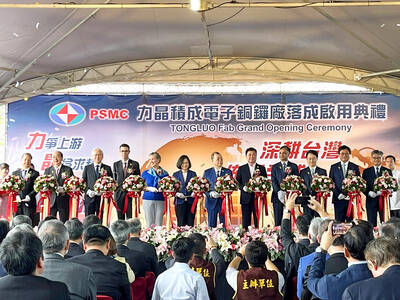
ARTIFICIAL INTELLIGENCE: The chipmaker last month raised its capital spending by 28 percent for this year to NT$32 billion from a previous estimate of NT$25 billion Contract chipmaker Powerchip Semiconductor Manufacturing Corp (力積電子) yesterday launched a new 12-inch fab, tapping into advanced chip-on-wafer-on-substrate (CoWoS) packaging technology to support rising demand for artificial intelligence (AI) devices. Powerchip is to offer interposers, one of three parts in CoWoS packaging technology, with shipments scheduled for the second half of this year, Powerchip chairman Frank Huang (黃崇仁) told reporters on the sidelines of a fab inauguration ceremony in the Tongluo Science Park (銅鑼科學園區) in Miaoli County yesterday. “We are working with customers to supply CoWoS-related business, utilizing part of this new fab’s capacity,” Huang said, adding that Powerchip intended to bridge
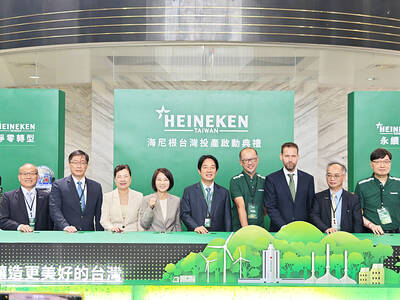
Dutch brewing company Heineken NV on Friday announced an investment of NT$13.5 billion (US$414.62 million) over the next five years in Taiwan. The first multinational brewing company to operate in Taiwan, Heineken made the statement at a ceremony held at its brewery in Pingtung County. It also outlined its efforts to make the brewery “net zero” by 2030. Heineken has been in the Taiwanese market for 20 years, Heineken Taiwan managing director Jeff Wu (吳建甫) said. With strong support from local consumers, the Dutch brewery decided to transition from sales to manufacturing in the country, Wu said. Heineken assumed majority ownership and management rights

Microsoft Corp yesterday said that it would create Thailand’s first data center region to boost cloud and artificial intelligence (AI) infrastructure, promising AI training to more than 100,000 people to develop tech. Bangkok is a key economic player in Southeast Asia, but it has lagged behind Indonesia and Singapore when it comes to the tech industry. Thailand has an “incredible opportunity to build a digital-first, AI-powered future,” Microsoft chairman and chief executive officer Satya Nadella said at an event in Bangkok. Data center regions are physical locations that store computing infrastructure, allowing secure and reliable access to cloud platforms. The global embrace of AI


 RSS
RSS