


October is normally a rocky month for Wall Street. And it has become turbulent again this year.
After a spectacular start to the month, the early October gains are nearly gone and investors are wondering where the rally went.
In the week to Friday, the Dow Jones Industrials fell 1.43 percent to close at 9,582.46 and the broad-market Standard and Poor's 500 index dropped 1.00 percent to 1,028.91.
The NASDAQ, which has seen the biggest gains in recent weeks, sank 2.45 percent to 1,865.59.
The market has now worked off most of the 9 percent gains for NASDAQ and 6 percent rise for the Dow from Oct. 1 to Oct. 14, and the selloff has tempered some of the enthusiasm about strong earnings and economic growth forecasts.
The past week was marked by a flood of corporate earnings reports, which have generally indicated healthy profit growth although some analysts have been concerned about tepid revenue growth an weak guidance for the coming months.
Some market watchers say the modest disappointment was simply an excuse to lock in gains.
Tobias Levkovich at Smith Barney said the market surge over the past seven months and the sharp rally in early October should be setting off warnings about moving too far, too fast.
"In most instances, the best investment returns are achieved in periods of intense pessimism and low prices, while the poorest returns often are associated with excessive optimism and higher prices," he said.
"There's a sense of uneasiness in the air," said Steven Narker, director of private client research at Merrill Lynch.
Ralph Acampora at Prudential Securities said the market is working off some of its strong gains, but predicts a move higher later this year and early next year.
Among active shares over the past week, Microsoft sank 8.02 percent to 26.63 dollars, with nearly all of the losses coming Friday after its earnings report disappointed investors by failing to show a pickup in corporate spending.
IBM fell 0.90 percent to 88.42 after its earnings report showed weak revenue growth.
Amazon, which also failed to lvie up to lofty earnings expectations, sank 8.68 percent to 54.51.
Profit-taking hit some firms even after they met expectations. American Airlines parent AMR, for example, fell 3.19 percent to 29.16 even after returning to profit for the first time since 2000.
Amid the bright spots, Texas Instruments shares jumped 9.98 percent to 27.45 after announcing its profits doubled over the past quarter.
AT&T gained 3.86 percent for the week to 19.90 amid reports of renewed merger talks with rival BellSouth.
Bonds rallied as investors became more cautious about stocks. The yield on the 10-year US Treasury bond dipped to 4.285 percent from 4.388 percent a week earlier, while the yield on the 30-year bond fell to 5.172 percent against 5.250 percent.

HSBC Holdings PLC is deepening its commitment to Taiwan as the economy emerges as one of the bank’s fastest-growing markets globally, driven by an artificial intelligence (AI) investment boom, expanding cross-border trade, and rising wealth creation. “The advantage that Taiwan has is a growth story linked to the semiconductor and broader AI industries, strong underlying corporate performance, and wealth creation,” said Surendra Rosha, HSBC’s co-chief executive for Asia and the Middle East, in an exclusive interview with the Taipei Times on June 2, during this year’s HSBC Taiwan Conference. That combination has helped HSBC cement its position as the most profitable international
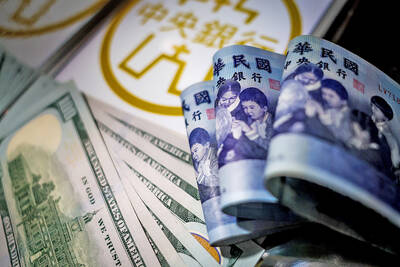
The New Taiwan dollar yesterday fell sharply against the US dollar to close at its lowest level since May 22 amid a massive outflow of funds from the country because of investors panicking over global equity markets. The NT dollar ended at NT$31.580 against the US dollar, slightly lower than its close of NT$31.568 on May 22, after moving between NT$31.5 and NT$31.648 on combined turnover of US$3.062 billion on the Taipei Foreign Exchange and the Cosmos Foreign Exchange. The NT dollar received a significant hit in the morning session, slumping as much as NT$0.173 at a time when other Asian currencies
Taiwan Semiconductor Manufacturing Co (TSMC, 台積電) is now ranked ninth among the world’s 100 most valuable companies after its market capitalization more than doubled over the past year, PricewaterhouseCoopers (PwC) Taiwan said in a report last month. TSMC’s market capitalization surged 101 percent year-on-year to US$1.427 trillion as of March 31, the accounting and consulting firm’s 2026 Global Top 100 Companies by Market Capitalization report said. The gain catapulted the world’s largest contract chipmaker from 12th place to ninth in the rankings, and it was the fastest-growing among the global top 10, it said. TSMC was the only Taiwanese company among the top
Taiwan Semiconductor Manufacturing Co (TSMC, 台積電) yesterday reported record revenue of NT$416.975 billion (US$13.17 billion) for last month, putting the world’s largest contract chipmaker on track to set a record for quarterly revenue. Last month’s figure surpassed March’s record NT$415.19 billion and represented increases of 1.5 percent from April and 30.1 percent from a year earlier. For the first five months of the year, TSMC generated NT$1.96 trillion in revenue, up 30 percent year-on-year, it said in a statement. TSMC has forecast second-quarter revenue of between US$39 billion and US$40.2 billion, representing sequential growth of about 10 percent and year-on-year growth of about


 RSS
RSS