


Asian stocks rose this week, with benchmarks in Japan, Singapore, South Korea and Australia having their biggest gains in at least six weeks.
Mizuho Financial Group Inc led Japanese banks to their biggest weekly rally in 13 years after a Japanese central bank survey showed business confidence climbed to a two-and-a-half-year high.
"The recovery is for real," said John Alkire, who oversees US$15 billion as chief investment officer at Morgan Stanley Asset & Investment Trust Management Co, in a televised interview with Bloomberg News in Tokyo.
Advantest Corp, Chartered Semiconductor Manufacturing Co and Samsung Electronics Co led gains in shares of companies that rely on the US for much of their sales. Increases in manufacturing and consumer sentiment indexes added to evidence of a pick-up in business spending in the world's largest economy.
Morgan Stanley Capital International Inc's Asia Pacific Index, which tracks more than 800 companies in 14 countries, rose 4.6 percent this week to 82.51, its highest since July 3, 2001. The banking and financial component of the MSCI Index jumped 7.6 percent this week.
A Singapore report that showed manufacturing in the city-state expanded in September at its fastest pace in 14 months and a South Korean report showing exports last month grew at their fastest pace in eight months also boosted regional markets.
The quarterly Tankan survey, Japan's most closely watched index of business confidence, increased in September to the highest since December 2000.
Mizuho, the nation's largest lender by assets, surged 33 percent to ?303,000 this week. Sumitomo Mitsui Financial Group Inc, Japan's second-largest bank, jumped 17 percent to ?528,000, while UFJ Holdings Inc, the fourth-largest, climbed 23 percent to ?527,000.
Mitsubishi Tokyo Financial Group Inc, the country's No. 3 bank by assets, rallied 22 percent to ?814,000. The lender also doubled its full-year profit forecast during the week because of lower costs related to bad loans.
"Banks are rallying on hopes of a recovery in the economy," said David Chapman, who helps manage about US$700 million in global equities at Towry Law Asia Ltd in Hong Kong.
The Nikkei 225 Stock Average added 3.8 percent to 10,709.29, and the Topix added 4.5 percent to 1066.86, their biggest gains since the week ended Aug. 22 and Aug. 15, respectively.
Advantest, the world's biggest maker of chip testing equipment, added 3.3 percent to ?7,620.
Signs of accelerating growth in Japan, the world's second-biggest economy, prompted investors to shift their money to domestic-focused stocks on prospects they'll gain more from an economic recovery. Ito-Yokado Co, Japan's largest retailer, added 14 percent to ?4,060.
Singapore's Straits Times index rose 2.6 percent, its biggest weekly rise in six. Chartered Semiconductor, which gets about two-thirds of its sales from the US, rose 6.8 percent.
The Singapore Institute of Purchasing and Materials Management said after the market closed Thursday that its key purchasing managers' index rose to 52, from 51.3 in August. A reading above 50 indicates production expanded.
Factories reported higher orders, signaling the city-state's economy may gain momentum in the months ahead.
South Korea's Kospi added 2.6 percent in the four days ended Oct. 2, its biggest weekly gain in six. The market was closed Friday for a holiday.
South Korean exports surged 24 percent from a year earlier to US$17.2 billion, the commerce ministry said in a statement Wednesday in Seoul. That's more than double August's gain and the 9.8 percent median increase forecast in a Bloomberg News survey of 10 economists.
Samsung Electronics, which gets about a fifth of its sales from the US, rose 5.3 percent to 408,500 won for the week. LG Electronics Inc, the nation's No. 2 electronics maker whose exports account for more than 60 percent of sales, gained 6.5 percent to 57,500 won.
Australia's S&P/ASX 200 Index gained 1 percent for the week, its biggest weekly advance in six. BHP Billiton, the world's largest miner, was the fourth biggest contributor to the rise with a gain of 1.6 percent for the week.
Hong Kong's Hang Seng index gained 2.8 percent this week to 11,608.72, its highest since May 24, 2002. HSBC Holdings Plc, the world's second-largest bank by assets, added 2.4 percent to HK$107 on optimism of economic expansion in the US and Japan.

GROWING OWINGS: While Luxembourg and China swapped the top three spots, the US continued to be the largest exposure for Taiwan for the 41st consecutive quarter The US remained the largest debtor nation to Taiwan’s banking sector for the 41st consecutive quarter at the end of September, after local banks’ exposure to the US market rose more than 2 percent from three months earlier, the central bank said. Exposure to the US increased to US$198.896 billion, up US$4.026 billion, or 2.07 percent, from US$194.87 billion in the previous quarter, data released by the central bank showed on Friday. Of the increase, about US$1.4 billion came from banks’ investments in securitized products and interbank loans in the US, while another US$2.6 billion stemmed from trust assets, including mutual funds,
AI TALENT: No financial details were released about the deal, in which top Groq executives, including its CEO, would join Nvidia to help advance the technology Nvidia Corp has agreed to a licensing deal with artificial intelligence (AI) start-up Groq, furthering its investments in companies connected to the AI boom and gaining the right to add a new type of technology to its products. The world’s largest publicly traded company has paid for the right to use Groq’s technology and is to integrate its chip design into future products. Some of the start-up’s executives are leaving to join Nvidia to help with that effort, the companies said. Groq would continue as an independent company with a new chief executive, it said on Wednesday in a post on its Web
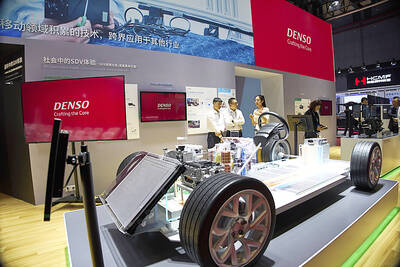
JOINT EFFORTS: MediaTek would partner with Denso to develop custom chips to support the car-part specialist company’s driver-assist systems in an expanding market MediaTek Inc (聯發科), the world’s largest mobile phone chip designer, yesterday said it is working closely with Japan’s Denso Corp to build a custom automotive system-on-chip (SoC) solution tailored for advanced driver-assistance systems and cockpit systems, adding another customer to its new application-specific IC (ASIC) business. This effort merges Denso’s automotive-grade safety expertise and deep vehicle integration with MediaTek’s technologies cultivated through the development of Media- Tek’s Dimensity AX, leveraging efficient, high-performance SoCs and artificial intelligence (AI) capabilities to offer a scalable, production-ready platform for next-generation driver assistance, the company said in a statement yesterday. “Through this collaboration, we are bringing two

Even as the US is embarked on a bitter rivalry with China over the deployment of artificial intelligence (AI), Chinese technology is quietly making inroads into the US market. Despite considerable geopolitical tensions, Chinese open-source AI models are winning over a growing number of programmers and companies in the US. These are different from the closed generative AI models that have become household names — ChatGPT-maker OpenAI or Google’s Gemini — whose inner workings are fiercely protected. In contrast, “open” models offered by many Chinese rivals, from Alibaba (阿里巴巴) to DeepSeek (深度求索), allow programmers to customize parts of the software to suit their


 RSS
RSS