


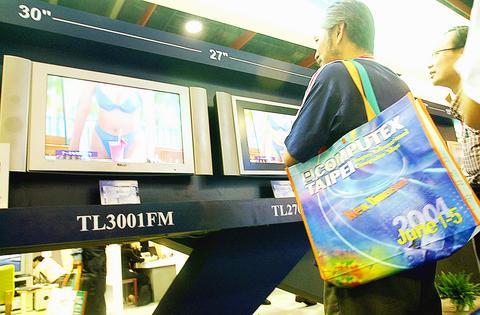
Technology companies are hoping that the merging of mobile phone, home entertainment and computer functions will create a new wave of consumer buying as the industry slowly emerges from a three-year downturn, according to officials from two global giants.
"The future is convergence -- all computers will communicate and all communication devices will compute," said Jason Chen (陳俊聖), a vice president at Intel Corp, during a keynote speech on the first day of Asia's largest computer trade show, Computex Taipei.
"Communications devices that compute will change usage models and create new products," Chen said.
The merging of devices is already happening, Chen said, as cell phones and personal digital assistants (PDAs) are replaced by more powerful smart phones that perform the functions of both devices.
Taiwan's traditional manufacturers of computer components are adapting to the changing technology. Originally a maker of motherboards, Shuttle Inc (
In the near future, experts predict, the average user will be able to use a handheld computer to do the things only a bulky desktop computer can do now.
To demonstrate that point, Chen played a three-dimensional computer game with a colleague using a laptop, and then a handheld computer, via a wireless Internet connection.
The ability to communicate with other computers and devices via a wireless broadband connection is leading the change, according to Texas Instruments CEO Thomas Engibous: "The TV was a TV with nothing connected to it but the signal coming in -- period. An audio system in the living room was just an audio system, standalone, going to some speakers. They're becoming connected now," he told reporters at a press conference yesterday.
"It's the biggest, most exciting thing," Engibous said.
Once users can send and receive e-mail on their cell phones, they will consider buying new third generation phones that already offer more than talk functions, Engibous said. After e-mail, users will want to download and watch video, listen to music and radio, and browse the Internet. In fact, video-conferencing in real time using a cell phone is already possible in Japan, Engibous said.
There is no shortage of new camera phones at Computex this year. One example from Mitac International Corp (
Taiwan is at the center of the change to connected devices. "As I can recall, it used to be Computex was a PC show and nothing else, and today we only walked through it very briefly this morning and you could tell right away ? that it was a communications show," Engibous said.
"That's a reflection of the economy and the electronics industry in general, it's becoming more of a communications world than just a computer world," Engibous said.
Taiwan is also moving beyond being the manufacturing base for the computer industry. "Taiwan's role in the past was in manufacturing," said Kelly Wu (

ISSUES: Gogoro has been struggling with ballooning losses and was recently embroiled in alleged subsidy fraud, using Chinese-made components instead of locally made parts Gogoro Inc (睿能創意), the nation’s biggest electric scooter maker, yesterday said that its chairman and CEO Horace Luke (陸學森) has resigned amid chronic losses and probes into the company’s alleged involvement in subsidy fraud. The board of directors nominated Reuntex Group (潤泰集團) general counsel Tamon Tseng (曾夢達) as the company’s new chairman, Gogoro said in a statement. Ruentex is Gogoro’s biggest stakeholder. Gogoro Taiwan general manager Henry Chiang (姜家煒) is to serve as acting CEO during the interim period, the statement said. Luke’s departure came as a bombshell yesterday. As a company founder, he has played a key role in pushing for the

China has claimed a breakthrough in developing homegrown chipmaking equipment, an important step in overcoming US sanctions designed to thwart Beijing’s semiconductor goals. State-linked organizations are advised to use a new laser-based immersion lithography machine with a resolution of 65 nanometers or better, the Chinese Ministry of Industry and Information Technology (MIIT) said in an announcement this month. Although the note does not specify the supplier, the spec marks a significant step up from the previous most advanced indigenous equipment — developed by Shanghai Micro Electronics Equipment Group Co (SMEE, 上海微電子) — which stood at about 90 nanometers. MIIT’s claimed advances last

CROSS-STRAIT TENSIONS: The US company could switch orders from TSMC to alternative suppliers, but that would lower chip quality, CEO Jensen Huang said Nvidia Corp CEO Jensen Huang (黃仁勳), whose products have become the hottest commodity in the technology world, on Wednesday said that the scramble for a limited amount of supply has frustrated some customers and raised tensions. “The demand on it is so great, and everyone wants to be first and everyone wants to be most,” he told the audience at a Goldman Sachs Group Inc technology conference in San Francisco. “We probably have more emotional customers today. Deservedly so. It’s tense. We’re trying to do the best we can.” Huang’s company is experiencing strong demand for its latest generation of chips, called

GLOBAL ECONOMY: Policymakers have a choice of a small 25 basis-point cut or a bold cut of 50 basis points, which would help the labor market, but might reignite inflation The US Federal Reserve is gearing up to announce its first interest rate cut in more than four years on Wednesday, with policymakers expected to debate how big a move to make less than two months before the US presidential election. Senior officials at the US central bank including Fed Chairman Jerome Powell have in recent weeks indicated that a rate cut is coming this month, as inflation eases toward the bank’s long-term target of two percent, and the labor market continues to cool. The Fed, which has a dual mandate from the US Congress to act independently to ensure


 RSS
RSS