


European governments will seek to boost exports and spur the faltering economy by pressing for China and neighboring Asian countries to reduce exchange-rate "imbalances" at next week's international monetary meetings, European Central Bank president Wim Duisenberg said.
With China's yuan fixed at about 8.3 per dollar, the 12-nation euro's 15 percent increase against the US currency in the past year has hampered European exports and contributed to the slide in economic growth to a 10-year low.
"Most East Asian countries have in one way or another backed their currency to the dollar and the burden of adjustment falls predominantly on the euro," Duisenberg said after a meeting of EU finance officials in Stresa, Italy. "We will undoubtedly discuss whether we can set a more even basis of burden for adjustments that has to take place."
European pressure -- to be brought to bear at next week's G7 and IMF meetings in Dubai -- comes after US Secretary of the Treasury John Snow failed to persuade finance ministers from Pacific rim countries to let currencies float.
The US$8 trillion economy of the 12-nation euro region shrank 0.1 percent in the April-to-June period, only the second quarterly contraction since the euro's arrival in 1999. Germany, Italy and the Netherlands fell into recession. The European Commission this week cut this year's growth forecast in half to 0.5 percent, which would be the slowest since 1993.
Duisenberg said the problem is "much wider" than China alone and any currency realignments "need to be very carefully prepared given the deep-seated vulnerabilities of the financial system in these countries."
The 12-nation euro region's trade deficit with China widened to 15.3 billion euros (US$17 billion) in the first five months from 13.2 billion euros a year ago. The deficit with Japan widened to 9.6 billion euros from 9 billion euros.
"One can revalue and repeg, repeg to different baskets or you can just widen the band," said Caio Koch-Weser, German deputy finance minister and head of the EU's economic and financial committee. "I'm not now giving a position on China. It should be discussed in discrete ways, not publicly, because it could even have counterproductive effects."
The cap on the yuan makes Chinese goods cheaper abroad and increases demand for its exports, which account for about a third of GDP. The peg has also helped to attract US$308 billion in foreign direct investment.
"We shouldn't be the only ones that suffer the dollar's adjustment higher or lower," French Finance Minister Francis Mer said.
EU officials said there was no discussion of foreign-exchange market intervention at the meetings, in which Duisenberg and his successor, Bank of France Governor Jean-Claude Trichet, took part.
"The intervention issue is not discussed in our circles," Dutch central bank president Arnout Wellink said in an interview. "Only in the case of extreme volatility, of real misalignments of currencies we could use perhaps the intervention instrument."
China, the world's fastest-growing major economy, says it needs to grow at least 7 percent annually to generate enough jobs for the 20 million people who enter the labor force every year.
Italian Finance Minister Giulio Tremonti, who will speak for the euro countries at the G7 meeting, said "we've decided to take measures, but we've not yet decided on the content of those measures."
The US trade deficit widened in July as imports rose to the second highest on record, led by oil and consumer goods such as games and clothing. The trading shortfall with China reached a record, the US Commerce Department said.
The US economy has shed 2.7 million jobs since US President George W. Bush took office, and manufacturers have cut payrolls for 37 consecutive months.
UK Chancellor of the Exchequer Gordon Brown called on Asia to do its part to boost world growth, while saying "there was no general or definitive discussion on either the Chinese currency or Japanese intervention" at Saturday's EU meeting. Brown wasn't at Friday's euro meeting because Britain doesn't use the currency.
Countries including the Philippines, South Korea and Taiwan, whose exports to China would suffer from a slowing Chinese economy, have rejected the US appeal to realign their currencies.
US senators last week said they will introduce legislation that would impose tariffs on Chinese imports unless China floats the yuan,which has been pegged to the US dollar since 1995.

Among the rows of vibrators, rubber torsos and leather harnesses at a Chinese sex toys exhibition in Shanghai this weekend, the beginnings of an artificial intelligence (AI)-driven shift in the industry quietly pulsed. China manufactures about 70 percent of the world’s sex toys, most of it the “hardware” on display at the fair — whether that be technicolor tentacled dildos or hyper-realistic personalized silicone dolls. Yet smart toys have been rising in popularity for some time. Many major European and US brands already offer tech-enhanced products that can enable long-distance love, monitor well-being and even bring people one step closer to

Malaysia’s leader yesterday announced plans to build a massive semiconductor design park, aiming to boost the Southeast Asian nation’s role in the global chip industry. A prominent player in the semiconductor industry for decades, Malaysia accounts for an estimated 13 percent of global back-end manufacturing, according to German tech giant Bosch. Now it wants to go beyond production and emerge as a chip design powerhouse too, Malaysian Prime Minister Anwar Ibrahim said. “I am pleased to announce the largest IC (integrated circuit) Design Park in Southeast Asia, that will house world-class anchor tenants and collaborate with global companies such as Arm [Holdings PLC],”

Sales in the retail, and food and beverage sectors last month continued to rise, increasing 0.7 percent and 13.6 percent respectively from a year earlier, setting record highs for the month of March, the Ministry of Economic Affairs said yesterday. Sales in the wholesale sector also grew last month by 4.6 annually, mainly due to the business opportunities for emerging applications related to artificial intelligence (AI) and high-performance computing technologies, the ministry said in a report. The ministry forecast that retail, and food and beverage sales this month would retain their growth momentum as the former would benefit from Tomb Sweeping Day
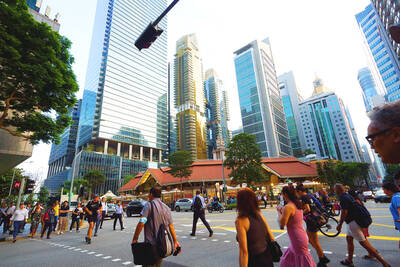
Thousands of parents in Singapore are furious after a Cordlife Group Ltd (康盛人生集團), a major operator of cord blood banks in Asia, irreparably damaged their children’s samples through improper handling, with some now pursuing legal action. The ongoing case, one of the worst to hit the largely untested industry, has renewed concerns over companies marketing themselves to anxious parents with mostly unproven assurances. This has implications across the region, given Cordlife’s operations in Hong Kong, Macau, Indonesia, the Philippines and India. The parents paid for years to have their infants’ cord blood stored, with the understanding that the stem cells they contained


 RSS
RSS