


Taiwan seems to be seeking neutral ground as agricultural policies divide developed and developing countries into two contending groups ahead of the WTO meeting this week.
"Rather than taking sides with either of the camps, Taiwan hopes to reduce subsidies offered to domestic farmers by 20 percent, as per the agreement made in Uruguay Round of trade talks from 1986 to 1993," said Chou Miao-feng (
Taiwan spends about NT$7 billion per year in farm subsidies, Chou said.
Prior to the fifth WTO ministerial conference set for Sept. 10 to Sept. 14 in Cancun, Mexico, developing countries have demanded that rich states cut their agricultural subsidies used to boost their farm exports.
In response, the developed countries, particularly those in the 15-member EU, have called for a reduction of customs duties imposed on agricultural products.
"Judging from the polarized stances taken by these two camps, the upcoming talks on this issue are set to go nowhere," said Kristy Hsu (
While no significant headway is expected to be made at the five-day meeting, Taiwan is more willing to give in to calls to reduce import tariffs and other non-tariff barriers for non-agricultural goods, said Liu Jung-chuo (劉榮座), director-general of the Ministry of Foreign Affairs' economic and trade department.
In addition, the Taiwanese delegation, led by Minister of Economics Affairs Lin Yi-fu (林義夫), is scheduled to announce a measure to drop tariffs on 125 goods from underdeveloped countries, the Cabinet said last week.
The nation will also continue its cash donations to the Doha Global Trust Fund that was set up to help developing countries to build their capacity for WTO negotiations, Liu said. Last year, Taiwan donated US$300,000 to the fund, but Liu refused to reveal the amount to be contributed this year.
Taiwan is planning to conduct bilateral talks with around 20 countries and is attaching great importance to various issues to be discussed during the meeting.
American Institute in Taiwan (AIT) Director Douglas Paal reminded Taiwan to honor its commitments to market liberalization -- especially in the protection of intellectual property rights (IPR).
"A key challenge for Taiwan is an effective IPR rights protection," Paal said at the opening of the WTO center yesterday morning. "The issue has serious consequence for our [US-Taiwan] relationship and Taiwan's high-tech sector in the future."
Paal said that Taiwan's future will depend on protecting copyrights because the nation's economy is becoming more knowledge based. He urged the nation to take an active role in the international trade body in terms of transparency, liberalization and openness.

Among the rows of vibrators, rubber torsos and leather harnesses at a Chinese sex toys exhibition in Shanghai this weekend, the beginnings of an artificial intelligence (AI)-driven shift in the industry quietly pulsed. China manufactures about 70 percent of the world’s sex toys, most of it the “hardware” on display at the fair — whether that be technicolor tentacled dildos or hyper-realistic personalized silicone dolls. Yet smart toys have been rising in popularity for some time. Many major European and US brands already offer tech-enhanced products that can enable long-distance love, monitor well-being and even bring people one step closer to

Malaysia’s leader yesterday announced plans to build a massive semiconductor design park, aiming to boost the Southeast Asian nation’s role in the global chip industry. A prominent player in the semiconductor industry for decades, Malaysia accounts for an estimated 13 percent of global back-end manufacturing, according to German tech giant Bosch. Now it wants to go beyond production and emerge as a chip design powerhouse too, Malaysian Prime Minister Anwar Ibrahim said. “I am pleased to announce the largest IC (integrated circuit) Design Park in Southeast Asia, that will house world-class anchor tenants and collaborate with global companies such as Arm [Holdings PLC],”

TRANSFORMATION: Taiwan is now home to the largest Google hardware research and development center outside of the US, thanks to the nation’s economic policies President Tsai Ing-wen (蔡英文) yesterday attended an event marking the opening of Google’s second hardware research and development (R&D) office in Taiwan, which was held at New Taipei City’s Banciao District (板橋). This signals Taiwan’s transformation into the world’s largest Google hardware research and development center outside of the US, validating the nation’s economic policy in the past eight years, she said. The “five plus two” innovative industries policy, “six core strategic industries” initiative and infrastructure projects have grown the national industry and established resilient supply chains that withstood the COVID-19 pandemic, Tsai said. Taiwan has improved investment conditions of the domestic economy
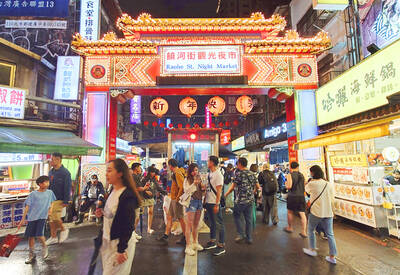
Sales in the retail, and food and beverage sectors last month continued to rise, increasing 0.7 percent and 13.6 percent respectively from a year earlier, setting record highs for the month of March, the Ministry of Economic Affairs said yesterday. Sales in the wholesale sector also grew last month by 4.6 annually, mainly due to the business opportunities for emerging applications related to artificial intelligence (AI) and high-performance computing technologies, the ministry said in a report. The ministry forecast that retail, and food and beverage sales this month would retain their growth momentum as the former would benefit from Tomb Sweeping Day


 RSS
RSS