


US stocks ended lower on Friday as pre-weekend profit-taking cut short a morning rally fed by an upbeat outlook from Intel Corp, the world's largest microchip maker.
Bonds nudged higher as investors staged a last-minute buying spree ahead of the weekend, helped in part by the stock market losing steam after its early jump.
Stocks shot higher early after Intel raised its revenue forecast for the current quarter, citing stronger demand from computer makers. Good earnings news in some retail stocks like Nordstrom Inc helped underpin stocks as well.
But traders said the market was unable to gain much upward momentum with many players away on vacation.
The market is "just a little tired after the run-up we've had," said Jon Brorson, managing director of growth equities at Neuberger Berman.
"People used the strong opening to take some money out of stocks and put it away for a while," Brorsaon said.
The Dow Jones Industrial Average slumped 74.81 points, or 0.79 percent, to 9,348.87, and the S&P 500 Index dropped 10.21 points, or 1.02 percent, to 993.06.After rallying nearly 2 percent earlier in the session, the NASDAQ Composite Index fell 12.23 points, or 0.69 percent, to 1,765.32, based on the latest available figures.
All three major indexes ended the week with gains, with the Dow up 0.3 percent, the S&P 500 up 0.2 percent, and the NASDAQ Composite up 3.7 percent.
Trading volumes were moderate on Friday with about 1.3 billion shares traded on the New York Stock Exchange and about 1.7 billion on NASDAQ.
Earlier this week, the Dow posted its highest close in 14 months and the NASDAQ climbed to a 16-month high.
"Stocks have moved back toward their recent highs, in some cases," said Joseph Stocke, portfolio manager at StoneRidge Investment Partners LLC. "It's not too unusual after a period of three years where the market hasn't done too well for investors to want to lock in profits when they can."
In a surprise statement before the open, Intel raised its third-quarter revenue target to a range of US$7.3 billion to US$7.8 billion, citing strength at its microprocessor business unit. Its prior revenue target was US$6.9 billion to US$7.5 billion. It also bumped up its gross profit margin forecast.
Shares of Intel climbed US$1, or 3.8 percent, to US$27.39, and ranked as the blue-chip Dow's top percentage gainers. Intel's rise also helped push the Philadelphia Stock Exchange semiconductor index up 0.9 percent.
Nordstrom rose US$1.07, or 4.5 percent, to US$25.07, a day after the upscale department store chain posted sharply higher second-quarter earnings as cost controls boosted margins.
In the bond market, the seasonal lack of liquidity and a dearth of economic data meant the market was particularly thin and directionless, with prices swinging on the smallest order.
"It's a long weekend in all but name," said a trader at a US primary dealer.
"I'm looking across the dealing room and I can see, like, a dozen heads, and you can bet they all drew the short straw," th trader said.
The benchmark 10-year note ended Friday's session unchanged at 98 and 6/32, with its yield at 4.48 percent, after rising slightly earlier in the day.
In contrast, the 30-year bond gained 7/32 to a price of 101 and 21/32, while its yield slipped to 5.26 percent from 5.28 percent late Thursday.
In the currency markets, encouraging US economic data continued to prop up the greenback against the euro, which has slumped due to a general underperformance in European assets.
"It's fairly clear that the US economic data has given the dollar a pretty good shove over the last couple of days," said Andrew Delano, currency analyst at IDEAglobal.
"We're also seeing some weak data out of the euro zone," he said. "The US is ultimately going to lead the global cyclical story. The US is going to draw substantial capital flows going forward."

HSBC Holdings PLC is deepening its commitment to Taiwan as the economy emerges as one of the bank’s fastest-growing markets globally, driven by an artificial intelligence (AI) investment boom, expanding cross-border trade, and rising wealth creation. “The advantage that Taiwan has is a growth story linked to the semiconductor and broader AI industries, strong underlying corporate performance, and wealth creation,” said Surendra Rosha, HSBC’s co-chief executive for Asia and the Middle East, in an exclusive interview with the Taipei Times on June 2, during this year’s HSBC Taiwan Conference. That combination has helped HSBC cement its position as the most profitable international
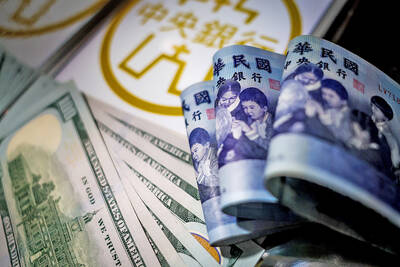
The New Taiwan dollar yesterday fell sharply against the US dollar to close at its lowest level since May 22 amid a massive outflow of funds from the country because of investors panicking over global equity markets. The NT dollar ended at NT$31.580 against the US dollar, slightly lower than its close of NT$31.568 on May 22, after moving between NT$31.5 and NT$31.648 on combined turnover of US$3.062 billion on the Taipei Foreign Exchange and the Cosmos Foreign Exchange. The NT dollar received a significant hit in the morning session, slumping as much as NT$0.173 at a time when other Asian currencies
Taiwan Semiconductor Manufacturing Co (TSMC, 台積電) is now ranked ninth among the world’s 100 most valuable companies after its market capitalization more than doubled over the past year, PricewaterhouseCoopers (PwC) Taiwan said in a report last month. TSMC’s market capitalization surged 101 percent year-on-year to US$1.427 trillion as of March 31, the accounting and consulting firm’s 2026 Global Top 100 Companies by Market Capitalization report said. The gain catapulted the world’s largest contract chipmaker from 12th place to ninth in the rankings, and it was the fastest-growing among the global top 10, it said. TSMC was the only Taiwanese company among the top
Taiwan Semiconductor Manufacturing Co (TSMC, 台積電) yesterday reported record revenue of NT$416.975 billion (US$13.17 billion) for last month, putting the world’s largest contract chipmaker on track to set a record for quarterly revenue. Last month’s figure surpassed March’s record NT$415.19 billion and represented increases of 1.5 percent from April and 30.1 percent from a year earlier. For the first five months of the year, TSMC generated NT$1.96 trillion in revenue, up 30 percent year-on-year, it said in a statement. TSMC has forecast second-quarter revenue of between US$39 billion and US$40.2 billion, representing sequential growth of about 10 percent and year-on-year growth of about


 RSS
RSS