


Asian stocks fell this week with Japan's Nikkei 225 Stock Average having its biggest decline in almost four months. Results from technology-related companies including Taiyo Yuden Co raised concern that their profit outlook doesn't justify the market's gain since April.
The Nikkei dropped 3 percent to 9327.53, its biggest weekly fall since the five days ended April 11. Buying from overseas investors, which helped the Nikkei gain 31 percent since April 28, turned to selling on Tuesday.
Indonesian stocks pared losses after falling as much as 4 percent on Tuesday following the nation's worst terror attack since October last year. Hong Kong's Hang Seng Index also had its worst week in four months, while Taiwan's TAIEX and South Korea's Kospi completed their biggest weekly drop in three months, weighed by companies including Korea Electric Power Corp and Taiwan Semiconductor Manufacturing Co, the world's largest maker of computer chips on a subcontracting basis.
"We've entered a phase where some investors are starting to think that it's time to be locking in their recent gains," said Hiroyuki Kotoku, who helps oversee the equivalent of US$59 billion as global investments manager at Tokio Marine & Fire Insurance Co.
"Market expectations for earnings growth in the technology industry have been too big," Kotoku said.
Taiyo Yuden, which makes ceramic capacitors and inductors, slid 21 percent to ?1,048 its biggest weekly drop since the five days ended Dec. 22, 2000. The company on Wednesday widened its full-year loss estimate to ?3.8 billion from ?1.9 billion citing a decline in prices of condensers -- electronic components used in personal computers and mobile phones.
DECLINES ACCELERATE
Murata Manufacturing Co, the world's biggest maker of ceramic capacitors, which are used to regulate electricity in cell phone handsets, lost 5.8 percent, to ?5,340. It is set to report quarterly earnings on Monday.
A shift in orders from overseas investors accelerated declines in the benchmarks, some investors said. People from outside Japan, who have been net buyers according to orders placed before the market open, turned net sellers on Tuesday for two days this week, the first time in 11 days they sold more shares than they bought.
"Recent gains were supported by foreigners and now that we are entering summer holidays, we are seeing some selling," said Norihito Kanai, who helps manage the equivalent of US$2.5 billion at Meiji Dresdner Asset Management Co in Tokyo.
The Topix index lost 2.7 percent to 917.47, its biggest weekly drop since April 4.
In the US, the Standard & Poor's 500 Index fell 0.3 percent this week, while the Dow Jones Industrial Average rose 0.4 percent. The NASDAQ Composite Index dropped 4.2 percent, the biggest weekly decline since January 17.
Since reaching this year's high on June 17, the S&P 500 has lost 3.4 percent amid concern that rising interest rates would slow growth in the economy.
Indonesia's Jakarta Composite Index dropped 0.7 percent to 505.360 after a car bomb killed at least 10 people and injured 147 at the JW Marriott hotel in Jakarta.
Telkom, as the country's largest telephone company is known, dropped 3.4 percent to 4,250 rupiah.
In Hong Kong, Cathay Pacific Airways Ltd was one of the only two stocks that gained on the 33-member Hang Seng Index this week.
Cathay, the island's largest passenger carrier, on Wednesday reported a first half loss while saying it will have a "much-improved performance" in the second half because SARS has been contained. Its stock jumped 4.1 percent to HK$11.50, its biggest weekly gain in two months. The Hang Seng dropped 3 percent.
The TAIEX dropped 2.9 percent to 5232.55. Exporters such as Taiwan Semiconductor and Hon Hai Precision Industry Co were the two biggest drags on the index after the island's export growth in July missed some economists' estimates.
Taiwan Semiconductor slid 3.3 percent to NT$58. Hon Hai, the island's biggest electronics maker by sales, gave up 11 percent to NT$122.
The nation's exports last month rose 4.5 percent from a year ago to US$11.6 billion, the government said Thursday after the market closed. The gain lagged the median 5.8 percent forecast in a Bloomberg News survey of seven economists.
The Kospi slumped 3.2 percent to 704.14. Korea Electric Power, which spends about a fifth of its fuel budget on oil, fell on concern higher crude prices may raise the company's costs. It slid 7 percent and helped make the Korea Electric and Gas Index the biggest drag on the Kospi.
Hyundai Motor Co, South Korea's largest automaker, slipped 8.8 percent to 32,600 won on concern that its agreement with workers to increase wages may raise labor costs.
AMP Ltd, Australia's biggest life insurer, slumped 8 percent, reaching a record low during the week after a report that its Henderson Global Investors unit may have broken rules for managing clients' money.

HSBC Holdings PLC is deepening its commitment to Taiwan as the economy emerges as one of the bank’s fastest-growing markets globally, driven by an artificial intelligence (AI) investment boom, expanding cross-border trade, and rising wealth creation. “The advantage that Taiwan has is a growth story linked to the semiconductor and broader AI industries, strong underlying corporate performance, and wealth creation,” said Surendra Rosha, HSBC’s co-chief executive for Asia and the Middle East, in an exclusive interview with the Taipei Times on June 2, during this year’s HSBC Taiwan Conference. That combination has helped HSBC cement its position as the most profitable international
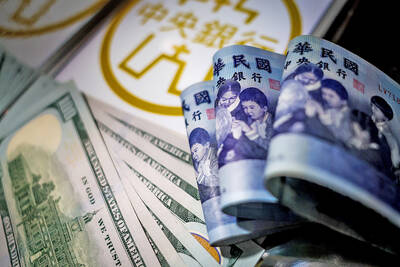
The New Taiwan dollar yesterday fell sharply against the US dollar to close at its lowest level since May 22 amid a massive outflow of funds from the country because of investors panicking over global equity markets. The NT dollar ended at NT$31.580 against the US dollar, slightly lower than its close of NT$31.568 on May 22, after moving between NT$31.5 and NT$31.648 on combined turnover of US$3.062 billion on the Taipei Foreign Exchange and the Cosmos Foreign Exchange. The NT dollar received a significant hit in the morning session, slumping as much as NT$0.173 at a time when other Asian currencies
Taiwan Semiconductor Manufacturing Co (TSMC, 台積電) is now ranked ninth among the world’s 100 most valuable companies after its market capitalization more than doubled over the past year, PricewaterhouseCoopers (PwC) Taiwan said in a report last month. TSMC’s market capitalization surged 101 percent year-on-year to US$1.427 trillion as of March 31, the accounting and consulting firm’s 2026 Global Top 100 Companies by Market Capitalization report said. The gain catapulted the world’s largest contract chipmaker from 12th place to ninth in the rankings, and it was the fastest-growing among the global top 10, it said. TSMC was the only Taiwanese company among the top
Taiwan Semiconductor Manufacturing Co (TSMC, 台積電) yesterday reported record revenue of NT$416.975 billion (US$13.17 billion) for last month, putting the world’s largest contract chipmaker on track to set a record for quarterly revenue. Last month’s figure surpassed March’s record NT$415.19 billion and represented increases of 1.5 percent from April and 30.1 percent from a year earlier. For the first five months of the year, TSMC generated NT$1.96 trillion in revenue, up 30 percent year-on-year, it said in a statement. TSMC has forecast second-quarter revenue of between US$39 billion and US$40.2 billion, representing sequential growth of about 10 percent and year-on-year growth of about


 RSS
RSS