


The Thai government's low-interest-rate policy has successfully buoyed the Southeast Asian nation's private spending since the 1997 financial crisis, Thailand-based businessmen told a 15-member business delegation from Taiwan yesterday.
With that policy, people in Thailand could afford to spend and the nation's auto, property and stock markets were able to recover in the shortest time possible, they said.
"Auto sales are estimated to reach as many as 600,000 cars this year," said Chiou Min-chang (裘明昌), a Taiwanese senior adviser to the Rojana Industrial Park Public Co in Bangkok.
With a population of 63 million people, Thailand's GDP per capita is around US$2,006. But the nation is currently a manufacturing base to almost all international auto-makers including Honda Motor Co, BMW, General Motors Corp and Toyota Motor Corp, Chiou said.
While auto prices in Thailand are relatively higher than those in its neighboring countries, Toyota Motor Thailand's auto production is currently producing at around 70 percent capacity, and likely to reach full capacity later in the year, according to a Bangkok Post report, citing company chairman Pramon Sutivong.
"Now is also a good time for Taiwanese auto and motorcycle manufacturers to move in and set up shops here in Thailand," Chiou said.
However, none of Taiwanese auto makers including Yulon Motor Corp (裕隆汽車) have been able to branch into Thailand since their foreign technical partners may still control the franchise rights, Chiou added.
Sharing a similar view, Vikrom Kromadit, CEO of Amata Corp, which developed one of the biggest industrial parks here, said that auto-part manufacturers make up nearly 50 percent of proprietary in his Amata Industrial Estate in eastern coastal Bangkok.
After generating revenues of 2 billion baht (US$47.6 million) last year, Kromadit, who also developed two industrial parks in Vietnam, said that the development of industrial parks in Thailand is on a fast-developing track in line with promotional efforts and tax incentives kicked off by the Board of Investment (BOI) to attract foreign investments.
The BOI in Thailand offers tax exemptions on imported machinery and tax breaks of up to eight years on corporate earnings, depending on which of the nation's three industrial zones businesses are located in.
The corporate income tax rate in Thailand is 30 percent.
To showcase its vast investment potential, Thailand is slated to host the fourth Asia-Pacific Economic Forum (APEC) Investment Mart in mid-October.
As an experienced land developer, Kromadit also said the recovery of local property markets is foreseeable.
Chiou said he expects to see the local property sector to get out of the five-year-long recession and grow by 30 percent within one year.
While taking part in a Taiwanese media group interview, Kittiratt Na-Ranong, president of the Stock Exchange of Thailand (SET), expressed confidence in future gains of the local stock market, saying that the local stock benchmark "may climb up to 800 points possibly within one year."
Na-Ranong said that his prediction is based on the stock market's averaged price/earnings ratio and dividend yield, which are as low as 8.34 times and 2.69 percent respectively.
With an average daily turnover of US$232 million, Thai stock investors, on average, had a 65 percent gain in the past year, he added.
According to the SET, foreign investors made up 25 percent of the market's transactions.

Among the rows of vibrators, rubber torsos and leather harnesses at a Chinese sex toys exhibition in Shanghai this weekend, the beginnings of an artificial intelligence (AI)-driven shift in the industry quietly pulsed. China manufactures about 70 percent of the world’s sex toys, most of it the “hardware” on display at the fair — whether that be technicolor tentacled dildos or hyper-realistic personalized silicone dolls. Yet smart toys have been rising in popularity for some time. Many major European and US brands already offer tech-enhanced products that can enable long-distance love, monitor well-being and even bring people one step closer to

Malaysia’s leader yesterday announced plans to build a massive semiconductor design park, aiming to boost the Southeast Asian nation’s role in the global chip industry. A prominent player in the semiconductor industry for decades, Malaysia accounts for an estimated 13 percent of global back-end manufacturing, according to German tech giant Bosch. Now it wants to go beyond production and emerge as a chip design powerhouse too, Malaysian Prime Minister Anwar Ibrahim said. “I am pleased to announce the largest IC (integrated circuit) Design Park in Southeast Asia, that will house world-class anchor tenants and collaborate with global companies such as Arm [Holdings PLC],”

Sales in the retail, and food and beverage sectors last month continued to rise, increasing 0.7 percent and 13.6 percent respectively from a year earlier, setting record highs for the month of March, the Ministry of Economic Affairs said yesterday. Sales in the wholesale sector also grew last month by 4.6 annually, mainly due to the business opportunities for emerging applications related to artificial intelligence (AI) and high-performance computing technologies, the ministry said in a report. The ministry forecast that retail, and food and beverage sales this month would retain their growth momentum as the former would benefit from Tomb Sweeping Day
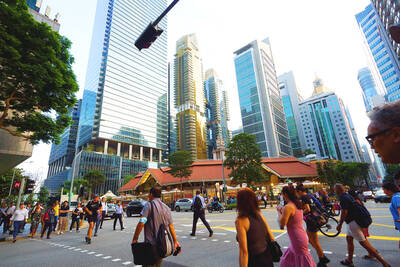
Thousands of parents in Singapore are furious after a Cordlife Group Ltd (康盛人生集團), a major operator of cord blood banks in Asia, irreparably damaged their children’s samples through improper handling, with some now pursuing legal action. The ongoing case, one of the worst to hit the largely untested industry, has renewed concerns over companies marketing themselves to anxious parents with mostly unproven assurances. This has implications across the region, given Cordlife’s operations in Hong Kong, Macau, Indonesia, the Philippines and India. The parents paid for years to have their infants’ cord blood stored, with the understanding that the stem cells they contained


 RSS
RSS