


Hong Kong banks will benefit from the territory's recently signed free trade agreement with China, making them more attractive to overseas suitors seeking prospective mergers and acquisitions, international accounting firm KPMG said yesterday.
KPMG partner-in-charge for financial services, Steve Roder, said the Closer Economic Partnership Arrangement (CEPA) will provide a boost to the Hong Kong economy, which in turn would bring benefits to the local banking sector.
The prospect of Hong Kong banks being able do yuan personal banking businesses will earn them fees from processing such transactions and make up for shortfalls in fee income due to the lower levels of Hong Kong dollar activity, he said.
Even prior to CEPA, there had always been a lot of bidders, including overseas ones, for banks in Hong Kong, Roder said.
"There have been a lot of discussions in the public domain about merger and acquisitions. The only problem is that there is a lack of results from those discussions," he said.
However, Roder said he expects these discussions to intensify as local and Chinese authorities issue more clarifications about the definition of Hong Kong banks.
Under the preliminary provisions of CEPA, the minimum asset requirement for Hong Kong banks to open branches in China will be lowered to US$6.0 billion from the current US$20 billion.
Additionally, when applying for a yuan license in China, the minimum profitability track records Hong Kong banks require will be shortened to two years from three and no longer be on a per-branch basis, but on a "pooling" basis.
Roder said CEPA will intensify the economic integration between Hong Kong and China and create more reason for Chinese banks to strengthen ties with those in Hong Kong through collaboration, acquisition of strategic stakes or affiliations in various forms.
As for foreign institutions, Roder said local banks remained attractive acquisition targets because of the present cheap valuations and the fact Hong Kong is still considered a stepping stone to expand into China.
KPMG partner for financial services Martin Wardle said corporate loans and overall asset quality of banks in Hong Kong stayed robust last year and the first half of this year, despite the very low level of economic activity and the outbreak of SARS.
"The corporate book remains relatively benign and hasn't been significantly affected by SARS," he said.
Wardle said the asset quality of the sector as a whole is strong with non-performing loans more than 35 percent covered with loan-loss provisions and the rest with collateral.
Wardle also said that he expects the sector to see some write-backs of provisions as the macroeconomic situation in Hong Kong picks up.
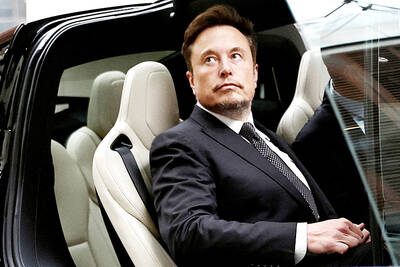
purpose: Tesla’s CEO sought to meet senior Chinese officials to discuss the rollout of its ‘full self-driving’ software in China and approval to transfer data they had collected Tesla Inc CEO Elon Musk arrived in Beijing yesterday on an unannounced visit, where he is expected to meet senior officials to discuss the rollout of "full self-driving" (FSD) software and permission to transfer data overseas, according to a person with knowledge of the matter. Chinese state media reported that he met Premier Li Qiang (李強) in Beijing, during which Li told Musk that Tesla's development in China could be regarded as a successful example of US-China economic and trade cooperation. Musk confirmed his meeting with the premier yesterday with a post on social media platform X. "Honored to meet with Premier Li
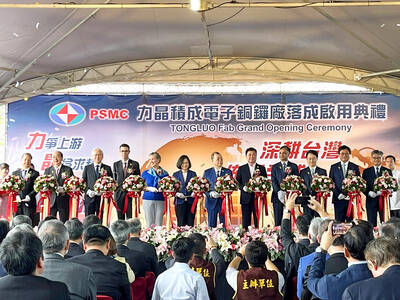
ARTIFICIAL INTELLIGENCE: The chipmaker last month raised its capital spending by 28 percent for this year to NT$32 billion from a previous estimate of NT$25 billion Contract chipmaker Powerchip Semiconductor Manufacturing Corp (力積電子) yesterday launched a new 12-inch fab, tapping into advanced chip-on-wafer-on-substrate (CoWoS) packaging technology to support rising demand for artificial intelligence (AI) devices. Powerchip is to offer interposers, one of three parts in CoWoS packaging technology, with shipments scheduled for the second half of this year, Powerchip chairman Frank Huang (黃崇仁) told reporters on the sidelines of a fab inauguration ceremony in the Tongluo Science Park (銅鑼科學園區) in Miaoli County yesterday. “We are working with customers to supply CoWoS-related business, utilizing part of this new fab’s capacity,” Huang said, adding that Powerchip intended to bridge
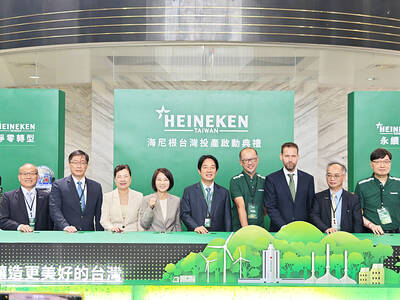
Dutch brewing company Heineken NV on Friday announced an investment of NT$13.5 billion (US$414.62 million) over the next five years in Taiwan. The first multinational brewing company to operate in Taiwan, Heineken made the statement at a ceremony held at its brewery in Pingtung County. It also outlined its efforts to make the brewery “net zero” by 2030. Heineken has been in the Taiwanese market for 20 years, Heineken Taiwan managing director Jeff Wu (吳建甫) said. With strong support from local consumers, the Dutch brewery decided to transition from sales to manufacturing in the country, Wu said. Heineken assumed majority ownership and management rights

Microsoft Corp yesterday said that it would create Thailand’s first data center region to boost cloud and artificial intelligence (AI) infrastructure, promising AI training to more than 100,000 people to develop tech. Bangkok is a key economic player in Southeast Asia, but it has lagged behind Indonesia and Singapore when it comes to the tech industry. Thailand has an “incredible opportunity to build a digital-first, AI-powered future,” Microsoft chairman and chief executive officer Satya Nadella said at an event in Bangkok. Data center regions are physical locations that store computing infrastructure, allowing secure and reliable access to cloud platforms. The global embrace of AI


 RSS
RSS