


The world's second-largest manufacturer of made-to-order computer chips, United Microelectronics Corp (UMC,
The move may be part of UMC's plan to partner with rising stars in the chip industry, analysts said yesterday.
"Most of UMC's customers specialize in the multimedia market, and UMC is looking to invest in companies with growth potential in this field," said Alfred Ying (
Ending days of speculation, an official at Princeton confirmed the investment plan, but said that the details had yet to be hammered out by board members at both companies.
"UMC already decided to invest in our company, but the [dollar] amount has not been decided yet and won't be until our board of directors meets on June 6 to discuss the issue," spokesperson Terry Tsai (
Chinese-language media speculated yesterday that UMC's CEO and vice chairman John Hsuan (宣明智) might be elected to Princeton's board in June.
An integrated circuit is a silicon chip, or microchip, on which millions of tiny resistors, capacitors and transistors are etched. ICs appear in products as varied as computers, mobile phones and answer machines. Multimedia ICs are used in DVD players and stereo systems to create 3D surround sound and clear, crisp video.
Back in January, UMC chairman Robert Tsao (
"Overall UMC's strategy is to invest in IC design houses in Taiwan and overseas to secure orders," said James Huang, (黃建銘), an analyst at SinoPac Securities Corp (建華證券). Huang warned, however, that there may be a conflict of interest for UMC between independent customers and customers in which UMC invests.
"UMC's priority may be to manufacture for the larger customers during times of tight capacity, which may conflict with the smaller companies it has invested in."
Rumor-laden Chinese-language media reported in January that the wife of the former president of Princeton, Chen Chuan-shu (陳傳書), accused him of keeping two sets of books at Princeton which led to a Bureau of Investigation visit in March to look into "improper accounting practices." Investors bailed out of the stock as a result of the investigation, which may have made the company's stock an attractive bargain for UMC, Huang said yesterday.
UMC remained tight-lipped about the possible investment yesterday.
"I cannot confirm [the plan] at the moment," said UMC spokesperson Alex Hinnawi. "At this point it is just speculation."
UMC shares fell NT$0.6, or 2.8 percent, on the TAIEX yesterday to close at NT$21.1. Princeton's stock fell NT$2, or 3.5 percent, to close at NT$55.5 on the over-the-counter market in Taipei.

HSBC Holdings PLC is deepening its commitment to Taiwan as the economy emerges as one of the bank’s fastest-growing markets globally, driven by an artificial intelligence (AI) investment boom, expanding cross-border trade, and rising wealth creation. “The advantage that Taiwan has is a growth story linked to the semiconductor and broader AI industries, strong underlying corporate performance, and wealth creation,” said Surendra Rosha, HSBC’s co-chief executive for Asia and the Middle East, in an exclusive interview with the Taipei Times on June 2, during this year’s HSBC Taiwan Conference. That combination has helped HSBC cement its position as the most profitable international
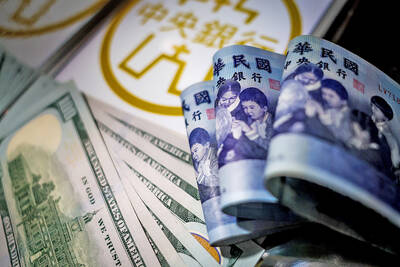
The New Taiwan dollar yesterday fell sharply against the US dollar to close at its lowest level since May 22 amid a massive outflow of funds from the country because of investors panicking over global equity markets. The NT dollar ended at NT$31.580 against the US dollar, slightly lower than its close of NT$31.568 on May 22, after moving between NT$31.5 and NT$31.648 on combined turnover of US$3.062 billion on the Taipei Foreign Exchange and the Cosmos Foreign Exchange. The NT dollar received a significant hit in the morning session, slumping as much as NT$0.173 at a time when other Asian currencies
Taiwan Semiconductor Manufacturing Co (TSMC, 台積電) is now ranked ninth among the world’s 100 most valuable companies after its market capitalization more than doubled over the past year, PricewaterhouseCoopers (PwC) Taiwan said in a report last month. TSMC’s market capitalization surged 101 percent year-on-year to US$1.427 trillion as of March 31, the accounting and consulting firm’s 2026 Global Top 100 Companies by Market Capitalization report said. The gain catapulted the world’s largest contract chipmaker from 12th place to ninth in the rankings, and it was the fastest-growing among the global top 10, it said. TSMC was the only Taiwanese company among the top
Taiwan Semiconductor Manufacturing Co (TSMC, 台積電) yesterday reported record revenue of NT$416.975 billion (US$13.17 billion) for last month, putting the world’s largest contract chipmaker on track to set a record for quarterly revenue. Last month’s figure surpassed March’s record NT$415.19 billion and represented increases of 1.5 percent from April and 30.1 percent from a year earlier. For the first five months of the year, TSMC generated NT$1.96 trillion in revenue, up 30 percent year-on-year, it said in a statement. TSMC has forecast second-quarter revenue of between US$39 billion and US$40.2 billion, representing sequential growth of about 10 percent and year-on-year growth of about


 RSS
RSS