


More than 110 years after it mined its first rough diamonds, De Beers, the dominant force in the world diamond trade, is turning its hand for the first time to selling the finished product, diamond jewelry, to the public.
But De Beers' US$400 million foray into retailing, a joint venture with the luxury goods maker LVMH Moet Hennessy Louis Vuitton called De Beers LV, is getting off to an awkward start.
Alain Lorenzo, the chief executive of De Beers LV, said Wednesday that the opening of the flagship store on Old Bond Street, just down the block from Cartier and Tiffany's in central London, had to be postponed for 10 days.
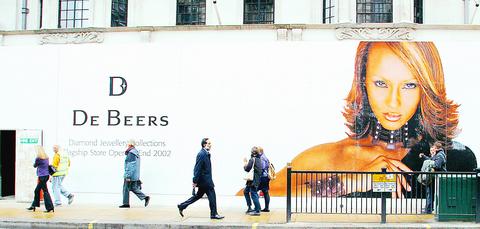
PHOTO: NY TIMES
The problem, embarrassingly enough for the world's rough-diamond giant, is too few diamonds. The store had not yet received enough diamond-studded jewelry items from suppliers to fill its showcases and display window.
Even before that, preparations for the ribbon-cutting were dogged by an advocacy group's protest campaign linking diamond mining to the uprooting of native Bushmen in Botswana, where De Beers has a joint venture with the government to exploit the world's most productive diamond deposits. Anglo American is the biggest shareholder in De Beers.
So audacious have activists from the Survival International group become that they managed to cover a huge billboard showing the model Iman wearing a De Beers diamond with one depicting a woman from the Bushman group.
Mocking De Beers' marketing tag line, "A diamond is forever," the replacement poster read, "The Bushmen aren't forever."
For all that, the company will still hold an opening party for the store on Thursday evening, with fashion models and celebrities like Sophie Dahl expected to attend. A spokeswoman for De Beers LV, Joan Parker, said that one guest at the party will be Shirley Bassey, who sang the title song for the 1971 James Bond movie Diamonds Are Forever.
Iman, who has become the face of De Beers' move into retailing, will not be there, Parker said, but her absence will be "for family reasons" and not because of any break with the company over the Bushman issue, as one newspaper here reported, Parker said.
The issue has become so fraught that De Beers this week threatened Survival International with a lawsuit for continuing to insist publicly that evictions of Bushmen were linked to diamond-mining, a connection denied by the Botswana government, by European legislators, by other British and Botswanan advocacy groups, by De Beers and by De Beers LV, the retail joint venture.
"No way does diamond-mining require the removal of people," said Andrew Bone, a spokesman for De Beers, which has prospected for diamonds in the Central Kalahari Game Reserve, the vast desert at the center of the controversy, and which still holds licenses to explore there.
Land issues
Stephen Corry, the director of Survival, is unpersuaded. "I can give De Beers this diamantine guarantee," he said. "The campaign will not end until the Bushman's land has been returned to them, for without it they are doomed."
A messy argument about treatment of indigenous people is probably the last thing De Beers needed, with the global diamond business facing a global economic slowdown and only just emerging from another controversy, over so-called conflict diamonds -- rough stones mined in war-torn regions and sold illicitly to finance rebellions and civil wars.
De Beers LV would rather draw attention on the exclusivity of its product offerings -- once it has them in stock, that is. Reporters invited to the London store on Wednesday for preopening interviews saw many empty display cases.
That was not the plan back in July, when the company said the store would be ready to open a day or two after the inaugural party Thursday evening.
"We were probably a bit optimistic," Lorenzo said.
When the doors do open -- the plan now is for a Dec. 3 debut, 10 days late but still in time for the main holiday shopping rush -- the store will offer diamond items ranging from US$750 trinkets to -- theoretically at least -- the 203-carat De Beers Millennium Star, which was the object of a failed November 2000 robbery at London's Millennium Dome. Lorenzo said the stone was worth "several dozens of millions of dollars" and is not kept at the store.
The London store is meant to be the forerunner of a chain that would include a New York store on the corner of Fifth Avenue and 55th Street, which the company hopes to open in 2004. The US accounts for half the world's US$60 billion in sales of cut and polished diamonds, but it is also problematic for the parent company, De Beers, because of a variety of antitrust investigations that preclude it from openly doing business there.
Making distinctions
For this reason, De Beers, which is based in South Africa, has sought to draw a distinction between itself and the retail venture, De Beers LV. Though De Beers' managing director, Gary Ralfe, is also chairman of De Beers LV, "De Beers management has no executive role in this company," Lorenzo said in an interview.
De Beers itself sells only rough diamonds, and controls two-thirds of the US$8 billion market in uncut stones. But it does not do business directly with its own retail joint venture. Instead, Andrew Coxon, the chief diamond buyer and one of a number of De Beers executives who have moved over to the retail joint venture, has been scouring wholesale diamond markets, particularly in Russia and Canada, to find the kinds of cut stones that suit his purpose. They must, he said in an interview, be of high quality and be certified as coming from sources untainted by conflict.
To get such stones, he said, De Beers LV must "stand in line behind Tiffany and Cartier" to buy from independent traders or from some of the 120 "sight-holders," the diamond dealers who are authorized to buy rough stones from De Beers for cutting, polishing and trading.
Coxon said that the retail venture's diamonds will be branded, with the name De Beers indelibly imprinted in minute characters on each stone of more than one-quarter carat. The logo will be visible only under 200-times magnification.
De Beers decided to become a retailer, Coxon said, because the company realized that "other luxury products were out-performing diamond jewelry," and because it wanted to reinvigorate the fragmented retail trade and increase global demand for diamonds. No one said anything about Bushmen until the project was well under way.
HSBC Holdings PLC is deepening its commitment to Taiwan as the economy emerges as one of the bank’s fastest-growing markets globally, driven by an artificial intelligence (AI) investment boom, expanding cross-border trade, and rising wealth creation. “The advantage that Taiwan has is a growth story linked to the semiconductor and broader AI industries, strong underlying corporate performance, and wealth creation,” said Surendra Rosha, HSBC’s co-chief executive for Asia and the Middle East, in an exclusive interview with the Taipei Times on June 2, during this year’s HSBC Taiwan Conference. That combination has helped HSBC cement its position as the most profitable international
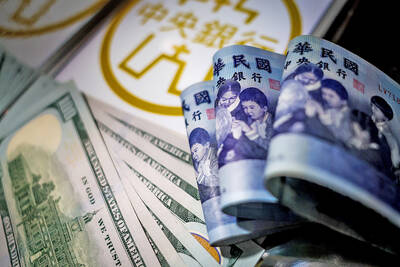
The New Taiwan dollar yesterday fell sharply against the US dollar to close at its lowest level since May 22 amid a massive outflow of funds from the country because of investors panicking over global equity markets. The NT dollar ended at NT$31.580 against the US dollar, slightly lower than its close of NT$31.568 on May 22, after moving between NT$31.5 and NT$31.648 on combined turnover of US$3.062 billion on the Taipei Foreign Exchange and the Cosmos Foreign Exchange. The NT dollar received a significant hit in the morning session, slumping as much as NT$0.173 at a time when other Asian currencies
Taiwan Semiconductor Manufacturing Co (TSMC, 台積電) is now ranked ninth among the world’s 100 most valuable companies after its market capitalization more than doubled over the past year, PricewaterhouseCoopers (PwC) Taiwan said in a report last month. TSMC’s market capitalization surged 101 percent year-on-year to US$1.427 trillion as of March 31, the accounting and consulting firm’s 2026 Global Top 100 Companies by Market Capitalization report said. The gain catapulted the world’s largest contract chipmaker from 12th place to ninth in the rankings, and it was the fastest-growing among the global top 10, it said. TSMC was the only Taiwanese company among the top
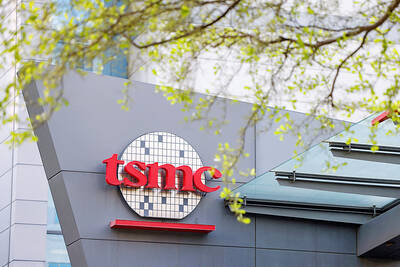
Taiwan Semiconductor Manufacturing Co (TSMC, 台積電) yesterday reported record revenue of NT$416.975 billion (US$13.17 billion) for last month, putting the world’s largest contract chipmaker on track to set a record for quarterly revenue. Last month’s figure surpassed March’s record NT$415.19 billion and represented increases of 1.5 percent from April and 30.1 percent from a year earlier. For the first five months of the year, TSMC generated NT$1.96 trillion in revenue, up 30 percent year-on-year, it said in a statement. TSMC has forecast second-quarter revenue of between US$39 billion and US$40.2 billion, representing sequential growth of about 10 percent and year-on-year growth of about


 RSS
RSS