


I need to bring back the sun, retrieve a book and save my family from the dreamtime world they're trapped in. I need to collect coins and opals, get messages from bottles and build a better boomerang. I have to jump, climb, swim, bounce on lawn chairs and old mattresses, break boxes and slot machines and locate secret areas.
I am playing several different action-adventure games, but they all seem to run together into one vast game. Was I looking for gold coins in Ty the Tasmanian Tiger? No, it was opals -- I need coins to get a lucky horseshoe in Super Mario Sunshine. No, wait, that's Sly Cooper and the Thievius Raccoonus; in Mario, the coins restore my health.
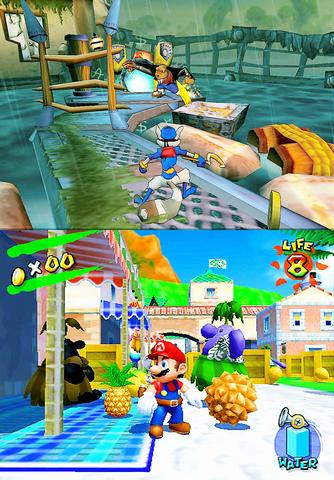
PHOTO: NY TIMES
These games are all "platformers," 3D descendants of the old 2D side-scrolling games in which the game character would jump from one platform -- a cliff, an ice floe, a cloud -- to another, collecting tokens and battling monsters. The great challenge for designers of platformers is to differentiate themselves from the pack. Thus monster plants, kangaroos and machine-wielding wolves all vie for our attention, screaming: "Play me! I'm different!"
Nintendo's Super Mario Sunshine sets itself apart from the masses by means of its weapon, a portable water hose called a Fludd, for Flash Liquidizing Ultra Dousing Device, which also doubles as a water-powered jet pack. On a visit to a tropical island, Mario is arrested in a case of mistaken identity. An evil look-alike has been destroying the island, covering it with graffiti and sludge, and Mario is ordered to clean up the mess with the Fludd. The sludge itself spits out nasty monsters that Mario must spritz, and cleaning graffiti gives him entry to other despoiled areas.
Super Mario Sunshine is yang to the yin of last year's Luigi's Mansion. Mansion took place in a dark, spooky mansion, Sunshine, on a bright island where sprightly music plays all day long. In Mansion, Luigi carried a vacuum cleaner on his back to suck up ghosts; in Sunshine, Mario carries a hose on his back to spritz gooey monsters. Sunshine is easily superior, in both its game play and atmosphere.
With its sunny graphics and clever game play, Mario does a good job of differentiating itself but has a flaw common to most platformers: a boring story. While interesting plot, characters and dialogue are increasingly common in more adult games, such elements are perfunctory in most platformers. Sly Cooper and the Thievius Raccoonus, developed by Sucker Punch, flouts this convention with a reasonably cogent story and some clever dialogue. While it is not in the same league as with story-intensive games like The Longest Journey or Final Fantasy X, it doesn't have to be. Just not boring the player to tears puts it well above its brethren.
Sly is a thief whose family heirloom, a book of thieving techniques, was stolen years ago. Sly is determined to retrieve this book, pages of which have been acquired by various gangsters.
The game unfolds at night, as Sly climbs over rooftops or sneaks into a gangster's lair to the accompaniment of sneaking-around music. Since Sly is a thief, he must often dodge spotlights and security systems, sidle along ledges and break through windows. While he hunts for the book, he himself is being hunted by the police, headed by Inspector Carmelita Fox. Their meetings involve Carmelita's telling Sly to turn himself in, Sly's breezy flirting with Carmelita, and Carmelita's doing her best to kill Sly.
Raccoonus is not nearly as pretty as Mario Sunshine. The animal characters remind me of Disney movies at their nadir in the early 1970s, giving the game the look of a mediocre children's cartoon. But the levels are wonderfully designed and imaginative, so in spite of its character design, the game has a real sense of style.
Hopping in the wilderness
The game play of Krome Studio's Ty the Tasmanian Tiger is not as original as that of Mario or Raccoonus. Instead the game tries to set itself apart through its colorful locale, Australia. With kangaroos hopping about the wilderness, didgeridoos on the soundtrack and cute accents for every character, Ty plays the Australia card for all it's worth.
Raccoonus has unusually entertaining dialogue, while Ty's conversations are dull even by the low standards of platformers. The characters drone on and on in their pleasant accents but never say anything remotely interesting.
Ty wanders through a variety of lands collecting various objects that will allow him to reach new places and get souped-up versions of his favorite weapon, the boomerang. He does the same things Mario and Sly do -- climbing, jumping, knocking down the bad guys -- but whereas the other two games keep this formula fresh, Ty soon begins to feel old. The game is not especially challenging, the hurdles one must overcome are not particularly original or clever, and I soon lost interest. It is perfectly playable, but it's hard to imagine anyone choosing it over Sunshine or Raccoonus.
For all the impressive graphics and originality in these games, my favorite platformer right now is Nintendo's Yoshi's Island: Super Mario Advance 3, a little game for the GameBoy Advance.
Yoshi's Island is not a new game -- it was released years ago for the Super Nintendo Entertainment System. Now it has been recreated for the GameBoy Advance. In this classic, a lizard named Yoshi must transport the baby Mario through hostile territory.
If enemies attack, he can snap out his tongue and swallow one, then spit it out at the next enemy or use it for fuel to lay an egg that can then be thrown. If Yoshi gets hit, Mario falls off his back and floats away in a little bubble, at which point Yoshi must chase after him and grab him before time runs out.
As a general rule, I am a sucker for elaborate games that use the latest technology: I love the indescribably gorgeous graphics of Ico, the elaborate cinematic sequences in Kingdom Hearts, and the visual tricks that would not have been feasible in older games, like the surreal hallucinations in eternal darkness.
Yet when it comes to platformers, I prefer old-fashioned side-scrolling games like Yoshi's Island. There is a beautiful simplicity to these two-dimensional games that is lost in a 3D world. There is no wandering around in confusion, no dealing with odd camera angles that make it impossible to see where you are going; there's just running, jumping and throwing things.
Still, one can never go back. While the side scroller lives on through the GameBoy Advance and makes an occasional appearance in a console game, the future is platformers in vast 3D worlds. Perhaps the answer lies not in going back to a simpler time, but in moving forward to games of even greater complexity. Let us put gold coins, opals, water hoses, eggs, boomerangs, slot machines and lawn chairs into one all-encompassing game.
Then, instead of being confused because I'm playing four games at once, just the one game will be enough to bewilder me.

HSBC Holdings PLC is deepening its commitment to Taiwan as the economy emerges as one of the bank’s fastest-growing markets globally, driven by an artificial intelligence (AI) investment boom, expanding cross-border trade, and rising wealth creation. “The advantage that Taiwan has is a growth story linked to the semiconductor and broader AI industries, strong underlying corporate performance, and wealth creation,” said Surendra Rosha, HSBC’s co-chief executive for Asia and the Middle East, in an exclusive interview with the Taipei Times on June 2, during this year’s HSBC Taiwan Conference. That combination has helped HSBC cement its position as the most profitable international
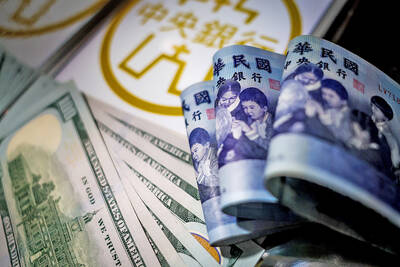
The New Taiwan dollar yesterday fell sharply against the US dollar to close at its lowest level since May 22 amid a massive outflow of funds from the country because of investors panicking over global equity markets. The NT dollar ended at NT$31.580 against the US dollar, slightly lower than its close of NT$31.568 on May 22, after moving between NT$31.5 and NT$31.648 on combined turnover of US$3.062 billion on the Taipei Foreign Exchange and the Cosmos Foreign Exchange. The NT dollar received a significant hit in the morning session, slumping as much as NT$0.173 at a time when other Asian currencies
Taiwan Semiconductor Manufacturing Co (TSMC, 台積電) is now ranked ninth among the world’s 100 most valuable companies after its market capitalization more than doubled over the past year, PricewaterhouseCoopers (PwC) Taiwan said in a report last month. TSMC’s market capitalization surged 101 percent year-on-year to US$1.427 trillion as of March 31, the accounting and consulting firm’s 2026 Global Top 100 Companies by Market Capitalization report said. The gain catapulted the world’s largest contract chipmaker from 12th place to ninth in the rankings, and it was the fastest-growing among the global top 10, it said. TSMC was the only Taiwanese company among the top
Taiwan Semiconductor Manufacturing Co (TSMC, 台積電) yesterday reported record revenue of NT$416.975 billion (US$13.17 billion) for last month, putting the world’s largest contract chipmaker on track to set a record for quarterly revenue. Last month’s figure surpassed March’s record NT$415.19 billion and represented increases of 1.5 percent from April and 30.1 percent from a year earlier. For the first five months of the year, TSMC generated NT$1.96 trillion in revenue, up 30 percent year-on-year, it said in a statement. TSMC has forecast second-quarter revenue of between US$39 billion and US$40.2 billion, representing sequential growth of about 10 percent and year-on-year growth of about


 RSS
RSS