


International real estate firm Jones Lang LaSalle yesterday was appointed as lead agent for the Taipei 101 tower with executives confident they could fill it with the big guns of international finance despite the glut in vacant office space.
According to Matthew Shaw, director of Jones Lang LaSalle in Taipei, his firm expects to fill 80 percent of the 60,000 ping available in the tower by its completion date in 2004.
"Clearly the financial sector is our primary target market," said Shaw, adding that, while the vacancy rate in the office market in general was high, there is a significant lack of premium international-standard office buildings.
"Despite the perception that there's a lot of vacancies in the market, even today if you're looking for 500 ping of contiguous space on one to three floors it's very difficult to find and if you're looking at the top 10 buildings you almost won't find it," Shaw said.
According to Christopher Pea-cock, president and CEO of Chicago-based Jones Lang LaSalle who attended the signing ceremony in Taipei yesterday, the standard of Taipei 101 will make it stand above the competition.
"We believe the quality and design of Taipei 101 will sell itself to tenants looking for top quality office premises," Peacock said.
Future market trends are also seen by Jones Lang LaSalle as being beneficial for the uptake of space in the tower, which will be one of the tallest in the world.
"If you're looking at future supply competing with Taipei 101, other buildings coming on [in] the next two years, there aren't actually that many buildings of the quality that the [financial sector] expects," Shaw said.
However according to a July report by Colliers International, the vacancy rates for the two top grades of office buildings -- premium and grade-A -- in the Hsinyi District stood at 25 percent.
For the premium banking area at the intersection of Mingsheng East Road and Tunhwa North Road the premium and grade-A vacancy rate stood at 8.8 percent and 11 percent, respectively, according to the report.
New supply in the Hsinyi District is expected to hit 18,720 ping this year and fall to only 9,700 ping next year, according to the report.
Shaw said he is confident that while today the Taipei Metro on Tunhwa South Road and the area around the Tunhwa-Mingsheng intersection account for the main concentrations of the financial sector, the focus will shift to the Hsinyi District.
Those companies making the shift to Taipei 101 will have to be willing to fork out what are expected to be the highest rental prices in the city.
"It will obviously be a benchmark. No doubt it will be the most expensive building in Taipei," Shaw said, adding that he expected "a reasonable premium over the next top 5 to 10 grade-A buildings in Taipei."
According to the Colliers International report, premium office rents in the Hsinyi District and in the Tunhwa-Mingsheng areas stood at around NT$2,300 to NT$2,400 per ping.
Shaw said, however, that he did not expect that rentals would see the peaks seen at Taipei Metro of around NT$4,500, due to the limited amount of space available in the towers.
While the shareholders of the Taipei Financial Center Corp, which owns the building, are committed to taking space in the NT$58 billion project and the Taipei Stock Exchange Co has signed on for five floors, Jones Lang LaSalle has yet to snag any other takers.
Shaw predicts that given market conditions that have multinationals exercising financial restraint, there will not likely be a significant amount of pre-leasing, with the majority of tenants signing on as the 2004 completion date nears.
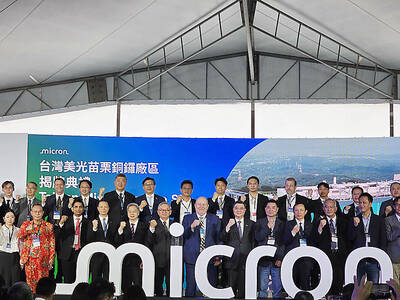
UNPRECEDENTED PACE: Micron Technology has announced plans to expand manufacturing capabilities with the acquisition of a new chip plant in Miaoli Micron Technology Inc unveiled a newly acquired chip plant in Miaoli County yesterday, as the company expands capacity to meet growing demand for advanced DRAM chips, including high-bandwidth memory chips amid the artificial intelligence boom. The plant in Miaoli County’s Tongluo Township (銅鑼), which Micron acquired from Powerchip Semiconductor Manufacturing Corp (力積電) for US$1.8 billion, is expected to make a sizeable capacity contribution to the company from fiscal 2028, the company said in a statement. It would be an extended production site of Micron’s large-scale manufacturing hub in Taichung, the company said. As the global semiconductor industry is racing to reach US$1 trillion

Singapore-based ride-hailing and delivery giant Grab Holdings Ltd has applied for regulatory approval to acquire the Taiwan operations of Germany-based Delivery Hero SE's Foodpanda in a deal valued at about US$600 million. Grab submitted the filing to the Fair Trade Commission on Friday last week, with the transaction subject to regulatory review and approval, the company said in a statement yesterday. Its independent governance structure would help foster a healthy and competitive market in Taiwan if the deal is approved, Grab said. Grab, which is listed on the NASDAQ, said in the filing that US-based Uber Technologies Inc holds about 13 percent of
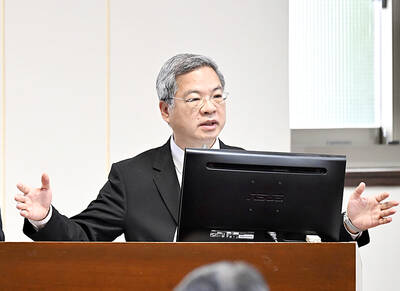
ABOVE LEGAL REQUIREMENT: The Ministry of Economic Affairs is prepared if LNG supply is disrupted, with more than the legal requirement of 11 days of inventory Taiwan has largely secured liquefied natural gas (LNG) supplies through May and arranged about half of June’s supply, Minister of Economic Affairs Kung Ming-hsin (龔明鑫) said yesterday. Since the Middle East conflict began on Feb. 28, Taiwan’s LNG inventories have remained more than 12 days, exceeding the legal requirement of 11 days, indicating no major supply concerns for domestic gas and electricity, Kung said at a meeting of the legislature’s Economics Committee in Taipei. The ministry aims to increase the figure to 14 days by the end of next year, he said. While one or two LNG or crude oil shipments for May

Taiwan’s food delivery market could undergo a major shift if Singapore-based Grab Holdings Ltd completes its planned acquisition of Delivery Hero SE’s Foodpanda business in Taiwan, industry experts said. Grab on Monday last week announced it would acquire Foodpanda’s Taiwan operations for US$600 million. The deal is expected to be finalized in the second half of this year, with Grab aiming to complete user migration to its platform by the first half of next year. A duopoly between Uber Eats and Foodpanda dominates Taiwan’s delivery market, a structure that has remained intact since the Fair Trade Commission (FTC) blocked Uber Technologies Inc’s


 RSS
RSS