


The financial and economic policy white papers of the four major presidential hopefuls -- KMT candidate Lien Chan (
However, important considerations such as cross-strait relations, the reconstruction of 921 earthquake-hit areas, the role of the future premier, and the consolidation of social welfare policies are missing, academics say.
"Taiwan has always pursued economic growth over economic sustainability," said Chu Wan-wen (
"However, in order to provide a cleaner environment and hence, standard of living, it is time for Taiwan to sacrifice some of its economic growth rate."
According to Lin Chuan (
Chu also said that Taiwan's economic development would be strongly influenced by its position toward China; however, no candidates so far have given a clear position with regard to these two interrelated issues.
In terms of domestic economic policy making, Chu pointed out that tax credits for the electronics industry should be removed since the industry has matured, and benefits for non-professional working people should be given more consideration.
Tseng Chu-wei (曾巨威), professor of public finance at National Chengchi University, said that Taiwan's structural unemployment situation has never been more serious, and it is important for the new government to establish some kind of social safety net. According to the Directorate General of Budget, Accounting, and Statistics (主計處), after seasonal adjustment, the unemployment rate last December was 3.03 percent, which was the highest over 14 years, and the time needed between jobs increased from 15 weeks to 33 weeks.
Specifically, social welfare policies are in need of organization. "Except for the national health insurance program, other programs such as the civil servant insurance program and the labor insurance program don't cover the general population," Lin said.
Chu also pointed out that candidates should publish "budget white papers" (
"It is so easy to just make political promises one after another without backing them up with budget proposals," said Chu. "Without a budget white paper, many policies will be used by competing political parties to maintain the status quo, and the election becomes just a cheating game."
Taiwan Semiconductor Manufacturing Co (TSMC, 台積電) has approved a capital budget of US$31.28 billion for production expansion to meet long-term development needs during the artificial intelligence (AI) boom. The company’s board meeting yesterday approved the capital appropriation plan for purposes such as the installation of advanced technology capacity and fab construction, the world’s largest contract chipmaker said in a statement. At an earnings conference last month, TSMC forecast that its capital expenditure for this year would be at the higher end of the US$52 billion to US$56 billion range it forecast in January in response to robust demand for 5G, AI and
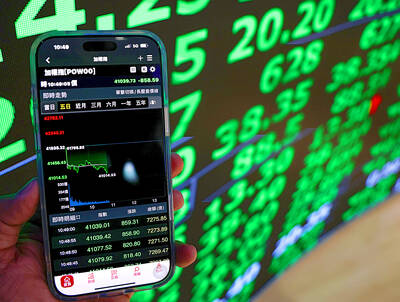
PORTFOLIO REBALANCING: The adjustments in three global equity indices reflect rising investor appetite for semiconductor and artificial intelligence-related stocks Taiwan’s weighting in major global equity indices compiled by MSCI Inc is to rise modestly following the latest quarterly review, underscoring the market’s expanding role in emerging-market portfolios, as global investors continue to favor the nation’s technology sector. Taiwan’s weighting in the MSCI Emerging Markets Index is to increase by 0.30 percentage points to 23.76 percent, after the changes take effect at the close of the May 29 session. Its weighting in the MSCI All-Country Asia ex-Japan Index is to rise 0.37 percentage points to 27.16 percent, while that in the MSCI All Country World Index is to edge up slightly to
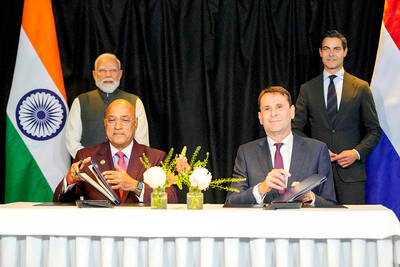
NEW MARKET: The partnership opens up India to the Dutch company, which already has a strong hold in the semiconductor market of South Korea, Taiwan and China ASML Holding NV entered into a partnership agreement with Tata Electronics Pvt Ltd aimed at ramping up India’s goal to develop domestic chip-manufacturing capabilities. The Dutch company’s technology would help power Tata Electronics’ planned 300 millimeter (mm) semiconductor foundry in Gujarat, according to a joint statement from the two companies on Saturday. The signing of a memorandum of understanding coincides with a visit by Indian Prime Minister Narendra Modi to the Netherlands, which is looking to deepen bilateral relations with New Delhi. ASML, whose top customers include Taiwan Semiconductor Manufacturing Co (台積電) and Samsung Electronics Co, makes lithography machines that can print
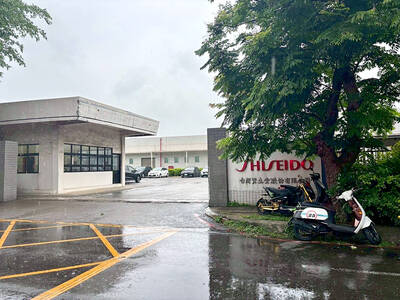
The Hsinchu County Government’s Labor Affairs Department yesterday said that it has received a plan from cosmetics brand Taiwan Shiseido Co (台灣資生堂) detailing mass layoffs at its plant in Hukou Township (湖口). While the labor authorities did not disclose the number of employees to be laid off, Japanese news media earlier in the day reported that the closure of the company’s factory in Hukou would result in 170 employees losing their jobs. Shiseido followed the law by reporting its layoff plan, the department said, adding that authorities would closely monitor negotiations between the management and affected employees and step in if any


 RSS
RSS