


Yesterday's 7.6 magnitude quake that originated near the central township of Puli and ripped outward through Nantou and Taichung counties, happened true to a prediction made in January by Taiwan's Center for Seismological Research. Taiwan, the center predicted, was "about to re-enter a period of large-scale earthquake activity." The center went on to say that the possibility of a large quake equal to or stronger than Japan's Kobe quake in 1995 was "very high."
But was yesterday's quake the big one the center predicted?
"This was a big one," said Dr. Shannon Lee, a professor at National Taiwan University of Science and Technology, "just not the big one we were -- and still are -- expecting."
Lee, who specializes in reinforcing buildings to better stand the impact of a major earthquake, is also a long-time proponent of strengthening building regulations to answer this need.
"In terms of Taiwan's seismological history, this quake surprised a lot of people," said Lee. "Nobody was predicting a large quake with an epicenter in Puli." Rather, Lee said, most seismologists and scientists had predicted that the next large earthquake, or "big one," would likely strike along well-known fault lines located in Miaoli and Chiayi counties.
Lee speaks for most of the scientific community when he says that just because people in Miaoli and Chiayi were spared the disastrous consequences of being at the epicenter of yesterday's quake, the second largest in Taiwan history, it doesn't mean that they are off the hook.
"Unfortunately, in terms of nature's seismological timeline, these fault lines are still due for a big break," said Lee.
The Miaoli fault snapped in 1935 resulting in a 7.1 quake that killed 3,000 people. The Chiayi fault last shifted in 1941 and was also a 7.1, but only around 300 people died.
"If we follow the rules of science and nature," according to Lee, both of these faults are still due for another seven-plus Richter-scale shake even taking into account yesterday's large quake.
Still, according to Lee and his colleagues, despite the tragedy and destruction, there can be a positive side to a big quake. "My job is to prepare buildings for earthquakes, but most of the time my colleagues and I feel like we are shouting at the deaf," Lee lamented yesterday, after touring the collapsed Sungshan Hotel on Pateh Road in Taipei.
"Before a big quake hits, most people either don't understand what we are talking about or they just don't care." But Lee said that after a big quake like yesterday's, the government and the people change their tune.
"We have their undivided attention," he said.
It's times like right now, Lee added, that tremendous gains can be made in obtaining much-needed government assistance in preparing Taiwan for the ever-present threat of future quakes.
Structural engineer Dr K.C. Tsai has described his job as a race against time. Tsai works at Taiwan's National Center for Research on Earthquake Engineering and has long argued that the government should heed the warnings of the scientific community and move to pass laws that require building owners to improve their structures. Tsai says it is a pity that it takes a big quake to prompt government action in improving Taiwan's building codes and standards.
"We recently presented a budget plan to the Ministry of the Interior (MOI) that would allow them to strengthen and improve the foundations and structures of all government buildings in Taiwan," Lee said.
"Hopefully this quake will prompt the government to move quickly to make these improvements a reality, not only to their own buildings, but to all structures in Taiwan."
In Taipei, where according to Tsai, the structural integrity of thousands of buildings is in doubt, the drive to strengthen building foundations is still very much a race against time.
"Most people are very pleased with how Taipei held up to the quake," says Roan Ching-yuen, a local architect. "There was limited destruction among Taipei's buildings and builders should be happy that, for the most part, their buildings performed well."
But Lee attributes the safety of Taipei's buildings to the fact that the quake was so far away.
"Taiwan is so active seismologically," he said, "that a quake can happen anywhere at anytime. Yesterday's quake in Puli is proof enough of that."
For Lee, who will travel to Nantou to check building foundations near the quake's epicenter, most evidence of the quake's destructive power is probably still to come.
"I would hate to see what a quake this size would do if it struck in downtown Taipei -- that's why, now, just as ever, we need to keep vigilant and be prepared," he said.

SILENCING CRITICS: In addition to blocking Taiwan, China aimed to prevent rights activists from speaking out against authoritarian states, a Cabinet department said The Ministry of Foreign Affairs (MOFA) yesterday condemned transnational repression by Beijing after RightsCon, a major digital human rights conference scheduled to be held in Zambia this week, was abruptly canceled due to Chinese pressure over Taiwanese participation. This year’s RightsCon, the world’s largest conference discussing issues “at the intersection of human rights and technology,” was scheduled to take place from tomorrow to Friday in Lusaka, and expected to draw 2,600 in-person attendees from 150 countries, along with 1,100 online participants. However, organizers were forced to cancel the event due to behind-the-scenes pressure from China, the ministry said, expressing its “strongest condemnation”
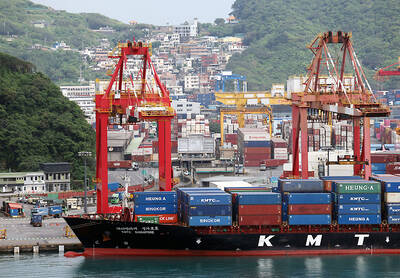
Taiwan’s economy grew far faster than expected in the first quarter, as booming demand for artificial intelligence (AI) applications drove a surge in exports, spilling over into investment and consumption, the Directorate-General of Budget, Accounting and Statistics (DGBAS) said yesterday. GDP growth was 13.69 percent year-on-year during the January-to-March period, beating the DGBAS’ February forecast by 2.23 percentage points and marking the most robust growth in nearly four decades, DGBAS senior official Chiang Hsin-yi (江心怡) told a news conference in Taipei. The result was powered by exports, which remain the backbone of Taiwan’s economy, Chiang said. Outbound shipments jumped 51.12 percent year-on-year to
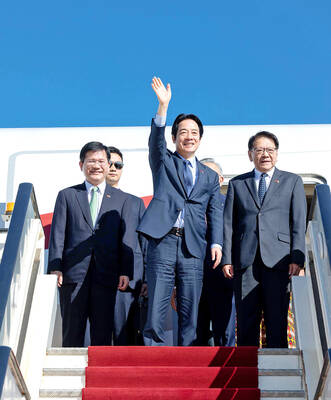
DELAYED BUT DETERMINED: The president’s visit highlights Taiwan’s right to international engagement amid regional pressure from China President Willaim Lai (賴清德) yesterday arrived in Eswatini, more than a week after his planned visit to Taiwan’s sole African ally was suspended because of revoked overflight permits. “The visit, originally scheduled for April 22, was postponed due to unforeseen external factors,” Lai wrote on social media. “After several days of careful arrangements by our diplomatic and national security teams, we successfully arrived today.” Lai said he looked forward to further deepening Taiwan-Eswatini relations through closer cooperation in the economy, agriculture, culture and education, as well as advancing the nation’s international partnerships. The president was initially scheduled to arrive in time to celebrate
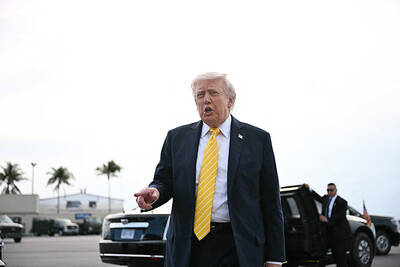
Iran’s Islamic Revolutionary Guard Corp (IRGC) yesterday said the US faced a choice between an “impossible” military operation or a “bad deal” with Tehran, after US President Donald Trump disparaged Iran’s latest peace proposal. Negotiations between the two countries have been deadlocked since a ceasefire came into effect on April 8, with only one round of direct peace talks held so far. Iran’s Tasnim and Fars news agencies reported that Tehran had submitted a 14-point proposal to mediator Pakistan, but Trump was quick to cast doubt on it. “I will soon be reviewing the plan that Iran has just sent to us, but


 RSS
RSS