


A throng of pro-China demonstrators gathered outside the Ministry of the Interior yesterday to demand that the government designate Retrocession Day as a national holiday.
Retrocession Day celebrates the end of the Japanese colonial period in Taiwan on Oct. 25, 1945, as well as the conclusion of the Sino-Japanese War (1937-1945), and is observed by Chinese worldwide.
"We need to remind the government of the importance of Retrocession Day -- of the more than 30 million Chinese who died at the hands of the Japanese military in China, and of the many who suffered under Japanese colonial rule here in Taiwan," said Tang Shu (
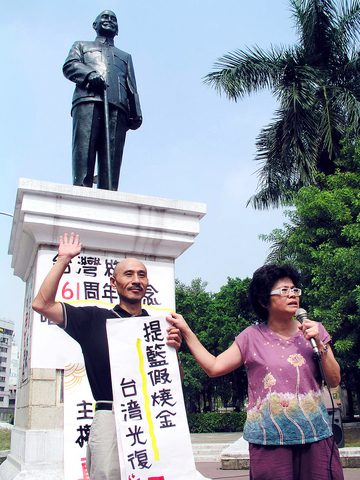
PHOTO: YU HSUEH-LAN, TAIPEI TIMES
Retrocession Day used to be a national holiday, but has not been observed since 2001 as the government has instead pushed for two-day weekends.
Luo Su-chuan (
Maggie Cheng (
"But we're not associated with the current anti-President Chen Shui-bian [陳水扁] campaign," Cheng added, despite the fact that numerous protesters wore "Depose Chen" baseball caps.
Shu, meanwhile, denounced Chen for not enshrining a holiday that was important to ethnic Chinese, adding that the US was pitting the Taiwanese and Chinese against each other to maintain its own hegemonic interests and a lucrative trade in weapons to Taiwan.
"The Americans don't like symbols of cross-strait unification such as Retrocession Day because they need to promote cross-strait enmity in order to sell their weapons," Tang said.
Tang added that although China has deployed more than 800 ballistic missiles on the east coast, "very few of the missiles actually target Taiwan."
Although the US was frustrated with a long-stalled arms package in the Legislative Yuan, US arms dealers were scrambling to sell other weapons to the country, Tang said.
Meanwhile, on a related issue, the Taiwan Society last night held an indoor rally in Kaohsiung to expand the "local culture movement," an event that the organizer hoped would counter the "misconceptions" about local culture and national identity created by the Chinese Nationalist Party's (KMT) "colonial culture" in the post-World War II period.
Yang Wen-chia (
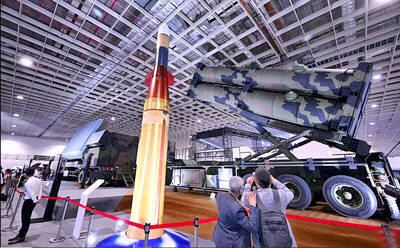
Taiwan is to commence mass production of the Tien Kung (天弓, “Sky Bow”) III, IV and V missiles by the second quarter of this year if the legislature approves the government’s NT$1.25 trillion (US$39.78 billion) special defense budget, an official said yesterday. Commenting on condition of anonymity, a defense official with knowledge of the matter said that the advanced systems are expected to provide crucial capabilities against ballistic and cruise missiles for the proposed “T-Dome,” an advanced, multi-layered air defense network. The Tien Kung III is an air defense missile with a maximum interception altitude of 35km. The Tien Kung IV and V
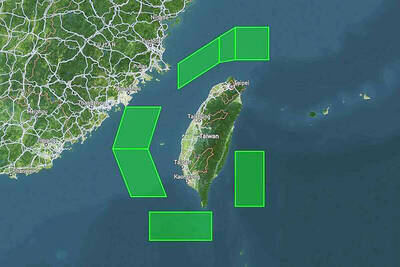
The disruption of 941 flights in and out of Taiwan due to China’s large-scale military exercises was no accident, but rather the result of a “quasi-blockade” used to simulate creating the air and sea routes needed for an amphibious landing, a military expert said. The disruptions occurred on Tuesday and lasted about 10 hours as China conducted live-fire drills in the Taiwan Strait. The Civil Aviation Administration (CAA) said the exercises affected 857 international flights and 84 domestic flights, affecting more than 100,000 travelers. Su Tzu-yun (蘇紫雲), a research fellow at the government-sponsored Institute for National Defense and Security Research, said the air
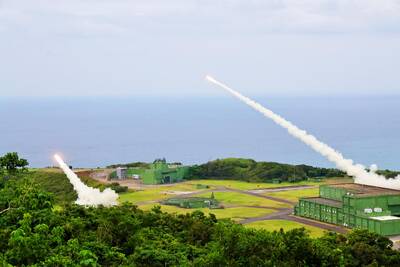
Taiwan lacks effective and cost-efficient armaments to intercept rockets, making the planned “T-Dome” interception system necessary, two experts said on Tuesday. The concerns were raised after China’s military fired two waves of rockets during live-fire drills around Taiwan on Tuesday, part of two-day exercises code-named “Justice Mission 2025.” The first wave involved 17 rockets launched at 9am from Pingtan in China’s Fujian Province, according to Lieutenant General Hsieh Jih-sheng (謝日升) of the Office of the Deputy Chief of the General Staff for Intelligence at the Ministry of National Defense. Those rockets landed 70 nautical miles (129.6km) northeast of Keelung without flying over Taiwan,
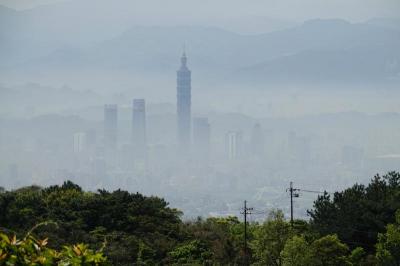
A strong continental cold air mass is to bring pollutants to Taiwan from tomorrow, the Ministry of Environment said today, as it issued an “orange” air quality alert for most of the country. All of Taiwan except for Hualien and Taitung counties is to be under an “orange” air quality alert tomorrow, indicating air quality that is unhealthy for sensitive groups. In China, areas from Shandong to Shanghai have been enveloped in haze since Saturday, the ministry said in a news release. Yesterday, hourly concentrations of PM2.5 in these areas ranged from 65 to 160 micrograms per cubic meter (mg/m³), and pollutants were


 RSS
RSS