


Asian shares rose last week, driving the MSCI Asia Pacific Index to a five-month high, as forecasts from Commonwealth Bank of Australia and Intel Corp boosted finance and technology companies.
Commonwealth Bank, the nation’s biggest lender, jumped 2.3 percent in Sydney after saying first-half unaudited cash profit rose.
Hynix Semiconductor Inc climbed 2.6 percent in Seoul as Intel forecast first-quarter sales that beat analyst estimates.
JFE Holdings Inc, Japan’s second-largest steelmaker by market value, fell 3.4 percent on speculation it may have to pay more for iron ore.
Cnooc Ltd, China’s largest offshore oil producer, sank 1.1 percent as crude fell for a fifth day.
The MSCI Asia Pacific Index gained 0.5 percent to 126.95 at 5:50pm in Tokyo, its highest level since Aug. 12.
The measure rose 2.2 percent in the previous five days. The gauge surged 53 percent in the past year on signs of recovery in the region’s economies.
“The good news is still flowing through, but some of it is looking a bit more mixed,” said Shane Oliver, head of investment strategy in Sydney at AMP Capital Investors, which oversees about US$90 billion globally.
“Investors are feeling a bit cautious,” he said.
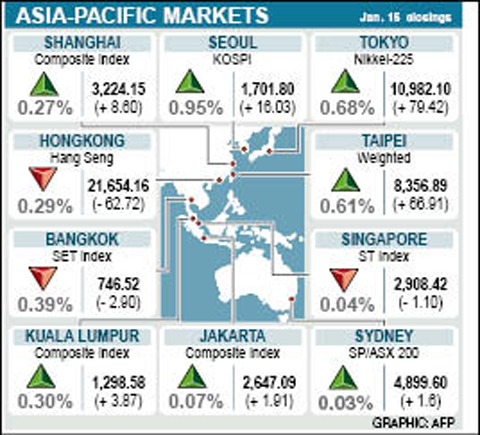
Japan’s Nikkei 225 Stock Average gained 0.7 percent. The Shanghai Composite Index added 0.3 percent.
South Korea’s KOSPI Index climbed 1 percent.
Daewoo Shipbuilding & Marine Engineering Co surged 15 percent in Seoul after Posco’s chief executive officer said he would consider a bid for the shipbuilder.
The MSCI Asia Pacific Index was set for its fourth weekly advance as reports last week of a bigger-than-expected increase in Australian jobs, a surge in Chinese exports and Japanese machine-tool orders boosted confidence in the strength of the global economy.
The gauge has climbed 80 percent from its lowest level in more than five years on March 9, outpacing gains of 70 percent by the S&P 500 and 64 percent for Europe’s Dow Jones Stoxx 600 Index.
Stocks in the MSCI measure are valued at 20 times estimated earnings, compared with 15 times for the S&P and 13 times for the Stoxx 600.
Hong Kong fell 0.29 percent, or 62.79 points, to 21,654.16.
TAIPEI
The TAIEX index climbed 66.91, or 0.8 percent, to close at 8,356.89, the highest since June 2008.
The index rose 0.9 percent this week, the fourth straight weekly gain.
Other regional markets:
KUALA MUMPUR: Malaysian shares were up 0.30 percent, or 3.87 points, at 1,298.58.
JAKARTA: Indonesian shares were flat, rising 1.91 points to 2,647.09.
MANILA: Philippine shares lost 0.11 percent, or 3.44 points, to 3,118.47 on profit-taking.
WELLINGTON: New Zealand shares fell 0.62 percent, or 20.38 points, to 3,257.95.
MUMBAI: Indian shares eased 0.17 percent, or 30.57 points, to 17,554.30.
Dealers unwound stocks ahead of the weekend, on growing concerns the central bank could tighten monetary policy to curb inflation.

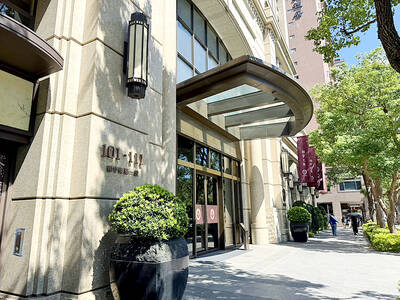
FORCED LABOR: A US court listed three Taiwanese and nine firms based in Taiwan in its indictment, with eight of the companies registered at the same address Nine companies registered in Taiwan, as well as three Taiwanese, on Tuesday were named by the US Department of the Treasury’s Office of Foreign Assets Control (OFAC) as Specially Designated Nationals (SDNs) as a result of a US federal court indictment. The indictment unsealed at the federal court in Brooklyn, New York, said that Chen Zhi (陳志), a dual Cambodian-British national, is being indicted for fraud conspiracy, money laundering and overseeing Prince Holding Group’s forced-labor scam camps in Cambodia. At its peak, the company allegedly made US$30 million per day, court documents showed. The US government has seized Chen’s noncustodial wallet, which contains
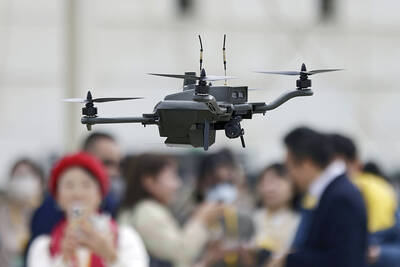
SUPPLY CHAIN: Taiwan’s advantages in the drone industry include rapid production capacity that is independent of Chinese-made parts, the economic ministry said The Executive Yuan yesterday approved plans to invest NT$44.2 billion (US$1.44 billion) into domestic production of uncrewed aerial vehicles over the next six years, bringing Taiwan’s output value to more than NT$40 billion by 2030 and making the nation Asia’s democratic hub for the drone supply chain. The proposed budget has NT$33.8 billion in new allocations and NT$10.43 billion in existing funds, the Ministry of Economic Affairs said. Under the new development program, the public sector would purchase nearly 100,000 drones, of which 50,898 would be for civil and government use, while 48,750 would be for national defense, it said. The Ministry of

SENATE RECOMMENDATION: The National Defense Authorization Act encourages the US secretary of defense to invite Taiwan’s navy to participate in the exercises in Hawaii The US Senate on Thursday last week passed the National Defense Authorization Act (NDAA) for Fiscal Year 2026, which strongly encourages the US secretary of defense to invite Taiwan’s naval forces to participate in the Rim of the Pacific (RIMPAC) exercise, as well as allocating military aid of US$1 billion for Taiwan. The bill, which authorizes appropriations for the military activities of the US Department of Defense, military construction and other purposes, passed with 77 votes in support and 20 against. While the NDAA authorizes about US$925 billion of defense spending, the Central News Agency yesterday reported that an aide of US
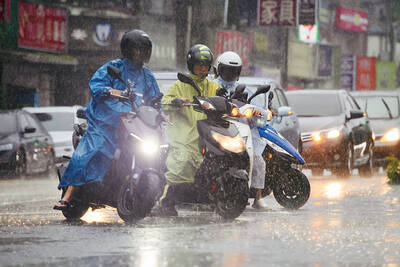
The combined effect of the monsoon, the outer rim of Typhoon Fengshen and a low-pressure system is expected to bring significant rainfall this week to various parts of the nation, the Central Weather Administration (CWA) said. The heaviest rain is expected to occur today and tomorrow, with torrential rain expected in Keelung’s north coast, Yilan and the mountainous regions of Taipei and New Taipei City, the CWA said. Rivers could rise rapidly, and residents should stay away from riverbanks and avoid going to the mountains or engaging in water activities, it said. Scattered showers are expected today in central and


 RSS
RSS