


An angry US public and Congress are pushing to snip the rip cord on golden parachutes used by fat cat CEOs to escape Wall Street’s mayhem.
Democrats in Congress — set to resume emergency talks yesterday with their Republican counterparts on a US$700 billion bailout for the financial industry — insisted that any agreed package include restrictions on executive pay.
They caught the mood of a nation sickened at watching the titans of finance walk away from Wall Street disasters not only unscathed, but enriched.
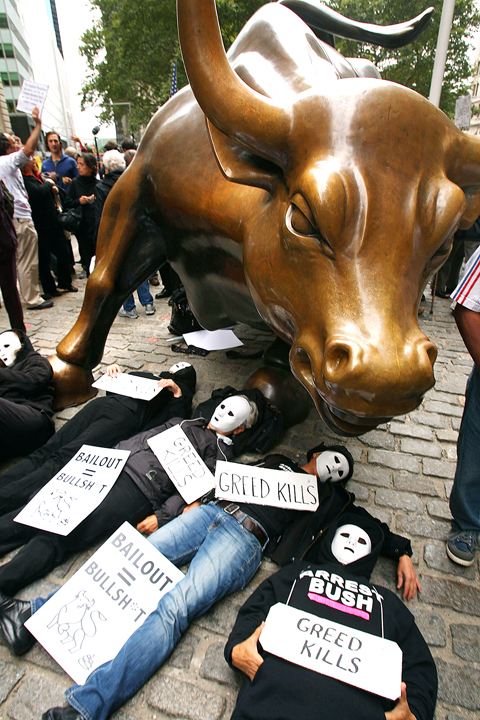
PHOTO: AFP
“The wealthiest people, those ... in the best position to pay, are being asked for no sacrifice at all,” read a petition to US Treasury Secretary Henry Paulson, which by Thursday, after three days, had 32,600 signatures.
The petition, organized by independent Senator Bernie Sanders from Vermont, attacked what it described as the Treasury’s attempt to let bungling executives “continue to make exorbitant salaries and bonuses.”
Those huge pay checks, bonuses and Midas-like farewells encapsulate what the public sees as Wall Street’s greed-is-good philosophy.
For example, the CEO of bankrupt Lehman Brothers, Richard Fuld, received total compensation of US$71.9 million last year, including stock, bonuses and other pay, a survey published by Forbes magazine showed.
Martin Sullivan, the chief executive of AIG, who left the insurance giant before it was rescued this month by the federal government, received US$14 million, a survey in USA Today said. He also quit with a US$47 million severance package.
Even punishment for those at the center of the chaos comes with a gold lining.
When the government took over collapsed mortgage giants Fannie Mae and Freddie Mac, ousted bosses Daniel Mudd and Richard Syron were not allowed US$12.59 million in severance payments.
Yet they still got out the door with US$9.43 million in retirement benefits.
Public anger at such figures underlies skepticism about the entire government rescue.
“We’ll never see that money again,” said Mathew May, a 24-year-old economics student attending a small demonstration near the New York Stock Exchange. “They deregulated the markets and ran wild. Now we’re bailing them out.”
Arun Gupta, an editor of alternative New York newspaper the Indypendent, said there was “socialism for the rich and dog-eat-dog capitalism for the rest of us.”
“Think about it,” Gupta wrote in an e-mail that quickly circulated to thousands of activists and inspired the New York street protest.
“They said providing healthcare for 9 million children, perhaps costing US$6 billion a year, was too expensive, but there’s evidently no sum of money large enough that will sate the Wall Street pigs,” Gupta said.
And left-wingers are not the only ones speaking out.
Newt Gingrich, the fiercely conservative former speaker in the House of Representatives, wrote in the National Review that the bailouts, likely to top a trillion dollars, smack of “crony capitalism.”
“Doesn’t that mean that we’re using the taxpayers’ money to hire people to save their friends with even more taxpayer money?” he asked.
Forbes, the magazine of the rich and the wealthy, also said enough was enough.
“The compensation schemes for Wall Street CEOs should be capped to a small fixed amount,” national editor Robert Lenzner wrote.
“The rest should be dependent on performance in a way that does not reward taking greater risk than is prudent. If CEOs don’t perform, they should get nothing,” he wrote.
One worker in the New York finance sector, who asked not to be named, said his colleagues were as angry as the general public.
“A lot of people are very upset that managers in their own companies and captains of industry in other areas made some really, really bad decisions,” he said.
“The most insulting thing is the golden parachutes where these jackals from Fannie and Freddie, having destroyed the company, walked away with millions .... It all comes down to greed,” he said.

‘NO SECURITY RISK’: The Railway Bureau reassured the public that the technicians’ activities were limited to technical guidance and did not involve sensitive systems The Railway Bureau yesterday said it had invited eight Chinese technicians to assist with an airport MRT construction project. The bureau issued the confirmation after an Internet user said Chinese nationals had entered the construction zone of Taiwan Taoyuan International Airport’s Terminal 3 project. They asked why “individuals from an enemy state” were allowed access to such a major national infrastructure project, which raised serious concerns over Taiwan’s industrial safety, sensitive systems and information security. The bureau’s Northern Region Engineering Branch Office said subcontractor Taiwan Handle Industrial Co (台灣手把工業) of the Taoyuan airport MRT’s “Contract No. CU05 Project A14 Station Civil, MEP &

A US uncrewed surface vessel (USV) encountered multiple Chinese warships during an autonomous transit of the Taiwan Strait, US defense company Seasats said in a statement on Wednesday. Seasats announced that a Lightfish USV had completed the first autonomous transit of the Taiwan Strait. Over five days, the USV traversed the entire length of the Strait while constantly monitoring surface vessel traffic, the company said. The Lightfish encountered multiple Chinese warships, one of which was a Chinese People’s Liberation Army Navy (PLAN) Type 056 corvette, it said. The Chinese vessels were operating “well within Taiwan’s exclusive economic zone without transmitting their identity via the
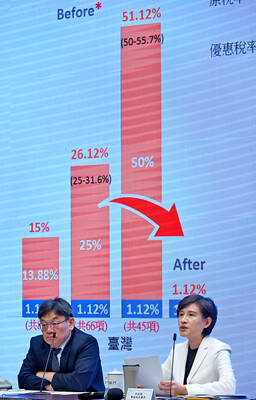
GREATER REACH? Auto parts and wood products would face tariffs of up to 15%, matching those targeting the EU, Japan and South Korea, Vice Premier said The US has announced that preferential tariff treatment for Taiwan’s non-semiconductor Section 232 goods would take effect retroactively from May 1, the Executive Yuan said yesterday. The US government yesterday posted a notice on the Federal Register’s public inspection Web site previewing tariff concessions for Taiwan under a memorandum of understanding (MOU) on Taiwan-US investment after two months of negotiations. The MOU signed on Jan. 15 stipulated three major preferential tariff arrangements: a 15 percent “reciprocal” tariff rate for Taiwan without stacking most-favored nation (MFN) rates; preferential Section 232 treatment for semiconductors and related products; and preferential Section 232 treatment for non-semiconductor
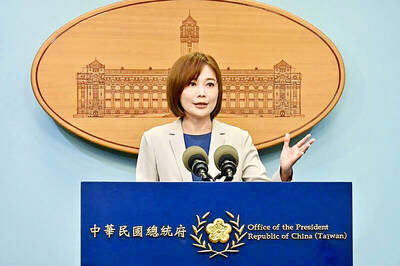
TIT-FOR-TAT: The US allegedly revoked the visa of a Chinese national working at Xinhua News Agency in the US in response to Beijing’s expulsion of Vivian Wang The Presidential Office yesterday condemned China for expelling a New York Times correspondent from Beijing following the newspaper’s interview with President William Lai (賴清德), saying the move highlighted Beijing’s suppression of press freedom and its threat to international news media. Taiwan has noted a series of recent incidents in which Beijing used similar tactics to “threaten and pressure international media outlets and journalists,” Presidential Office spokeswoman Karen Kuo (郭雅慧) said in a statement. “This concerns not only press freedom and freedom of expression, but also the safety of journalists, and Taiwan and relevant partners are paying close attention to the situation,” she


 RSS
RSS