


Robots that smile and blink. A "ubiquitous" Internet that envelops people in an always-wired world. Radio ID tags on every product and person, letting you check whether the wine you're thinking of buying will go with that steak or if your children have arrived safely at school.
These visions of the future were among innovations exhibited on Tuesday on the sidelines of the APEC summit.
South Korea, which leads the world in per-capita high-speed Internet connections and is a major producer of memory chips and flat-screen displays, is showcasing its technological prowess during this week's APEC forum in Busan.
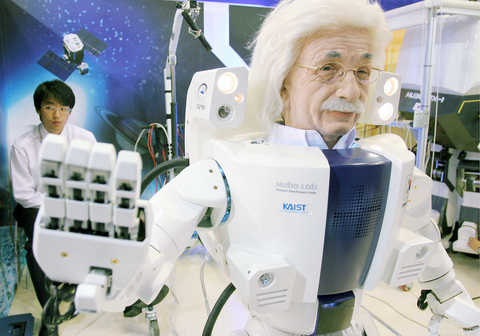
PHOTO: EPA
World leaders and other APEC delegates are getting the chance to participate in the first-ever trial of wireless high-speed Internet access called WiBro.
The technology, based on the worldwide WiMax standard, allows users to surf the Web at speeds almost as fast as wired connections while moving, also enabling voice and video calling via the Internet.
The service will be offered to South Korean consumers next year, in the form of WiBro-enabled phone handsets, laptop computers and expansion cards.
The move is part of South Korea's campaign to create a "ubiquitous" information society, including everything from e-health to e-learning to e-government.
"When we're in the ubiquitous era, we'll be living in a world where we have knowledge and robots everywhere," Information and Communication Minister Chin Dae-je told journalists.
The star of the showcase is a 137cm tall, two-legged robot topped with a head modeled after Albert Einstein. "Albert Hubo" has 31 motors behind its face allowing it to laugh, blink -- and even scowl when someone tries to tip it over. It can also speak in sign language using its five-fingered hands.
"Our first goal is to make robots as similar to humans as possible," said Oh Jun-ho, director of the government-funded Humanoid Robot Research Center, declining to speculate on the applications for such a machine.
But one of the demonstrations provides a possible hint: a robot-staffed bar a la Star Wars.
Also on show was digital multimedia broadcasting (DMB), a service unveiled this year in South Korea that delivers TV broadcasts and music to mobile phones via satellite. The country aims to establish DMB as a worldwide standard to keep people's eyes glued to their handsets.
For those wanting the big picture, Samsung and LG showed off massive plasma screens measuring 260cm diagonally that they said were the world's largest.
Other innovations planned for rollout in coming years are radio ID tags on all products, so people with properly equipped phones can wave them in front of a bottle of wine and get information on whether that year was a good vintage. Children with radio tags built into phones will check in at sensor stations when they arrive at school, triggering a text message sent to their parents to let them know they got there safely.

SILENCING CRITICS: In addition to blocking Taiwan, China aimed to prevent rights activists from speaking out against authoritarian states, a Cabinet department said The Ministry of Foreign Affairs (MOFA) yesterday condemned transnational repression by Beijing after RightsCon, a major digital human rights conference scheduled to be held in Zambia this week, was abruptly canceled due to Chinese pressure over Taiwanese participation. This year’s RightsCon, the world’s largest conference discussing issues “at the intersection of human rights and technology,” was scheduled to take place from tomorrow to Friday in Lusaka, and expected to draw 2,600 in-person attendees from 150 countries, along with 1,100 online participants. However, organizers were forced to cancel the event due to behind-the-scenes pressure from China, the ministry said, expressing its “strongest condemnation”
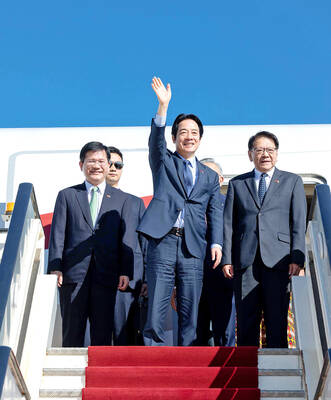
DELAYED BUT DETERMINED: The president’s visit highlights Taiwan’s right to international engagement amid regional pressure from China President Willaim Lai (賴清德) yesterday arrived in Eswatini, more than a week after his planned visit to Taiwan’s sole African ally was suspended because of revoked overflight permits. “The visit, originally scheduled for April 22, was postponed due to unforeseen external factors,” Lai wrote on social media. “After several days of careful arrangements by our diplomatic and national security teams, we successfully arrived today.” Lai said he looked forward to further deepening Taiwan-Eswatini relations through closer cooperation in the economy, agriculture, culture and education, as well as advancing the nation’s international partnerships. The president was initially scheduled to arrive in time to celebrate
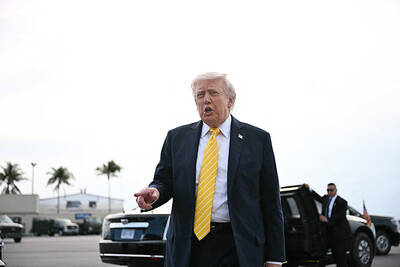
Iran’s Islamic Revolutionary Guard Corp (IRGC) yesterday said the US faced a choice between an “impossible” military operation or a “bad deal” with Tehran, after US President Donald Trump disparaged Iran’s latest peace proposal. Negotiations between the two countries have been deadlocked since a ceasefire came into effect on April 8, with only one round of direct peace talks held so far. Iran’s Tasnim and Fars news agencies reported that Tehran had submitted a 14-point proposal to mediator Pakistan, but Trump was quick to cast doubt on it. “I will soon be reviewing the plan that Iran has just sent to us, but

A group affiliated with indicted Chinese immigrant Xu Chunying (徐春鶯) is to be dissolved for monitoring Chinese immigrants in Taiwan, a source said yesterday. Xu, the secretary-general of the Cross-Strait Marriage and Family Service Alliance, was indicted on March 24 on charges of violating the Anti-Infiltration Act (反滲透法). The alliance “illegally monitored" Chinese immigrants living in Taiwan on behalf of the Chinese Communist Party (CCP) and the Ministry of the Interior is expected to dissolve the organization in the coming days under provisions of the Civil Associations Act (人民團體法), the source said. Xu, who married a Taiwanese in 1993 and became a Republic


 RSS
RSS