


The notion that aquariums should be purely educational, aimed at teaching hordes of school children about the wonders of marine life, is passe.
Nowadays, aquariums are big business. Take for example, the soon-to-be-opened Siam Ocean World, a 1 billion baht (US$24.4 million) investment by Australia's Oceanis Group, scheduled to open on Dec. 1 in Bangkok's newest posh department store -- Siam Paragon -- in the heart of the capital.
Taking up 10,000m2 of space with a capacity for more than 4 million liters of water and a planned population of 30,000 marine animals, Siam Ocean World is already billing itself as the largest aquarium in Southeast Asia.
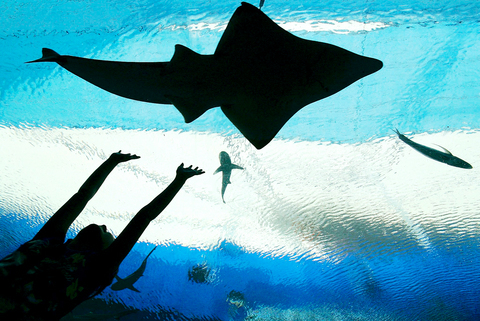
PHOTO: EPA
Aquaria KLCC, which opened in Kuala Lumpur in August, can still claim to have Southeast Asia's longest underwater tunnel, at 90m.
The Kuala Lumpur aquarium, which cost 1.1 billion ringgit (US$29.3 million), is situated in a convention center connected to the capital's famed Petronas Twin Towers. Similar to Siam Ocean World, KLCC hopes to become a prime tourist attraction for the city.
Thailand has seen the launch of two smaller aquariums over the past two years, including the Underwater World Pattaya and the Waghor Aquarium, in Prachuab Khiri Khan province.
The Pattaya aquarium reportedly involved a US$6 million investment by Singapore's Haw Par Group. Waghor Aquarium, which got off to a bad start -- most of the fish died in the first year -- and only officially opened for business last August, is owned by the government's Department of Unofficial Education, and required a construction budget of 200 million baht (US$5 million).
"One of the reasons we're seeing more aquariums these days is because of improvements in technology," said Geoff Olson, general manager for Asia of the Oceanis Group. "Old aquariums used to have flat windows; now you can basically create a room out of curved glass."
The Siam Ocean World aquarium, for example, will include a 270-degree acrylic underwater tunnel leading to a 10.5m diameter room built like an inverted fish bowl.
"So we're in the fishbowl and the animals are outside looking at us," Olson said.
Oceanis claims to be the world's top investor-operator in aquariums. The private company owns and operates aquariums in Melbourne and Mooloolaba in Australia, the Chang Feng Ocean World in Shanghai, China, and Busan Aquarium in Busan, South Korea.
Besides the Siam Ocean World, its largest investment to date, Oceanis is also constructing an aquarium in Dubai and will start building another in Seoul next year.
Negotiations are underway for aquariums in Paris, Istanbul and Prague.
"A lot of the places we're going to are developing markets, except for Paris," said Olsen. "Essentially the business model comes down to size of population and the ability of the population to come to aquariums."
Asia, with its densely populated cities and rising incomes, was the obvious place for Oceanis to start out.
The Bangkok aquarium, for instance, will charge a 450 baht (US$11) entry fee for adults and 280 baht for children, with no price differential between Thais and foreigners.
It is expected to draw at least 1.5 million visitors during it first year of operations, of whom only 20 percent are expected to be foreigners. The aquarium also anticipates 100,000 school children per annum.
Oceanis chose Siam Paragon as a venue because of its upscale positioning -- the department store will also include an opera house -- easy accessibility to Bangkok's overhead sky-train system and its central location.
"Commercially, our first and foremost goal is to promote an entertaining experience for the general public," Olsen said. "Into that, we weave educational messages and educational experiences."
Oceanis will utilize its global connections to stock Siam Ocean World, with grey nurse sharks imported from a breeder in South Africa, elephant-nose sharks from Australia and penguins imported from South Korea, but the great majority of the animals will come from Thai waters.

‘NO SECURITY RISK’: The Railway Bureau reassured the public that the technicians’ activities were limited to technical guidance and did not involve sensitive systems The Railway Bureau yesterday said it had invited eight Chinese technicians to assist with an airport MRT construction project. The bureau issued the confirmation after an Internet user said Chinese nationals had entered the construction zone of Taiwan Taoyuan International Airport’s Terminal 3 project. They asked why “individuals from an enemy state” were allowed access to such a major national infrastructure project, which raised serious concerns over Taiwan’s industrial safety, sensitive systems and information security. The bureau’s Northern Region Engineering Branch Office said subcontractor Taiwan Handle Industrial Co (台灣手把工業) of the Taoyuan airport MRT’s “Contract No. CU05 Project A14 Station Civil, MEP &

A US uncrewed surface vessel (USV) encountered multiple Chinese warships during an autonomous transit of the Taiwan Strait, US defense company Seasats said in a statement on Wednesday. Seasats announced that a Lightfish USV had completed the first autonomous transit of the Taiwan Strait. Over five days, the USV traversed the entire length of the Strait while constantly monitoring surface vessel traffic, the company said. The Lightfish encountered multiple Chinese warships, one of which was a Chinese People’s Liberation Army Navy (PLAN) Type 056 corvette, it said. The Chinese vessels were operating “well within Taiwan’s exclusive economic zone without transmitting their identity via the
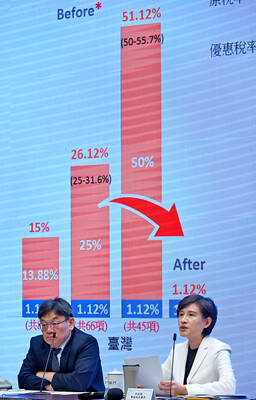
GREATER REACH? Auto parts and wood products would face tariffs of up to 15%, matching those targeting the EU, Japan and South Korea, Vice Premier said The US has announced that preferential tariff treatment for Taiwan’s non-semiconductor Section 232 goods would take effect retroactively from May 1, the Executive Yuan said yesterday. The US government yesterday posted a notice on the Federal Register’s public inspection Web site previewing tariff concessions for Taiwan under a memorandum of understanding (MOU) on Taiwan-US investment after two months of negotiations. The MOU signed on Jan. 15 stipulated three major preferential tariff arrangements: a 15 percent “reciprocal” tariff rate for Taiwan without stacking most-favored nation (MFN) rates; preferential Section 232 treatment for semiconductors and related products; and preferential Section 232 treatment for non-semiconductor
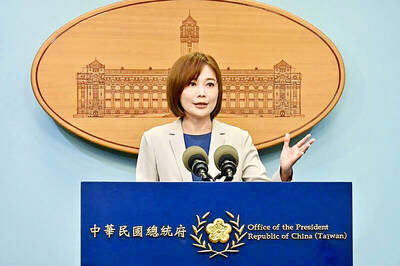
TIT-FOR-TAT: The US allegedly revoked the visa of a Chinese national working at Xinhua News Agency in the US in response to Beijing’s expulsion of Vivian Wang The Presidential Office yesterday condemned China for expelling a New York Times correspondent from Beijing following the newspaper’s interview with President William Lai (賴清德), saying the move highlighted Beijing’s suppression of press freedom and its threat to international news media. Taiwan has noted a series of recent incidents in which Beijing used similar tactics to “threaten and pressure international media outlets and journalists,” Presidential Office spokeswoman Karen Kuo (郭雅慧) said in a statement. “This concerns not only press freedom and freedom of expression, but also the safety of journalists, and Taiwan and relevant partners are paying close attention to the situation,” she


 RSS
RSS