


Star TV, Rupert Murdoch's Asian broadcaster, acquired a strategic stake in an Indonesian television network on Thursday, securing a place in one of Asia's fastest-growing markets, the two companies said.
Star TV, a satellite and cable operator based in Hong Kong, will buy 20 percent of the national network ANTV, giving it a firmer foothold in Indonesia, Asia's third most populous country. Star TV pay-television services are already available on cable and satellite in Indonesia.
The deal is a politically delicate marriage. Advisers to the Star-ANTV transaction were concerned that Murdoch's high profile could spur public opposition to the deal. Moreover, ANTV is owned by the family of Aburizal Bakrie, Indonesia's chief economics minister, drawing even more scrutiny.
In an effort to head off any opposition, ANTV has promised to improve the quality of news broadcasts and secure their independence. It has already hired away one of Indonesia's most respected news directors from a rival network.
ANTV executives said that control over programming, particularly news content, would remain in Indonesian hands.
"This is good for both parties, good for the country. Star is bringing in a lot of experience from the international market," said Anin Bakrie, who heads ANTV and is the eldest son of the economics minister.
But he added that Star was intent on supporting the growth of "local expertise and content."
Jannie Poon, a spokesman for Star, said, "This brings us the opportunity to learn from a local partner in Indonesia."
She added that Star intended to be a "low key" investor and that "control remains with ANTV."
The deal helps extend Star's reach in Asia at a modest price. Bakrie declined to disclose what Star paid, but analysts said it was probably well below US$20 million.
He also said that the company had been profitable for the last three years, without elaborating.
Star TV already broadcasts 50 television services in Asia in eight languages, with China and India among the markets.
In Indonesia's crowded television market, ANTV is a low-ranked but promising partner.
Its share of Indonesia's 180 million viewers has crept up to 5 percent from 2.5 percent in the last three years. According to a weekly audience survey by AGB Nielsen, the network generally rates as the country's eighth most popular service.
Local television advertising grew by almost 30 percent last year, to US$1.4 billion, 69 percent of all advertising.
In the first seven months of this year, ANTV received 896 billion rupiah (US$86 million) in advertising revenue, according to an AGB Nielsen estimate.

‘NO SECURITY RISK’: The Railway Bureau reassured the public that the technicians’ activities were limited to technical guidance and did not involve sensitive systems The Railway Bureau yesterday said it had invited eight Chinese technicians to assist with an airport MRT construction project. The bureau issued the confirmation after an Internet user said Chinese nationals had entered the construction zone of Taiwan Taoyuan International Airport’s Terminal 3 project. They asked why “individuals from an enemy state” were allowed access to such a major national infrastructure project, which raised serious concerns over Taiwan’s industrial safety, sensitive systems and information security. The bureau’s Northern Region Engineering Branch Office said subcontractor Taiwan Handle Industrial Co (台灣手把工業) of the Taoyuan airport MRT’s “Contract No. CU05 Project A14 Station Civil, MEP &

A US uncrewed surface vessel (USV) encountered multiple Chinese warships during an autonomous transit of the Taiwan Strait, US defense company Seasats said in a statement on Wednesday. Seasats announced that a Lightfish USV had completed the first autonomous transit of the Taiwan Strait. Over five days, the USV traversed the entire length of the Strait while constantly monitoring surface vessel traffic, the company said. The Lightfish encountered multiple Chinese warships, one of which was a Chinese People’s Liberation Army Navy (PLAN) Type 056 corvette, it said. The Chinese vessels were operating “well within Taiwan’s exclusive economic zone without transmitting their identity via the
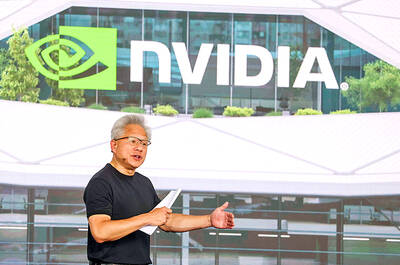
‘BOOMING’: ’ The number of partners we have here is incredible. You can see from their stock prices. They’re doing so well, they’re so happy,’ Jensen Huang said Nvidia Corp’s spending in Taiwan has ballooned to about US$150 billion a year, 10 times the US$10 billion to US$15 billion the company spent five years ago, Nvidia chief executive officer Jensen Huang (黃仁勳) said yesterday, suggesting Taiwan’s strategic importance in the global artificial intelligence (AI) supply chain. “Taiwan is the epicenter of the AI revolution. This is where the chips come, packaging comes. This is where the systems are made. This is where AI supercomputers were created,” Huang said at a meeting for the company’s employees in Beitou-Shilin Technology Park (北投士林科技園區) in Taipei, the planned site of Nvidia’s Taipei headquarters. “Taiwan
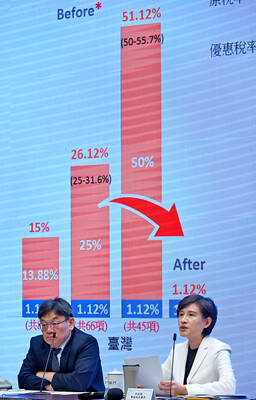
GREATER REACH? Auto parts and wood products would face tariffs of up to 15%, matching those targeting the EU, Japan and South Korea, Vice Premier said The US has announced that preferential tariff treatment for Taiwan’s non-semiconductor Section 232 goods would take effect retroactively from May 1, the Executive Yuan said yesterday. The US government yesterday posted a notice on the Federal Register’s public inspection Web site previewing tariff concessions for Taiwan under a memorandum of understanding (MOU) on Taiwan-US investment after two months of negotiations. The MOU signed on Jan. 15 stipulated three major preferential tariff arrangements: a 15 percent “reciprocal” tariff rate for Taiwan without stacking most-favored nation (MFN) rates; preferential Section 232 treatment for semiconductors and related products; and preferential Section 232 treatment for non-semiconductor


 RSS
RSS