


The fight between two clothiers over who gets to put a crocodile logo on their shirts is raging in China, and teeth are being bared on both sides.
French sportswear maker Lacoste vowed yesterday to pursue its longstanding feud with rival Crocodile International over the logo despite its loss of a copyright lawsuit in Shanghai.
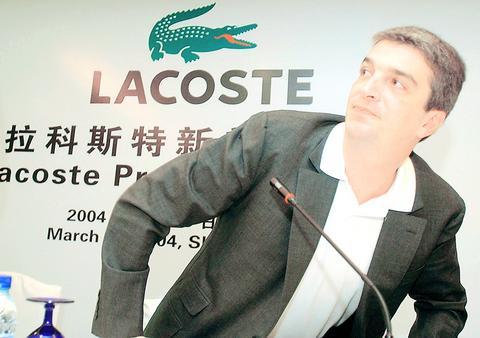
PHOTO: AP
Lacoste, maker of the status-symbol polo shirts with crocodile appliques, has clashed with Crocodile International in many markets, but rarely as harshly as in China -- a reflection of the growing importance of this market and the troubles caused by rampant piracy of brand-name products.
Lacoste's crocodile logo faces right; Crocodile's faces left. Otherwise, they look similar enough that in most markets authorities have ruled they could cause undue confusion for consumers.
Last week, the Shanghai No. 2 Intermediate People's Court ordered La Chemise Lacoste to pay US$1 and publicly apologize to Singapore-based Crocodile International for trying to register its competitor's trademark as its own.
Lacoste family heir and spokesman Philippe Lacoste said yesterday that his company had no intention of using Crocodile International's logo when it photocopied it and presented it to Chinese trademark officials seven years ago.
"It was purely a defensive move," Lacoste said.
Crocodile International said the decision reinforced its right to the crocodile trademark.
"The Crocodile trademark is our intellectual property in China, and we will continue to exercise our right to protect and enhance our brand," Ang Boon-tian, managing director of Crocodile International, said in a statement.
Privately held Lacoste contends that the Shanghai court decision has no impact on its own complaints against Crocodile for use of the crocodile logo.
Crocodile International, founded in 1947, began selling its products in China in 1993.
Lacoste first put a crocodile on its shirts when it was established in France in 1933. It registered the logo in China in 1980 and in 1984 began sales there of its "alligator shirt," an icon of preppy style in its early-1980s heyday.
Having beaten Crocodile International to one of Asia's biggest markets, Lacoste has also sought to register variations of the original Lacoste logo as well as the Chinese-language characters for crocodile, eyu.
But dozens of copycat brands are sold in China. In a market loaded with crocodile logos, Lacoste fears the value of its brand image will be lost.
"It's worse here than anywhere else," said Paul Ranjard, a lawyer representing Lacoste in China.
"China, everybody knows, is the biggest potential market in the world," Ranjard said. "Lacoste has no intention of sharing its trademark in China."
The battle over claims to the crocodile began in the 1970s when Lacoste began distributing its products in Asia, where Crocodile International had already registered its own, similar logo.
And Lacoste has a separate agreement with Crocodile Garments, a Hong Kong company, allowing both companies to coexist in Hong Kong and the Chinese mainland.

A signaling system malfunction disrupted high-speed rail (HSR) services beginning at 8am today, with trains temporarily reduced to three northbound and three southbound trains per hour as authorities conduct inspections. The malfunction occurred on a section of track in Miaoli County during pre-operation checks early this morning, forcing northbound and southbound trains to use a single track, the HSR operator said. The regular schedule has been replaced with three hourly trains offering only nonreserved seating in each direction, stopping at every station, it said, adding that business class cars would still have reserved seating. Departures from terminal stations are scheduled at the top

Taiwan is still in the process of assessing the possibility of recruiting workers from Eswatini, the Ministry of Foreign Affairs said yesterday, adding that its goal is to help Eswatini upgrade its vocational training centers. If there are plans to recruit workers from Eswatini, safeguarding national security, protecting public health and ensuring the employment rights of Taiwanese would be prerequisites, Department of West Asian and African Affairs Director-General Yen Chia-liang (顏嘉良) told a news conference. Key considerations would also include filling labor shortages in specific industries, and fostering bilateral professional and technical exchanges, he said. Yen was asked about the progress of labor

A US uncrewed surface vessel (USV) encountered multiple Chinese warships during an autonomous transit of the Taiwan Strait, US defense company Seasats said in a statement on Wednesday. Seasats announced that a Lightfish USV had completed the first autonomous transit of the Taiwan Strait. Over five days, the USV traversed the entire length of the Strait while constantly monitoring surface vessel traffic, the company said. The Lightfish encountered multiple Chinese warships, one of which was a Chinese People’s Liberation Army Navy (PLAN) Type 056 corvette, it said. The Chinese vessels were operating “well within Taiwan’s exclusive economic zone without transmitting their identity via the

VERBOSE VESSELS: A CGA cutter and a China Coast Guard exchanged verbal barbs for more than a day in Taiwanese-controlled waters before the Chinese vessel left The Taiwanese and Chinese coast guards had a standoff near the strategically located Pratas Islands (Dongsha Islands, 東沙群島) in the north of the South China Sea, the Coast Guard Administration (CGA) said yesterday. The two sides engaged in intense radio exchanges over sovereignty claims during the 33-hour standoff. China Coast Guard vessel 3501 eventually left the restricted waters, 26.6 nautical miles (49.2km) west of the Pratas Islands, at 5pm yesterday, the CGA said. Lying approximately between southern Taiwan and Hong Kong, the Taiwan-controlled Pratas are seen by some security experts as vulnerable to Chinese attack due to their distance — more than


 RSS
RSS