


Inside a musty British Army tent in the military zone along Kuwait's southern border with Iraq, Lieuten-ant Colonel Christopher Tickell grins at camp scuttlebutt that fate has tapped him to be the first chief executive officer of what might be called Iraq Oil Inc.
"Too bad I won't be getting paid on those grounds," laughs Tickell, commander of the 23 Engineers Regiment, a battle group of some 500 armed heavy-equipment roustabouts, plus combat-helicopter and bulldozer pilots. They are assigned the task of seizing the fortified swath of 18 oilfields that arc from the southern tip of the Euphrates River to Iraq's southeastern frontier with Iran. In them: more than 20 billion barrels of oil.
In the event of war, Tickell says one of his primary jobs will be to race his engineers forward to capture the 10 billion barrels of proven crude-oil reserves percolating beneath the Rumaila field.
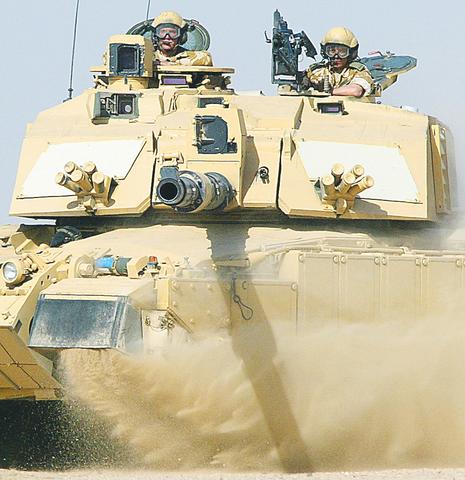
PHOTO: REUTERS
Their mission: help prevent Iraqi President Saddam Hussein from setting his country's southern oil wells on fire or at the least contain any damage. During the 1991 war on Iraq, Hussein set ablaze 737 of Kuwait's 858 working wells and destroyed US$33 billion of industrial infrastructure.
"We don't want that to happen again," Tickell says.
According to military planners now deploying some 240,000 US and British troops along the sandstorm-swept frontier, the 38-year-old combat engineering commander from the village of Waterbeach will for all intents and purposes be in charge of Iraq's oil industry in the south during the first few days of any armed conflict.
"Tickell's combat engineers are the first-aid component to save Iraq's southern wellheads," explains a senior British military strategist who cannot be named for security reasons.
"The 23 will help plow the way to the oilfields and secure the area for post-conflict nation building. If Saddam sets them aflame, the engineers will ensure professional oil firefighters get there quickly."
Slapping caked sand off the dark blue diamond shoulder patch used to identify the 23 Engineers, Tickell, a relative of former British Ambassador to the UN Sir Crispin Tickell, sits down in a collapsible canvas field chair and ponders a battle plan designed to create a post-war Iraq that can be funded by the sale of oil.
"We are facing booby traps, mines, explosives,'' says Tickell, known to his troops as Colonel Chris. "Rumaila and the other fields are a significant challenge."
Indeed, the muggy air outside Tickell's command tent is disturbed by squadrons of armed Royal Engineer helicopters from the 51 Field Squadron Air Assault flying overhead.
Yo-yoing down from tethers through clouds of thick sand, cranes and other heavy construction gear, the engineers and other ground and air combat troops practice for the 60km journey to the Iraqi oil capital of Basra. Some 483km and eight oilfields further to the northwest lies Baghdad.
Nearby, armor-plated 23 Engineer bulldozers and Challenger battle tanks from the Queen's Royal Lancers are being loaded for the rush to secure Rumaila, the port facility at the Iraqi town of Um Qsar and the Shaatt al-Arab passage, the oil-tanker waterway.
Outside Fort Pegasus, one of the hundreds of battle camps encircled by high walls of soft sand, Captain Richard Coates of the 1st Fusiliers shoulders his weapon and digs his feet into the firm tire tracks left by a passing Warrior light-armor vehicle.
"We were here during the 1991 war and watched Saddam blow up the Kuwaiti oil wells" says Coates, whose unit is part of Britain's 7th Armor Brigade, the so-called Desert Rat brigade.
"The Desert Rats remember driving through the night and thick plumes of smoke. It was an industrial toxic-waste hazard and we don't want it to happen again."
The British Army is even sending lawyers to prepare the ground for an invasion. Lieutenant Colonel M.J. Mercer, one of six military lawyers in Kuwait with British forces, says the idea is to be prepared in the case that Hussein uses the oil fields as bases. If so, it may be the Western military that destroys them.

‘NO SECURITY RISK’: The Railway Bureau reassured the public that the technicians’ activities were limited to technical guidance and did not involve sensitive systems The Railway Bureau yesterday said it had invited eight Chinese technicians to assist with an airport MRT construction project. The bureau issued the confirmation after an Internet user said Chinese nationals had entered the construction zone of Taiwan Taoyuan International Airport’s Terminal 3 project. They asked why “individuals from an enemy state” were allowed access to such a major national infrastructure project, which raised serious concerns over Taiwan’s industrial safety, sensitive systems and information security. The bureau’s Northern Region Engineering Branch Office said subcontractor Taiwan Handle Industrial Co (台灣手把工業) of the Taoyuan airport MRT’s “Contract No. CU05 Project A14 Station Civil, MEP &

A US uncrewed surface vessel (USV) encountered multiple Chinese warships during an autonomous transit of the Taiwan Strait, US defense company Seasats said in a statement on Wednesday. Seasats announced that a Lightfish USV had completed the first autonomous transit of the Taiwan Strait. Over five days, the USV traversed the entire length of the Strait while constantly monitoring surface vessel traffic, the company said. The Lightfish encountered multiple Chinese warships, one of which was a Chinese People’s Liberation Army Navy (PLAN) Type 056 corvette, it said. The Chinese vessels were operating “well within Taiwan’s exclusive economic zone without transmitting their identity via the
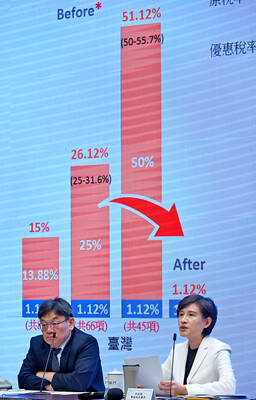
GREATER REACH? Auto parts and wood products would face tariffs of up to 15%, matching those targeting the EU, Japan and South Korea, Vice Premier said The US has announced that preferential tariff treatment for Taiwan’s non-semiconductor Section 232 goods would take effect retroactively from May 1, the Executive Yuan said yesterday. The US government yesterday posted a notice on the Federal Register’s public inspection Web site previewing tariff concessions for Taiwan under a memorandum of understanding (MOU) on Taiwan-US investment after two months of negotiations. The MOU signed on Jan. 15 stipulated three major preferential tariff arrangements: a 15 percent “reciprocal” tariff rate for Taiwan without stacking most-favored nation (MFN) rates; preferential Section 232 treatment for semiconductors and related products; and preferential Section 232 treatment for non-semiconductor

TIT-FOR-TAT: The US allegedly revoked the visa of a Chinese national working at Xinhua News Agency in the US in response to Beijing’s expulsion of Vivian Wang The Presidential Office yesterday condemned China for expelling a New York Times correspondent from Beijing following the newspaper’s interview with President William Lai (賴清德), saying the move highlighted Beijing’s suppression of press freedom and its threat to international news media. Taiwan has noted a series of recent incidents in which Beijing used similar tactics to “threaten and pressure international media outlets and journalists,” Presidential Office spokeswoman Karen Kuo (郭雅慧) said in a statement. “This concerns not only press freedom and freedom of expression, but also the safety of journalists, and Taiwan and relevant partners are paying close attention to the situation,” she


 RSS
RSS