


In 1913, a year after the last Manchu emperor left the throne, China issued bonds that were backed by revenues from government-owned salt mines. Now, a group of Americans is telling China it's time to pay up on those bonds they say are worth US$89 billion today.
"There's a clear obligation for China to pay under international law," says B. Riney Green, a Nashville, Tennessee, attorney who is representing the American Bondholders Foundation, a group of some 345 families from 24 states.
China, however, has long insisted it is not responsible for the debts incurred before Mao Tse-tung led the communists to power in 1949. Calls to the Chinese Embassy in Washington were not returned.
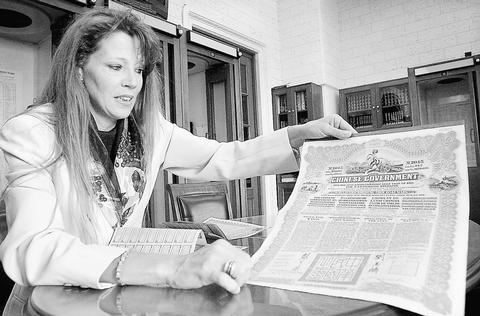
PHOTO: AP
The American group holds more than 18,000 Chinese government bonds issued between 1913 and 1942, the great majority from sales in 1913 of "gold loan" bonds payable in British pound sterling and three other European currencies.
Geri Santos of Apollo Beach, Florida, said she found the bond certificates in a black bag after her mother died.
"We didn't know what they were" until she read a newspaper article about others with the Chinese bonds, and she still does not know how much they are worth. ``But I think there's going to be a payoff.''
Foundation members were in Washington last week seeking to raise awareness of their issue. Getting the Bush administration to take on a new dispute with China could be difficult.
"We're very realistic about our expectations," Green said.
But the foundation president, Tennessee cattle rancher Jonna Bianco, said members are not without hope. In 1987, as part of its negotiations with Britain on the return of Hong Kong, China did agree to partially honor pre-1949 debts to British bondholders. Those debts included gold loan bonds.
Treasury Department figures show that as of January, China was the fourth-biggest foreign holder of US Treasury securities, with US$65.5 billion, and Bianco said it receives more than US$4 billion a year in interest from those investments.
One possibility would be to seize some of those interest payments to compensate the holders of defaulted bonds, although Green said: ``We're not trying to precipitate some kind of financial crisis with China. That would be a last resort.''
Bianco said that with China's recent accession to the WTO, Beijing must abide by international rules on business transactions. Her group plans to file a formal complaint with the WTO.
``Nobody's trying to be greedy,'' Bianco said. She said the claimants have agreed that, if they reach a settlement with China, they would donate 10 percent of the after-tax money to the US government and set aside an additional 30 percent for humanitarian and charitable organizations.
"The administration owes its citizens the obligation to at least discuss the issue," said US Representative Bart Gordon, a Tennessee Democrat.
Gordon wrote President George W. Bush in January saying that because bondholders cannot take China to court, they are dependent on executive-branch action for a fair resolution of their claims. He said he has not received a response. Bianco said the Chinese government generally has ignored her many inquiries. One letter from China asked if the US paid back its debts after gaining independence from Britain. She wrote back that it did.
Officials of the State Department and the Securities and Exchange Commission have suggested that the group go through the Foreign Bondholders Protective Council, a private, nonprofit organization created in the 1930s to help individual Americans collect on defaulted foreign government bonds.
John Petty, who was an assistant treasury secretary during the Johnson and Nixon administrations, now heads the council. He said it was active before World War II and then again in the 1970s and 1980s because of unpaid East European bonds, but has not done much in the last 15 years.
Petty said he is prepared to assist those holding the Chinese bonds but needs some indication the administration is interested. "Unless you have the administration supporting the resolution of the problem, any intermediary is basically pushing on a string, he said.

Taiwanese Olympic badminton men’s doubles gold medalist Wang Chi-lin (王齊麟) and his new partner, Chiu Hsiang-chieh (邱相榤), clinched the men’s doubles title at the Yonex Taipei Open yesterday, becoming the second Taiwanese team to win a title in the tournament. Ranked 19th in the world, the Taiwanese duo defeated Kang Min-hyuk and Ki Dong-ju of South Korea 21-18, 21-15 in a pulsating 43-minute final to clinch their first doubles title after teaming up last year. Wang, the men’s doubles gold medalist at the 2020 and 2024 Olympics, partnered with Chiu in August last year after the retirement of his teammate Lee Yang

FALSE DOCUMENTS? Actor William Liao said he was ‘voluntarily cooperating’ with police after a suspect was accused of helping to produce false medical certificates Police yesterday questioned at least six entertainers amid allegations of evasion of compulsory military service, with Lee Chuan (李銓), a member of boy band Choc7 (超克7), and actor Daniel Chen (陳大天) among those summoned. The New Taipei City District Prosecutors’ Office in January launched an investigation into a group that was allegedly helping men dodge compulsory military service using falsified medical documents. Actor Darren Wang (王大陸) has been accused of being one of the group’s clients. As the investigation expanded, investigators at New Taipei City’s Yonghe Precinct said that other entertainers commissioned the group to obtain false documents. The main suspect, a man surnamed

The government is considering polices to increase rental subsidies for people living in social housing who get married and have children, Premier Cho Jung-tai (卓榮泰) said yesterday. During an interview with the Plain Law Movement (法律白話文) podcast, Cho said that housing prices cannot be brought down overnight without affecting banks and mortgages. Therefore, the government is focusing on providing more aid for young people by taking 3 to 5 percent of urban renewal projects and zone expropriations and using that land for social housing, he said. Single people living in social housing who get married and become parents could obtain 50 percent more

DEMOGRAPHICS: Robotics is the most promising answer to looming labor woes, the long-term care system and national contingency response, an official said Taiwan is to launch a five-year plan to boost the robotics industry in a bid to address labor shortages stemming from a declining and aging population, the Executive Yuan said yesterday. The government approved the initiative, dubbed the Smart Robotics Industry Promotion Plan, via executive order, senior officials told a post-Cabinet meeting news conference in Taipei. Taiwan’s population decline would strain the economy and the nation’s ability to care for vulnerable and elderly people, said Peter Hong (洪樂文), who heads the National Science and Technology Council’s (NSTC) Department of Engineering and Technologies. Projections show that the proportion of Taiwanese 65 or older would


 RSS
RSS