


Amazon.com Inc's list of its best-selling books in the past 24 hours looks like a cross-section of its customers' psyches: the predictions of Nostradamus, photographs of Manhattan skyscrapers and studies of terrorism.
Nostradamus: The Complete Prophecies by John Hogue, published in paperback in 1999, topped the list, perhaps because customers wanted to see how closely the 16th-century French astrologer foretold Tuesday's destruction by terrorists of the World Trade Center's twin towers. In all, four Nostradamus books, two on the World Trade Center and one about terrorism dominated the No. 1 online bookseller's top 10 list.
Second on the list was Twin Towers: The Life of New York City's World Trade Center (1999) by Angus Kress Gillespie, with a cover photo of the now-gone buildings.
Simon Reeve's The New Jackals: Ramzi Yousef, Osama Bin Laden and the Future of Terrorism (1999), an account of the 1993 bombing of the World Trade Center and subsequent attacks by a Bin Laden-funded terrorist, held the No. 3 slot.
Books detailing the prophecies of Nostradamus may have become more popular through the day as many Americans opened their computer in-boxes to find an e-mail purporting to quote the astrologer as saying the collapse of ``twin brothers torn apart by chaos'' would spark World War III.
The e-mail is a hoax, according to experts. "The second quatrain is entirely made-up, and the first quatrain is composed of lines taken from two completely different prophecies of Nostradamus linked together for effect," said snopes.com, a Web site devoted to countering Internet scams and hoaxes.
Americans hungry for more information related to Tuesday's terrorist attacks on New York and Washington jammed the Internet with requests in the past few days. On Yahoo Inc's Web site, the top searches were for World Trade Center, Pentagon, Osama bin Laden, Afghanistan and Nostradamus.
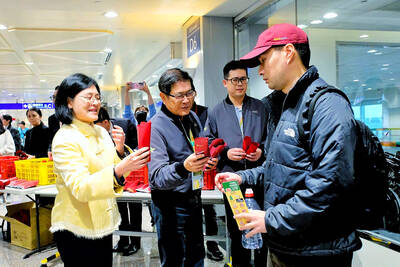
An Emirates flight from Dubai arrived at Taiwan Taoyuan International Airport yesterday afternoon, the first service of the airline since the US and Israel launched strikes against Iran on Saturday. Flight EK366 took off from the United Arab Emirates (UAE) at 3:51am yesterday and landed at 4:02pm before taxiing to the airport’s D6 gate at Terminal 2 at 4:08pm, data from the airport and FlightAware, a global flight tracking site, showed. Of the 501 passengers on the flight, 275 were Taiwanese, including 96 group tour travelers, the data showed. Tourism Administration Deputy Director-General Huang He-ting (黃荷婷) greeted Taiwanese passengers at the airport and

POSSIBILITIES EMERGE: With Taiwan’s victory and Japan’s narrow win over Australia, Taiwan now have a chance to advance if South Korea also beat the Aussies Taiwan has high hopes that the national baseball team would advance to the World Baseball Classic (WBC) quarter-finals after clinching a crucial 5-4 victory over South Korea in a nail-biting extra-inning game at the Tokyo Dome yesterday. Boosted by three home runs — two solo shots by Yu Chang (張育成) and Cheng Tsung-che (鄭宗哲) and a two-run homer by Stuart Fairchild — the triumph gave Taiwan a much-needed second victory in the five-team Pool C, where only the top two finishers would advance to the knockout stage in Miami, Florida. Entering extra innings with the game tied at four apiece, Taiwan scored
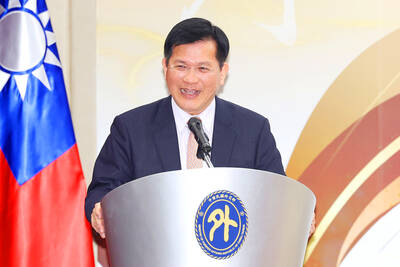
MISSION OF PEACE: The foreign minister urged Beijing to respect Taiwan’s existence as an independent nation, and work together to ensure peace and stability in the region Minister of Foreign Affairs Lin Chia-lung (林佳龍) yesterday rejected Chinese Minister of Foreign Affairs Wang Yi’s (王毅) comments about Taiwan, criticizing China as a “troublemaker” in the international community and a disruptor of cross-strait peace. Speaking at a news conference on the sidelines of the Chinese National People’s Congress, Wang said that Taiwan has always been a territory of China and that it would be impossible for it to become its own country. The “return” of Taiwan to China was the natural outcome of the Chinese people’s resistance against Japan in World War II, and that any pursuit of independence was “doomed
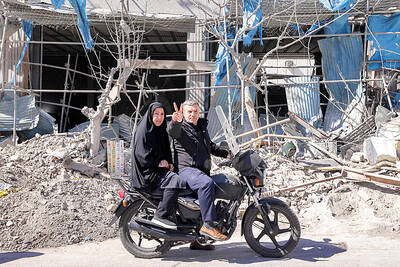
STRAIT OF HORMUZ: In the case of a prolonged blockade by Iran, Taiwan would look to sources of LNG outside the Middle East, including Australia and the US Taiwan would not have to ration power due to a shortage of natural gas, Minister of Economic Affairs Kung Ming-hsin (龔明鑫) said yesterday, after reports that the Strait of Hormuz was closed amid the conflict in the Middle East. The government has secured liquefied natural gas (LNG) supplies for this month and contingency measures are in place if the conflict extends into next month, Kung told lawmakers. Saying that 25 percent of Taiwan’s natural gas supplies are from Qatar, Chinese Nationalist Party (KMT) caucus secretary-general Lin Pei-hsiang (林沛祥) asked about the situation in light of the conflict. There would be “no problems” with


 RSS
RSS