


A denim-clad woman and a shaggy-haired man walk slowly toward each other. They meet in a glowing shaft of light and begin to kiss. It's a fleeting snapshot of young love, and then the scene fades.
But something lingers. It isn't the handsome kissing couple or the hip-hugger jeans they're selling. Rather, it's a scrappy tenor voice wrapped in the warm embrace of a French horn -- a 30-second dose of romance in its most concentrated, potent form.
A scant few of the millions of viewers watching the commercial for the Gap's winter clothing line recognize the closing bars of The Shining, by British singer-songwriter Badly Drawn Boy. They do, however, absorb en masse a message conveyed without ad copy or clever slogan or cheesy jingle: The Gap is Love. The Gap is Holiday Spirit. The Gap, most important, is as cool as this lo-fi baroque pop tune.
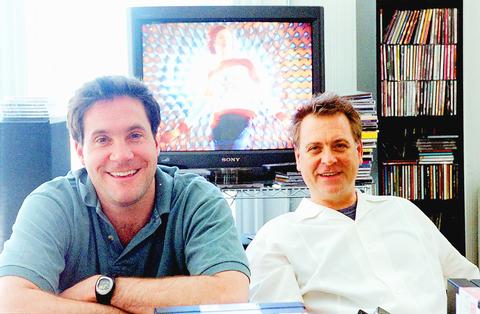
PHOTO: NY TIMES
Hipsters, start your engines. It's safe to go to the mall -- thanks to Lance Jensen and Gary Koepke, two Bostonians whose pursuits include playing in local bands you've never heard of, collecting cutting-edge albums you've never heard of, and running Modernista, a Boston ad agency that is fast becoming known in the industry for its bold use of contemporary songs in commercials.
"It goes straight to the sweet spot," says Jensen, deconstructing the not-so-mysterious power of music with Koepke and a reporter at a conference table in Modernista's airy loft in the Chinatown neighborhood. "There's nothing lost in the translation. It's all about the attitude, really, and moving people emotionally."
It's unclear if his last point refers to music or to advertising. But it hardly matters. In Modernista's world -- where stacks of CDs vie for feng shui-designed space with skis and boots just sent over from Rossignol, the firm's newest client -- songs and selling are inextricably bound. And judging from both client and consumer response, it's a match made in heaven.
Since opening its doors Jan. 1, last year, Modernista has compiled a list of clients that would delight any Manhattan CEO, let alone a start-up boutique agency in Boston. In 16 months Modernista, which maintains a staff of 25, has won accounts from the Gap, MTV, Hummer, the Travel Channel and Rossignol.
With a playlist that spans slow-core (Low), ambient house (the Orb), alternative rap (De La Soul), retro chic (Tom Jones), and shoe-gazing rock (Lush), the Ad Guys -- historically derided as smarmy salesmen -- are suddenly the hippest DJs around. As mainstream radio increasingly narrows to a handful of musical niches, TV commercials have become the place to hear interesting, ambitious songs. And those commercials, bleeping with the sounds of electronica and oozing indie creed, are selling establishment products to the alternative nation.
Target young market
"They're doing edgy work targeting a young market, and they're doing a great job," says Judy Neer, an executive at Pile and Co, a Boston-based firm that specializes in advertising agency reviews. "Based on the size and caliber of the work they've won so quickly, we consider Modernista one of the hot new start-ups to watch."
Jensen, 37, and Koepke, a 43-year-old Milwaukee native, ricochet between absurdly humble and supremely confident. Hip music is the norm in TV ads, they make a point of noting, and there are scads of people just like them in agencies around the country who are just as passionate about it as they are.
The reason Modernista's reputation is growing, say Koepke and Jensen, is that their commercials are -- in a word -- better. They attribute their talent for cranking out hip, minimalist spots with pitch-perfect soundtracks to "a feel," says Koepke -- who is partial to Hendrix, Ornette Coleman, the Talking Heads, and the Sex Pistols and is largely responsible for the visual element in Modernista's work.
"It's like a knack," clarifies Jensen, the concept and word man. A Milford, Connecticut, native and graduate of Boston College, Jensen counts among his all-time favorite acts My Bloody Valentine, Yes, Blue Nile, Peter Gabriel, Aphex Twin, and Husker Du.
Jensen became something of a rock star in advertising circles based largely on his work as creative director and writer for the award-winning "Drivers Wanted" Volkswagen campaign while he was at Boston-based Arnold Communications. He left Arnold to start Modernista with Koepke, who was founding creative director of Vibe magazine and former graphic designer at Portland-based Wieden and Kennedy.
Jensen's career-making Da Da Da spot follows a pair of 20-somethings as they pick up and abandon an old armchair in a VW Golf, to the tune of the German new wave band Trio. The ad became a pop-culture icon, and Trio's label reissued the group's 1981 album based on interest it generated.
Koepke and Jensen are unphased by the notion that a car commercial resuscitated a rock album. "TV is the modern art medium," says Koepke. "It's the modern altar, where you can express yourself and reach 30 million people." You can even spur a new CD, like the just-released As Seen on TV: Music from Commercials.
Da Da Da doesn't rate as a watershed moment for pop music in advertising the way that, say, Nike's use of the Beatles' Revolution did, but that's just the point. To reach a younger demographic, Jensen and his ilk are eschewing mainstream acts and building brand identity with cutting-edge, forgotten, and obscure music.
"It fits your life, or your complete lack thereof," went the tag line to the Da Da Da spot. With that little slacker mantra, Jensen crystallized an aesthetic that Modernista is running with, to surprising destinations.
Consider the company's campaign for the Travel Channel. "Bringing there ... here" is a brilliantly economical distillation of the client's product. But a new TV spot showing skate kids mountain-boarding down a sheep-studded slope in New Zealand -- with a sort of alpine-surreal soundtrack by avant-garde trumpeter Ben Neill -- is a fairly radical departure for a cable channel more identified with the NPR crowd.
"For the first time, the excitement and feel of a commercial really matched our programming," says Amy Troiano, director of on-air promotion for the Travel Channel. "It catches people's eyes and ears. Lance and Gary put the Travel Channel on the radar screen for a different demographic. Our ratings increased enormously in the fourth quarter."
Hot as it is, Modernista doesn't always get what it wants. Following Bruce Springsteen's lead when he turned down a reported US$12 million to license Born in the USA to Chrysler, plenty of acts have declined requests to use their songs in commercials. Jensen originally wanted to use Luna's dreamy cover of Sweet Child O' Mine, the Guns N' Roses song, for the Gap holiday ad. Luna wasn't interested; neither were a few other musicians Modernista has solicited.
Product endorsement
To the suggestion that product endorsement might pose a threat to an artist's integrity or credibility, Jensen rolls his eyes. "It's corporate sponsorship. What's-his-name painted the Sistine Chapel not because he was a religious nut but because that was his job. I don't understand the concept of selling out."
If Jensen's attitude smacks of pure commercialism, his execution is anything but. Jensen is a true music lover, committed to using songs as ad soundtracks that evoke a mood true to the artist's original intent.
"When the music is used correctly, it doesn't change the meaning of the words," he says. "But when you use the words in the song as the copy line, like Nissan did with `I want to get away' [from a Lenny Kravitz song], and it shows people getting away -- that's not what Lenny Kravitz meant by that. It's bastardizing the meaning of the song."
For the Gap's spring line, Modernista commissioned four versions of Handel's Hallelujah Chorus -- from electronica guru Tricky, reggae singer Ziggy Marley, rock band Heart, and trip-hop ensemble Thievery Corporation. Each of the four spots features a lone dancer lost in blissful reverie. Startlingly simple, the ads evoke a breadth of influences: the rites of the season, the celebratory nature of the music, and the individualism of each musical artist.
"We always say it has to be cool music but our moms have to like it too," says Jensen.
And therein lies the essence of Modernista's marketing genius: bringing cutting-edge cachet to the middle of the road. Using hip music to define, and redefine, something as inherently unhip as khakis. Merging product and culture in a world where the difference between the two is vanishing.
While it's hard to quantify an ad campaign's contribution to sales figures, the current trend in advertising is a clear indication of just how strongly clients believe in the power of music.
"Did Pepsi sell more the day after Britney Spears' 90-second Super Bowl commercial? I don't know," muses Jensen. "But Pepsi's job is to be part of the pop culture. The Gap and Volkswagen use music in that way too. We're showing products, but we're trying to entertain as well. I think it's a cumulative effect. And over the long haul," he ventures with a rare smile, "I think it works."

‘NO SECURITY RISK’: The Railway Bureau reassured the public that the technicians’ activities were limited to technical guidance and did not involve sensitive systems The Railway Bureau yesterday said it had invited eight Chinese technicians to assist with an airport MRT construction project. The bureau issued the confirmation after an Internet user said Chinese nationals had entered the construction zone of Taiwan Taoyuan International Airport’s Terminal 3 project. They asked why “individuals from an enemy state” were allowed access to such a major national infrastructure project, which raised serious concerns over Taiwan’s industrial safety, sensitive systems and information security. The bureau’s Northern Region Engineering Branch Office said subcontractor Taiwan Handle Industrial Co (台灣手把工業) of the Taoyuan airport MRT’s “Contract No. CU05 Project A14 Station Civil, MEP &

A US uncrewed surface vessel (USV) encountered multiple Chinese warships during an autonomous transit of the Taiwan Strait, US defense company Seasats said in a statement on Wednesday. Seasats announced that a Lightfish USV had completed the first autonomous transit of the Taiwan Strait. Over five days, the USV traversed the entire length of the Strait while constantly monitoring surface vessel traffic, the company said. The Lightfish encountered multiple Chinese warships, one of which was a Chinese People’s Liberation Army Navy (PLAN) Type 056 corvette, it said. The Chinese vessels were operating “well within Taiwan’s exclusive economic zone without transmitting their identity via the

GREATER REACH? Auto parts and wood products would face tariffs of up to 15%, matching those targeting the EU, Japan and South Korea, Vice Premier said The US has announced that preferential tariff treatment for Taiwan’s non-semiconductor Section 232 goods would take effect retroactively from May 1, the Executive Yuan said yesterday. The US government yesterday posted a notice on the Federal Register’s public inspection Web site previewing tariff concessions for Taiwan under a memorandum of understanding (MOU) on Taiwan-US investment after two months of negotiations. The MOU signed on Jan. 15 stipulated three major preferential tariff arrangements: a 15 percent “reciprocal” tariff rate for Taiwan without stacking most-favored nation (MFN) rates; preferential Section 232 treatment for semiconductors and related products; and preferential Section 232 treatment for non-semiconductor

The National Chungshan Institute of Science and Technology yesterday showcased its locally developed variants of the Vision 60 robotic patrol dog, which it plans to deploy on the nation’s outlying territories in the South China Sea. The variants were produced under the Joint Lab project — created by the institute and domestic companies — and assembled with domestically produced motors, lenses and artificial intelligence (AI) systems alongside licensed tech from the US, Missile and Rocket Systems Research Division deputy director Jen Kuo-kang (任國光) told the media event at a military base in Taipei’s Dazhi (大直) area. Taiwan has built up its strengths


 RSS
RSS