


National Semiconductor Corp, which makes chips for cellular phones and personal computers, said it will eliminate 1,100 jobs, or 10 percent of its workforce, to reduce costs as orders slump.
The company will break even or have a loss of as much as US$0.04 a share in the fourth quarter ending May 27, and sales will miss analysts' forecasts, spokesman Bill Callahan said. National Semiconductor will take a charge of US$10 million to US$12 million for the reductions, which will save US$70 million to US$80 million a year.
National Semiconductor and other companies that supply chips to cell-phone and PC makers have been forced to shrink their work forces and reduce growth forecasts because a slowdown in demand for the devices created inventory buildups at customers.
Manufacturers aren't ordering as many new chips until they work through their existing stockpiles, the company said.
The shares of Santa Clara, California-based National fell as much as 7 percent to US$23.22 after the company reduced its forecast. The stock has lost more than half its value in the past year.
On average, analysts polled by First Call/Thomson Financial expected fourth-quarter profit of US$0.04 a share, excluding certain costs and charges. Sales in the current period will be US$390 million to US$400 million, the company said, compared with forecasts for US$431 million, the average estimate of three analysts surveyed by IBES International Inc.
The PC market didn't recover as fast as the company expected, and handset manufactures still have large inventories of chips, Chief Operating Officer Donald Macleod said on a conference call today.
"The assumption was that February was the low point," said Chairman and Chief Executive Brian Halla. That proved too optimistic, he said.
In March, the company said it would miss analysts' fourth-quarter estimates, which at the time called for US$496.3 million in sales and earnings of US$0.23 a share.
Halla repositioned National Semiconductor to take advantage of the booming market for cell phones and for the base stations that send signals to the phones. The company sold its Cyrix unit, which made cheap microprocessors for PCs, ceding that market to Intel Corp and Advanced Micro Devices Inc. National Semiconductor focused instead on developing its Geode system-on-a-chip semiconductors for the hand-held computer market.
A decline in demand for cell phones with more features and for base stations has delayed Halla's plans, analysts said.
The company will eliminate 800 full-time employees and 128 contractors through firings, attrition and retirements, National said. Employees will receive severance packages and placement services.

‘NO SECURITY RISK’: The Railway Bureau reassured the public that the technicians’ activities were limited to technical guidance and did not involve sensitive systems The Railway Bureau yesterday said it had invited eight Chinese technicians to assist with an airport MRT construction project. The bureau issued the confirmation after an Internet user said Chinese nationals had entered the construction zone of Taiwan Taoyuan International Airport’s Terminal 3 project. They asked why “individuals from an enemy state” were allowed access to such a major national infrastructure project, which raised serious concerns over Taiwan’s industrial safety, sensitive systems and information security. The bureau’s Northern Region Engineering Branch Office said subcontractor Taiwan Handle Industrial Co (台灣手把工業) of the Taoyuan airport MRT’s “Contract No. CU05 Project A14 Station Civil, MEP &

A US uncrewed surface vessel (USV) encountered multiple Chinese warships during an autonomous transit of the Taiwan Strait, US defense company Seasats said in a statement on Wednesday. Seasats announced that a Lightfish USV had completed the first autonomous transit of the Taiwan Strait. Over five days, the USV traversed the entire length of the Strait while constantly monitoring surface vessel traffic, the company said. The Lightfish encountered multiple Chinese warships, one of which was a Chinese People’s Liberation Army Navy (PLAN) Type 056 corvette, it said. The Chinese vessels were operating “well within Taiwan’s exclusive economic zone without transmitting their identity via the
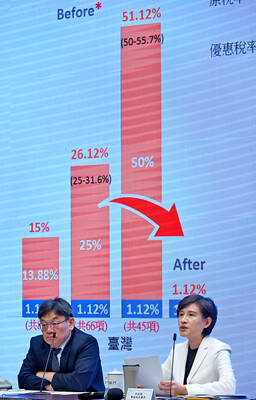
GREATER REACH? Auto parts and wood products would face tariffs of up to 15%, matching those targeting the EU, Japan and South Korea, Vice Premier said The US has announced that preferential tariff treatment for Taiwan’s non-semiconductor Section 232 goods would take effect retroactively from May 1, the Executive Yuan said yesterday. The US government yesterday posted a notice on the Federal Register’s public inspection Web site previewing tariff concessions for Taiwan under a memorandum of understanding (MOU) on Taiwan-US investment after two months of negotiations. The MOU signed on Jan. 15 stipulated three major preferential tariff arrangements: a 15 percent “reciprocal” tariff rate for Taiwan without stacking most-favored nation (MFN) rates; preferential Section 232 treatment for semiconductors and related products; and preferential Section 232 treatment for non-semiconductor

TIT-FOR-TAT: The US allegedly revoked the visa of a Chinese national working at Xinhua News Agency in the US in response to Beijing’s expulsion of Vivian Wang The Presidential Office yesterday condemned China for expelling a New York Times correspondent from Beijing following the newspaper’s interview with President William Lai (賴清德), saying the move highlighted Beijing’s suppression of press freedom and its threat to international news media. Taiwan has noted a series of recent incidents in which Beijing used similar tactics to “threaten and pressure international media outlets and journalists,” Presidential Office spokeswoman Karen Kuo (郭雅慧) said in a statement. “This concerns not only press freedom and freedom of expression, but also the safety of journalists, and Taiwan and relevant partners are paying close attention to the situation,” she


 RSS
RSS