

ASEAN leaders yesterday agreed on pursuing a “calibrated engagement” with Myanmar’s post-coup government, according to a joint statement, as the regional bloc seeks a path toward normalization.
Myanmar is still a member of ASEAN, but it has been frozen out of high-level meetings since a military junta seized power in a coup in 2021.
Thailand has been leading efforts to normalize relations with Myanmar since coup leader Min Aung Hlaing was installed as civilian president this year following elections dismissed by monitors as a charade.
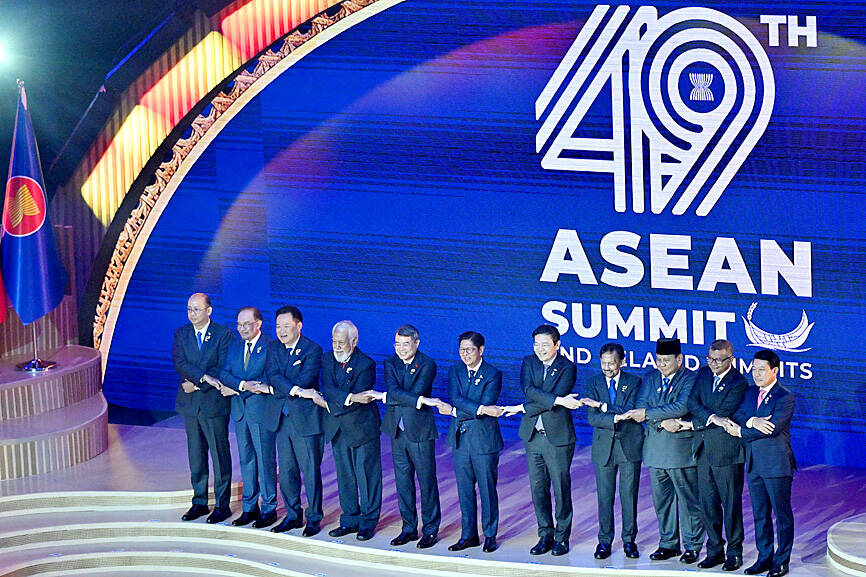
Photo: Reuters
Bangkok has called for a “calibrated engagement” with Myanmar in an effort to implement ASEAN’s “five-point consensus” plan aimed at ending the war between the military and a coalition of pro-democracy rebels and ethnic minority armed groups.
ASEAN leaders meeting in Manila adopted that language in calling for the pursuit of “a calibrated engagement with Myanmar through a phased and progress-based approach, taking into account developments on the ground,” according to the joint statement.
The five-point plan has yielded little in the half-decade since it was agreed to, with Philippine President Ferdinand Marcos Jr conceding at a May summit he had not seen “any progress in Myanmar.”
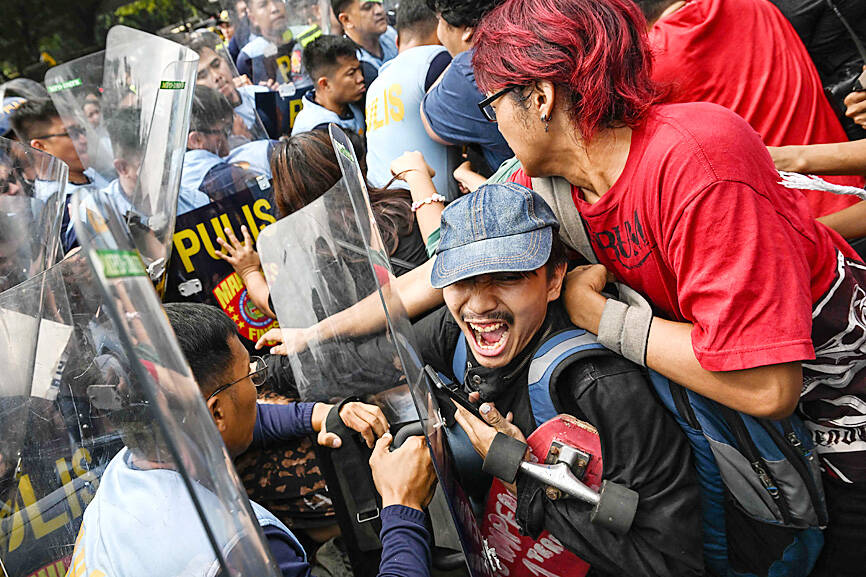
Photo: AFP
In opening remarks at an ASEAN leaders’ retreat in Manila yesterday, he repeated a question he had posed to the group six months earlier: “What more can we do for Myanmar?”
“I hope our session leads to practical and forward-looking discussions on how we can further advance the implementation of the five-point consensus, make our efforts more responsive to the realities on the ground, and support a peaceful, inclusive, Myanmar-owned and Myanmar-led process,” he said.
The ASEAN bloc’s rotating chair would pass at the end of this year from the Philippines to Singapore, which analysts say opposes normalizing ties with Myanmar.
Meanwhile, hopes of achieving a so-called Code of Conduct in the disputed South China Sea between ASEAN states and China during Manila’s year in the chair have flagged.
A Southeast Asian diplomat involved in summit preparations said he did not expect a code to be signed at the summit.
Philippine Secretary of Foreign Affairs Maria Theresa Lazaro indicated as much on Saturday, saying negotiations were “80 percent” complete.
“If it happens, then it’s a small miracle,” said Siew Mun Tang (鄧秀明), former head of the ASEAN Studies Centre at Singapore’s ISEAS-Yusof Ishak Institute.
Beijing claims most of the South China Sea despite an international ruling that its assertion has no legal basis, and its coast guard has clashed repeatedly with that of the Philippines.
US President Donald Trump is scheduled to arrive tomorrow, near the summit’s conclusion, a visit that would include a meeting with the leaders of his fellow Quadrilateral Security Dialogue countries India, Japan and Australia — the first such sit-down of his second term.
Nearly 20,000 police officers have been deployed around Metro Manila for the summit, with progressive groups predicting a turnout of thousands tomorrow for an anti-Trump march on the summit site.

‘CARELESS’: After years of advocating to sell more AI chips to China, Jensen Huang’s links to the country would come under greater scrutiny than ever before At the heart of the biggest controversy to confront Nvidia Corp in its three-decade history is a former television journalist who became a semiconductor power broker renting advanced chips to China’s top firms. Huang Le (黃樂), also known as Alice Huang, has been identified in a series of reports as a spy who was recruited by Beijing to target Nvidia CEO Jensen Huang (黃仁勳). She came into his orbit after founding Megaspeed International, the largest buyer of Nvidia’s chips in Southeast Asia — a major route for smuggling the firm’s advanced hardware into China. The CEO previously said there was nothing inappropriate

A Chinese university with deep ties to the People’s Liberation Army bought Nvidia’s powerful H200 AI chips last month despite being on a US export blacklist, procurement records show, highlighting gaps in Washington’s efforts to curb China’s access to advanced technology. The findings come as Nvidia and its CEO Jensen Huang face mounting scrutiny in Washington over his lobbying for looser restrictions on sales of AI chips to China, following reports alleging he was targeted by a Chinese spying operation. Huang has argued that continued US sales to China would preserve American technological leadership and keep Chinese customers reliant on US technology.

World leaders yesterday took the stage at COP31 in Antalya, Turkey, but some prominent names are missing from this year’s annual UN climate summit even as global warming intensifies. The two-week conference started earlier this week in the Mediterranean resort city of Antalya, with governments under pressure to tackle the climate crisis after a year of heat waves in Europe, deadly floods in Nepal and major wildfires in Indonesia. Dozens of leaders are expected to speak during the “high-level segment” taking place yesterday and today, including Turkish President Recep Tayyip Erdogan, Brazilian President Luiz Inacio Lula da Silva and Iranian

‘DESTRUCTIVE’: A political scientists warned that the tragedy could be exploited for political gain amid an ongoing crisis surrounding the Constitutional Tribunal The alleged perpetrator of a deadly weekend shooting spree in Krakow has died, Polish police said yesterday, two days after he was critically wounded in a shoot-out with officers and as the deeply divided nation faces a week of political tensions. “We inform you that the perpetrator of the tragic events died this morning in the hospital,” regional police wrote on X of the 24-year-old Polish man who allegedly opened fire on Saturday in central Krakow, killing six people. Authorities said the man had been “fascinated by far-right ideologies” and Polish Prime Minister Donald Tusk called the shooting — the deadliest in


 RSS