

The alleged perpetrator of a deadly weekend shooting spree in Krakow has died, Polish police said yesterday, two days after he was critically wounded in a shoot-out with officers and as the deeply divided nation faces a week of political tensions.
“We inform you that the perpetrator of the tragic events died this morning in the hospital,” regional police wrote on X of the 24-year-old Polish man who allegedly opened fire on Saturday in central Krakow, killing six people.
Authorities said the man had been “fascinated by far-right ideologies” and Polish Prime Minister Donald Tusk called the shooting — the deadliest in the country since the end of communism in 1989 — an act of “terrorism.”

Photo: Reuters
Six people, including two foreigners, were killed in the shooting spree, and about 15 others were wounded, authorities said.
The gunman is suspected to have killed nine people in all after the bodies of three people — his parents and sister — were found at their home two hours’ drive from Krakow.
The shooting comes as Poland prepares for a critical week.
A high-stakes meeting of the Constitutional Tribunal is due to be held today, a focal point in the ongoing battle between Tusk’s administration and its opponents over judicial appointments.
The right-wing opposition accuses the liberal, pro-European administration of undermining the constitutional order.
The governing coalition, for its part, maintains it is trying to correct “political” nominations to the court and reforms made by the nationalists, which it claims run counter to European democratic standards.
For several weeks, nationalist protesters have camped outside the court to “defend it,” but the crisis escalated abruptly late last month.
Riot police moved in to block access and a judge newly appointed by the parliamentary majority said she was taking over in the interim — effectively suspending the incumbent, who is close to Polish President Karol Nawrocki.
After the shooting, the nationalist Law and Justice party, which was in power from 2015 to 2023, called off planned protests for yesterday and today.
However, they could resume later in the week.
An Independence March planned for tomorrow is causing the greatest concern.
The annual event draws up to hundreds of thousands of right-wing supporters, from Catholic conservatives and white-supremacist fringe groups to anti-Semitic, pro-Russian far-right elements.
Nawrocki has announced his attendance.
Some observers have described it as “high-risk,” fearing that the crowd might deviate from its agreed route and head instead to the Constitutional Tribunal.
Tusk on Sunday dismissed rumors that the march could be stopped.
“No one intends to ban the Independence March,” he wrote on X. “Speculation on this matter is nothing but disinformation.”
However, he urged participants to “refrain from aggression” and warned against taking part in counterdemonstrations.
His appeals might go unheeded given the divisions in Polish politics, which are unfolding against the backdrop of a rising far-right movement.
“An extremely destructive polarization which does not merely dismantle the state in an institutional sense, but also divides society even more deeply on an emotional level,” journalist Boguslaw Chrabota wrote in the weekly Rzeczpospolita on Sunday.
Radicalization of political discourse “gives rise to Polish Breiviks,” he said, referring to the Krakow shooting and Anders Breivik, who killed 77 people in Norway in 2011.
Warsaw University political scientist Ewa Marciniak said that the tragedy in Krakow could soon be exploited for political gain.
“Tragedies like the one in Krakow only serve to sharpen political divisions,” she said. “After a period of shared mourning comes the search for those responsible, all taking place in a political climate defined by deep-seated, mutual hostility among political leaders.”
With parliamentary elections scheduled for autumn next year, events such as the Krakow tragedy or the ongoing crisis surrounding the Constitutional Tribunal, are likely to be used “to deepen conflicts” and “draw the public into them,” she added.

Giant pandas Ping Ping and Fu Shuang delighted visitors to Zoo Atlanta during their public debut Friday, chewing bamboo and lounging in their new US habitat while on loan from China. A male named Ping Ping and female Fu Shuang arrived from Chengdu in via a FedEx flight dubbed the “Panda Express,” and are to be hosted in the southern US facility for the next 10 years. Pandas are “animals that have got a unique ability to inspire curiosity, instill passion, evoke joy, and unite people around the globe,” chief executive officer Raymond King told onlookers at Zoo Atlanta. “This extraordinary
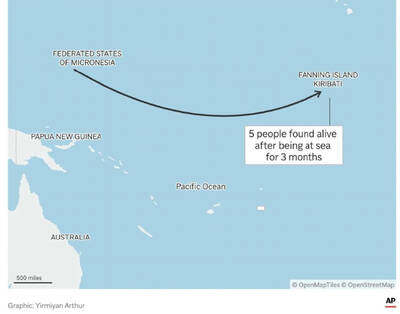
KIRIBATI: Nine people on a skiff had been reported missing after they failed to return to Ruo Island in Micronesia on July 30. Four people remained missing Five people, including two children, were rescued this week in the South Pacific island nation of Kiribati after three months drifting at sea in a 20-foot (6m) skiff, authorities said. Another four remained missing. Villagers rescued the group on Sunday off Fanning Island in Kiribati, the Australian Broadcasting Corp (ABC) reported, after they had drifted an estimated 5,400km east from the Federated States of Micronesia. The US Coast Guard in Guam yesterday confirmed that the skiff with nine people aboard had been reported missing after it failed to return to Ruo Island in Micronesia on July 30. 10-DAY SEARCH A 10-day search covering

China plans to roll out a broad set of standards governing the safety of artificial intelligence (AI) from development through deployment, representing some of the most comprehensive guidelines to guard against a loss of control over increasingly powerful artificial intelligence. The state economic planner yesterday said it was quickening legislation to govern and oversee how AI is developed and applied, covering the entire life cycle of models. The regulations would extend to areas from data to computing power, Wang Ruomeng (汪若夢), deputy director-general of the Department of Innovation and High-Tech Development at China’s National Development and Reform Commission, told a briefing in
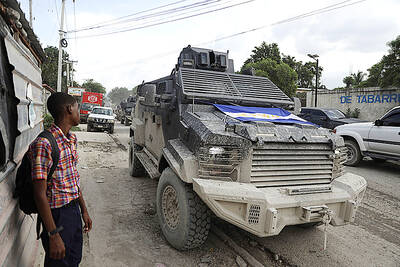
One of Haiti’s most powerful gangs said on Friday that it reached out to a government agency responsible for dismantling armed gangs in a push for “peace, stability and national reconciliation.” The 400 Mawozo gang sent a three-page statement to The Associated Press stressing that “dialogue is not a capitulation,” but rather an “act of patriotic responsibility to preserve human lives.” The UN and human rights groups have accused 400 Mawozo of raping, killing and kidnapping people, which it has denied. On Sunday last week, gang leader Wilson Joseph said that he wrote to the UN Secretary-General and requested that the organization


 RSS