

Ukrainian President Volodymyr Zelenskiy yesterday said that Russia has continued to strike Ukraine’s energy facilities even after US President Donald Trump said a day earlier that the warring countries had agreed on an energy ceasefire.
Speaking at the Warsaw Security Forum in Poland, Zelenskiy said Ukraine had learned through media reports that Trump had secured an energy ceasefire deal with Russia, which would involve a mutual pause in strikes on energy sites.
Zelenskiy said he would be willing to honor such an agreement, if Moscow did the same.
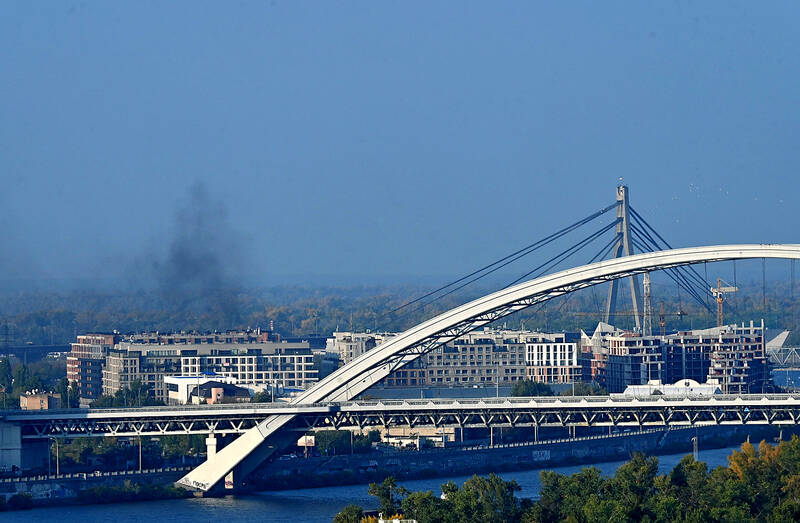
Photo: AFP
“We support it, but I have not heard approval of this proposal from the Russian side,” Zelenskiy said.
Trump’s brief social media post on Sunday claiming the purported agreement offered few details, but said that the energy ceasefire took effect immediately, adding: “Do not break it!”
However, Zelenskiy said Ukraine had been “horribly surprised” that following Trump’s “sudden but very important post,” Russia had struck numerous energy facilities including a power plant in the northeastern city of Kharkiv, as well as a gas production facility and a civilian gas station.
“It was clear that [Russian President Vladimir] Putin does not read Truth Social,” Zelenskiy said, referring to Trump’s social media platform.
Trump previously announced a similar agreement on ceasing energy strikes that did not come to fruition. In a social media post on Sept. 14, he said both countries had agreed “not to hit” each other’s energy infrastructure, but offered no details on that proposal either.
Russia has used attacks on energy facilities to deny Ukrainian civilians power, heat and running water during the war, hoping to wear down public resistance to Moscow’s full-scale invasion. Ukrainian officials describe the strategy as “weaponizing winter,” and fear Russia could ramp up such attacks as cold weather approaches.
Meanwhile, Ukraine has leveled strikes against Russian energy sites like oil refineries, sometimes deep within Russian territory, prompting Trump to blame Zelenskiy for high diesel prices on world markets.
On Friday, Trump struck a deal with Putin to import Russian diesel to address high fuel prices just weeks ahead of US midterm elections.
Yesterday, Zelenskiy said Kyiv was ready to comply with Trump’s requests to stop striking Russian refineries if Moscow halted attacks on Ukraine’s energy system, and asked Trump to press the Kremlin to agree. He added that if Moscow does not agree to an energy ceasefire this winter, “we will respond.”
“We are waiting for the details of the conversation between the Americans and the Russians, and we are waiting to see what specific steps the Americans are ready to take,” he said. “This energy ceasefire can work, and it can become a major step toward ending the war.”
The EU’s top diplomat yesterday welcomed the prospect of a pause in energy strikes in Ukraine, particularly as winter approaches, but said she sees no sign that Russia would be willing to respect it.
“We haven’t yet seen that also Russia will stick to it,” EU High Representative for Foreign Affairs and Security Policy Kaja Kallas said at a meeting of the bloc’s foreign ministers in Luxembourg. “Personally, I would also welcome that the ceasefire would include people not being killed, not only energy.”
Ukrainian and European officials reacted with dismay to Trump’s diesel deal with Putin, saying it would help fund Russia’s war effort.
Estonian Minister of Foreign Affairs Margus Tsahkna yesterday told reporters in Luxembourg that he does not believe the deal “is actually going to change anything” in terms of fuel prices, and that it is ”much more connected to the domestic situation in the US.”
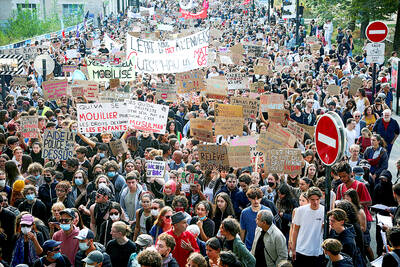
VIOLENT STANDOFFS: The government said 215 students have been injured since the start of the movement last month, including a teenager who lost a hand on Monday Thousands of demonstrators yesterday massed under heavy police surveillance in Paris and cities across France, as unions and teachers joined high-school students who for days have been demanding better conditions in protests punctuated by violent clashes. Students have blocked the entrances to hundreds of high schools for 15-to-17-year-olds since late last month, complaining of missing teachers, overloaded schedules, dilapidated classrooms and buildings that cannot cope with rising temperatures. In the Paris suburb of Creteil, where the protests started last month, students piled barriers outside the Saint-Exupery high school. “We are here to make our voice heard, all too often forgotten,” student Abderrahmane Abdelkader

As shark attack survivor Mel Ismail fought the predator that severed his leg, he noticed something odd. “I saw its eye ... a big black eye,” Ismail said. “But it was winking back at me — I was trying to get my fingers in its eye and just pushing its eye as I was being dragged.” When the shark swam off, he managed to struggle back to shore, the surfer and professional firefighter said in an Australian Broadcasting Corp interview broadcast on Thursday. He was surfing at Glenfield Beach near Geraldton on Australia’s west coast when he was attacked on Sept. 14. He

A Tuvalu government adviser yesterday said it felt like Australia had “taken over” the tiny country’s sovereignty during a visit by leaders to the Pacific island. The official — a senior government adviser who asked to remain anonymous because they were not authorized to speak to the media — said they were disappointed in Australia’s handling of the visit. The comments came during a visit by Australian Prime Minister Anthony Albanese and other leaders to Tuvalu, which has become a symbol of the existential threat posed by rising seas and is a key partner in Canberra’s Pacific strategy. “Just because we signed the

Halfway around the world from Russia, in a Caribbean tourism hot spot, men young and old are being lured by Moscow with tantalizing job offers, only to find themselves en route to the front lines in Ukraine. Moscow and Kyiv have recruited thousands of foreign nationals into their armies since Russia launched its invasion of Ukraine in 2022. Moscow is accused, in some cases, of using fake job ads to hoodwink men from deprived backgrounds in Africa, Asia and Latin America into traveling to Russia and then forcing them to fight on arrival. From countries such as India, Kenya, Equatorial Guinea, Colombia and


 RSS
RSS