

As shark attack survivor Mel Ismail fought the predator that severed his leg, he noticed something odd.
“I saw its eye ... a big black eye,” Ismail said. “But it was winking back at me — I was trying to get my fingers in its eye and just pushing its eye as I was being dragged.”
When the shark swam off, he managed to struggle back to shore, the surfer and professional firefighter said in an Australian Broadcasting Corp interview broadcast on Thursday.
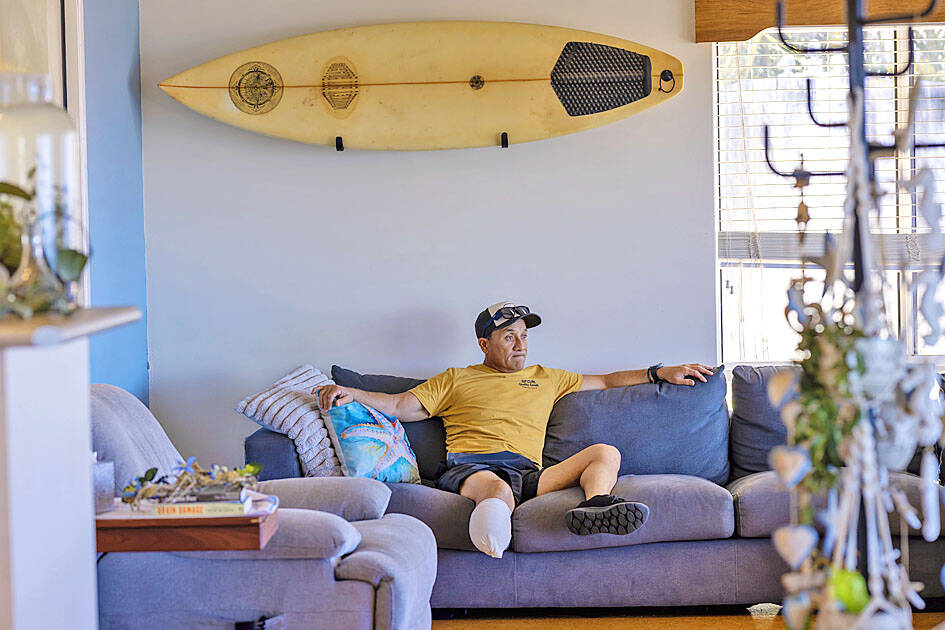
Photo: Australian Broadcasting Corp via AP
He was surfing at Glenfield Beach near Geraldton on Australia’s west coast when he was attacked on Sept. 14. He lost his right leg below the knee.
Ismail said he was resting when he spotted a pod of about 20 dolphins before being hit by something big. It was the first time he has spoken publicly about the attack.
“I thought I got hit by a dolphin, initially,” Ismail said. “And suddenly — bang — something grabbed me and dragged me down into the water. And I knew it was a shark.”
Ismail said it looked like the shark winked at him before it bit his leg.
Many sharks, including the white shark and mako shark, do not have eyelids, but when attacking prey, they roll their eyeballs backward into their sockets as a protective measure, exposing a tough layer of white cartilage.
Authorities have yet to determine the species of shark that attacked Ismail.
Alone and bleeding at the back of the surf break, Ismail caught a wave that took him about 20m closer to shore.
Ismail said he was out of breath and losing strength when he spotted surfer Shannan Dunn coming down the dunes on to the beach.
Dunn went to Ismail’s rescue, helping the shark victim on to his board.
Ismail described Dunn as having “eyes like saucers.”
“The first thing he [Dunn] said to me is, ‘Where’s the shark?’” Ismail said. “I said, ‘I don’t know. I’ve got a bit going on here.’”
Once they returned to the beach, an onlooker crafted a tourniquet for Ismail using a leg rope and another onlooker phoned for an ambulance.
A pair of teenagers helped Ismail climb into Dunn’s car and they drove along the beach to meet an ambulance.
“I had a heap of people laughing, keeping me alive, keeping me positive in the back,” Ismail said.
“I gave a few knuckles to the people there, because I was feeling good,” he added. “I started to feel like I [was] going to make it.”
Four days after Ismail was attacked, 63-year-old swimmer Greg O’Neill was fatally mauled by a large white shark. O’Neill was attacked off Sorrento Beach in Perth’s northern suburbs.
Ismail said he intends to return to the surf as a bodyboarder.
There have been five fatal shark attacks in Australia this year.
Three spearfishing divers were killed by sharks off the Australian coast in four weeks over May and June. In January, a 12-year-old boy died in a hospital days after he was mauled by a bull shark in Sydney Harbor.
Australia has averaged between two and three fatal shark attacks a year since 2000, the Australian Shark Incident Database showed.
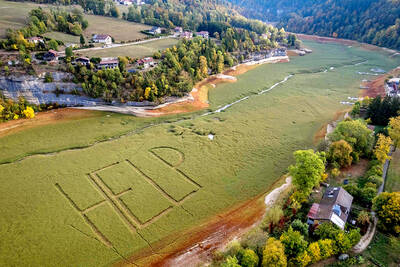
The picturesque Lac des Brenets between France and Switzerland has dried up after a record-breaking hot summer, leaving locals crying out for help to save the lake. Indeed, the words “HELP” and “SOS” have been scratched out in the weeds now flourishing on the exposed lake bed. The drought has ruined pleasure boat tourism, while some question whether the lake will ever return to enduring full health. “It’s absolutely heartbreaking,” said historian David Favre, who lives in Les Brenets. “As children, we used to spend all our summers swimming at the beach, having fun by the water, diving, jumping in and sometimes even
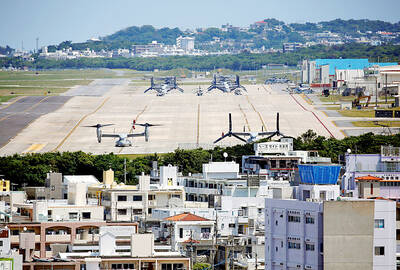
STRAIN ON TIES: The police arrested a 20-year-old man who matched the description of a suspect caught on CCTV leaving a hotel in Naha with the victim’s belongings A US Marine stationed on Japan’s southern island of Okinawa was arrested on suspicion of the murder of a Japanese woman, police said yesterday. The suspect “killed the 39-year-old woman at a hotel in Naha and stole her wallet on Saturday,” a local police spokesman said. US Ambassador George Glass posted on social media that he had spoken with Japan’s foreign ministry and Okinawa’s governor to offer “our sincere condolences and pledging full cooperation as the investigation continues.” Japanese Prime Minister Sanae Takaichi called the crime “exceptionally brutal and vicious” on X. The government has urged the US “to provide maximum cooperation
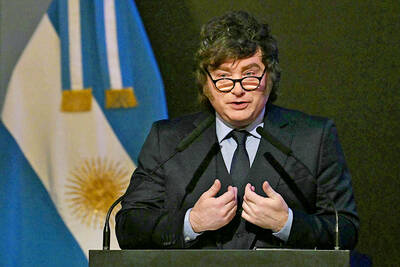
WARNING: Some analysts have expressed concern over what kind of investors the citizenship scheme would attract, saying it could bring in people of dubious origin Argentine President Javier Milei’s government on Friday said the country would offer citizenship to foreigners who invest at least US$350,000 in the country. Latin America’s third-largest economy lagged far behind Brazil and Mexico in the foreign direct investment stakes last year, according to the Organisation for Economic Co-operation and Development (OECD). Milei, a free-market radical, has slashed public spending, deregulated the economy and dismantled trade barriers in a bid to make Argentina more competitive and boost the Treasury’s dwindling dollar reserves. However, investors are still waiting for Argentina’s roller-coaster economy to “prove that what it’s doing will actually be sustainable over time,” economist
China’s influence in Latin America is now viewed more positively than that of the US, a major poll conducted in 17 Latin American countries showed on Friday. China overtook the US in terms of influence for the first time since the annual Latinobarometro survey began in 1995. It showed 57 percent of people in Latin America considering the US to be a positive influence, down from 60 percent in 2020. Meanwhile, China was considered a positive influence by 65 percent of respondents, a jump from 48 percent six years ago. Costa Rica and the Dominican Republic were the only countries in the region where


 RSS
RSS