

Ukraine’s economy is being crippled by intensifying Russian strikes hitting key sectors, and its GDP could slump by 1.5 points in 2026, Kyiv officials said on Saturday, warning of a “very difficult” winter ahead.
Russia, which devastated Ukraine’s energy sector during the course of 4.5 years of war, has since this summer stepped up a campaign of missiles and drones that Kyiv is struggling to intercept. These have severely restricted grain exports in the Black Sea — a crucial source of Kyiv’s revenue. The strikes have also targeted steel companies, another key sector, as well as supply chains — notably in the rail sector — and major warehouses.
“The economy is in the most difficult situation,” Ukrainian Prime Minister Sergiy Koretsky said during the annual Yalta European Strategy forum in Kyiv.
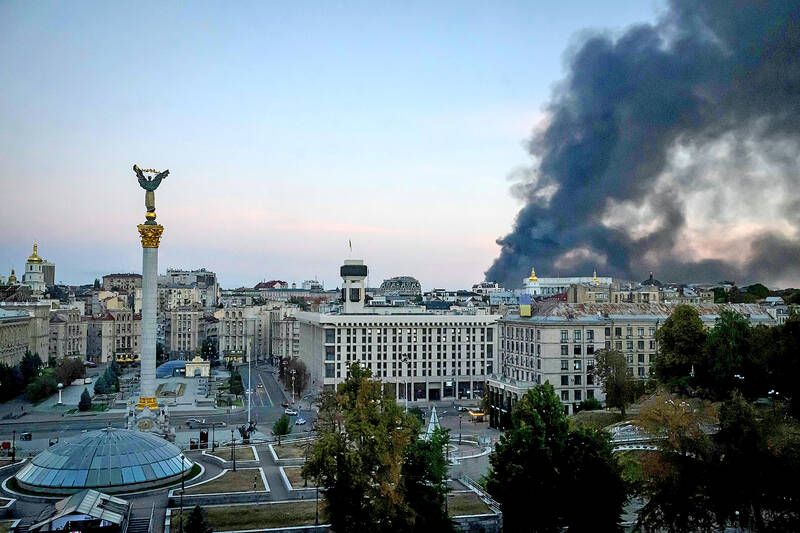
Photo: AFP
He said the intensity of the strikes and the level of destruction have increased.
“We anticipate a very difficult winter in terms of both critical infrastructure, which is being destroyed every day by Russian attacks, but also in terms of overall economic conditions in the country,” Ukrainian Minister of Economy and Environment Oleksandr Kravchenko said.
Kyiv estimates that “the total destruction of infrastructure and assets are likely to be close to US$10 billion” this year.
This destruction and the blockage of seaports are likely to reduce national GDP by 1.5 points, Kravchenko added, with some Western experts calling the situation “catastrophic.”
Roksolana Pidlasa, the head of the budget committee in Ukraine’s parliament, described a bleak outlook.
“It can get worse, but it’s already bad now,” she told the same forum.
“Russia specifically targets revenue-generating industries by attacking grain corridors, by attacking seaports and metallurgical plants,” she said at the same forum. “It is not something that you could reconstruct quickly.”
Ukraine’s largest steelworks, ArcelorMittal Kryvyi Rig, on Saturday said that a Russian missile strike killed two of its workers and damaged facilities.
Kyiv has also upped its retaliatory strikes on Russia, targeting oil facilities, factories and warehouses. Ukrainian President Volodymyr Zelenskiy hopes his US counterpart Donald Trump would pressure Russia to ensure Black Sea ports reopen and for a mutual suspension of strikes on energy sites. He warned of the risk of food crises in African and Asian countries, saying that Moscow was also unable to export its grain through the Black Sea. Both countries are key global suppliers of grain.
“At the very least, again, if peace is impossible from today ... we can at least resolve the issue of an energy truce, a food truce, food security; such decisions can be made,” he told the Kyiv forum this weekend.
Zelenskiy called on resolving these “now” and “not in winter.”
At the same time, Kyiv’s military spending is rising. In 2024 “one day of war costs 140 million US dollars per day, this year it costs 190 million dollars a day,” Pidlasa said.
Kyiv has had to start using international aid this year to even pay its soldiers’ wages, she said.
The release of about US$30 billion in international aid intended to finance this year’s budget deficit is conditional upon parliament passing draft laws demanded by Western countries, Koretsky said.
These include anti-corruption measures after Ukraine was hit by several large-scale graft scandals during the war with Russia. However, the Ukrainian parliament is struggling to approve suggested laws, which include unpopular measures such as imposing duties on parcels from abroad, intended to boost revenues.
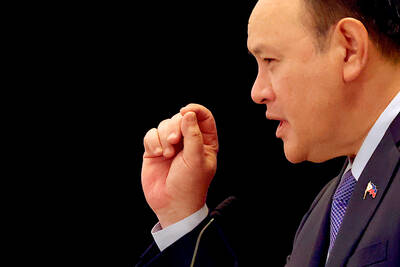
Philippine Secretary of National Defense Gilberto Teodoro Jr on Tuesday hit out at China at an international forum after a memo asserting Beijing’s position over their longstanding maritime dispute was delivered to him while he was speaking on stage. The unusual incident was captured on video at the Seoul Defense Dialogue as the secretary was responding to a question about “gray zone” coercion in the South China Sea. The video shows what appears to be a conference staffer placing it on the table next to him while speaking. “I have a note here, I think this is from China,” he said, describing
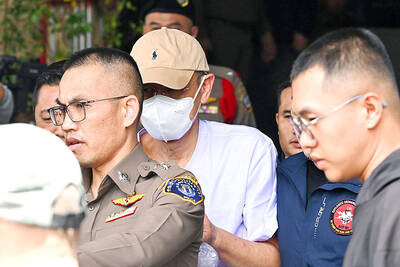
Thai police yesterday said that they arrested a senior Buddhist monk on suspicion of embezzling US$2.8 million intended for his monastery, alongside a suspected female accomplice he was having sex with. The case is the latest scandal to hit the clergy in Buddhist-majority Thailand after a sex and extortion case involving senior monks last year prompted public outrage and calls for greater scrutiny of temple finances. Phra Wachirayan Wi, the 66-year-old abbot of the 14th-century Wat Phutthaisawan in the ancient capital of Ayutthaya, was arrested on Thursday on charges including embezzlement and money laundering, lead police investigator Pattanasak Bupphasuwan said. A 47-year-old woman

SECRET FOOTAGE: A 17-year-old girl told British broadcaster Channel 4 that she had been approached by a man who covertly recorded her and their interaction Calls are growing louder in Europe for action against “pervert” smart glasses after secretly filmed footage of girls and women appeared online — with a petition in Britain demanding a ban on their sale. Anyone wearing smart glasses can take photos, film videos, listen to music, make phone calls, translate text or interact with an artificial intelligence (AI) assistant, with sales now hitting millions. The devices grabbed attention this summer after a marketing tie-up between Kylie Jenner, beauty mogul and member of the Kardashian dynasty, and tech giant Meta. Since smartphones are now embedded in daily life, “big tech” is
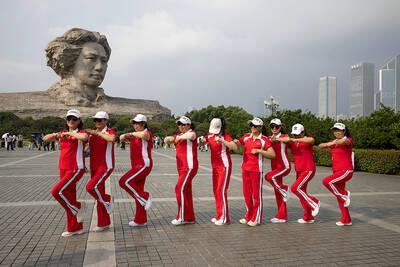
China yesterday marked half a century since the death of Mao Zedong (毛澤東), founder of the People’s Republic, who brought roughly one-quarter of the world’s population under communist rule and whose specter still haunts China’s future. Mao’s death on Sept. 9, 1976, at age 82, mourned by many and welcomed by some who suffered under his nearly three-decade rule, also hastened the end of the Cultural Revolution, a frenzied mass movement he launched in 1966. The party later condemned the Cultural Revolution as a grave error for which Mao bore primary responsibility, but still reveres him, saying his achievements outweigh his mistakes. Mao’s


 RSS
RSS