

Ontario Premier Doug Ford on Saturday answered US President Donald Trump’s “Lake America” decree with a billboard-sized message on the Canadian shoreline — “Lake Ontario. Now and Always” — as Canadian leaders met Trump’s move with ridicule rather than outrage.
Wearing a Canada national soccer team jersey, Ford unveiled the sign near Grimsby and posed for photographs. The message is repeated in French.
The display followed Trump’s executive order directing US federal agencies to call Lake Ontario “Lake America.” After months of tariffs, threats to make Canada the 51st US state and personal attacks on its leaders, the reaction in Canada has mixed defiance with mockery.
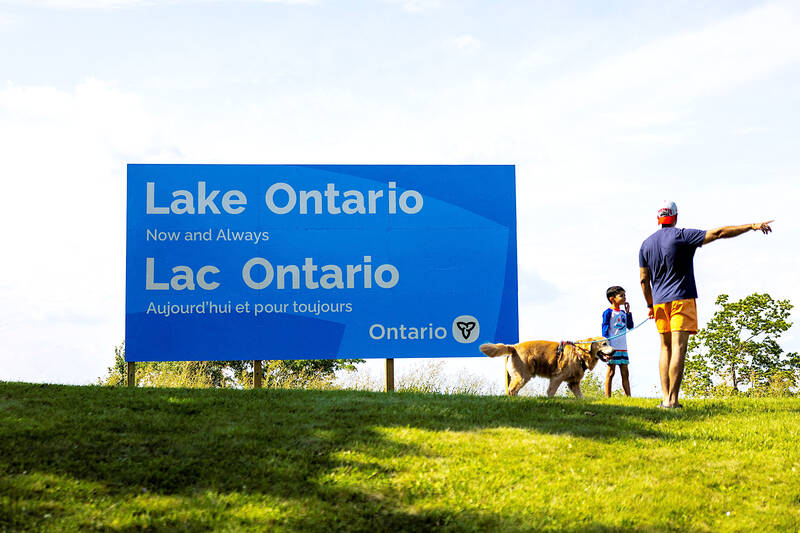
Photo: Reuters
Trump was trying to rename the lake, because Ontario and Canada were “standing up for ourselves,” Ford said, adding that the name would outlast the US president.
“Long after President Trump is gone, it will still be called Lake Ontario,” Ford said in a video posted on social media.
Manitoba Premier Wab Kinew compared Trump to an aging rock band trying to revive an old hit.
“You know when a rock band is really over the hill, and you see them like in a casino playing some song from like 50 years ago. I think that’s the part of Donald Trump’s presidency we’re at now. Like he thought they had a real hit, a real golden oldie, with the Gulf of Mexico,” Kinew said, referring to Trump’s executive order renaming the Gulf of Mexico the Gulf of America. “And he’s trying to bring back that, and he’s trying to play the hits for his base, but I think everybody here thinks it’s a little sad, and it’s not his best work.”
The mockery was not limited to politicians. Canadian historian Robert Bothwell was even more scathing.
“The greatest country on earth takes this moron seriously?” Bothwell asked.
However, he said the dispute was more serious than the jokes, adding that Trump’s broader aim was “to subordinate Canada and at best make it a colony, at worst absorb it into the United States.”
Nelson Wiseman, professor emeritus at the University of Toronto, said Trump “would like Canada to act like a vassal state, but it refuses to do so. That irritates him.”
The dispute comes as relations between the longtime allies worsen over trade. Negotiations collapsed last week, both governments accused the other of making late demands, and Canada announced retaliatory tariffs set to take effect next month.
Trump’s order also came amid an escalating war of words with Ford. In an interview earlier this week, Ford said former US president Ronald Reagan would be “throwing up” over Trump’s tariff policies and “disgusted with President Trump.”
Trump fired back by dismissing Ford’s comments as “bluster,” calling him Canadian Prime Minister Mark Carney’s “flunky” and mocking him as the “less charismatic, intelligent and overall unimpressive brother” of the late Toronto mayor Rob Ford.
Trump on Saturday continued promoting the new name, reposting a meme showing Canada geese with Trump-like blond hair firing rifles as they “protected” “Lake America.”
Trump has repeatedly used maps to make political points. A “Gulf of America” map was displayed for a time beside the Resolute Desk in the Oval Office, and Trump has posted images depicting Canada as part of the US or as the 51st state.
The name Lake Ontario comes from the Huron indigenous people’s word “oniatari:io,” which means “lake of shining waters.” The Canadian province of Ontario, founded in 1867, took its name from the lake.
Wendat Nation Grand Chief Pierre Picard, whose people historically lived from the St Lawrence Valley to the Great Lakes and whose language gave Lake Ontario its name, called Trump’s move an attempt to erase indigenous history.
“I want to tell him that it is unacceptable for us, as a nation, to have a president who can eradicate our history, our culture and our identity,” Picard said.
Canadian Prime Minister Mark Carney rejected the move, saying that the lake’s indigenous roots and the name predate both Canadian Confederation and the US Declaration of Independence. Trump cannot require Canada to adopt the new name.

A cross-party group of Japanese lawmakers, including one from Prime Minister Sanae Takaichi’s governing party, yesterday headed to Beijing to meet with Chinese officials for the first time since ties between the two Asian rivals deteriorated after Takaichi’s comment on Taiwan angered China. The group, which includes Gaku Hashimoto, a lawmaker of Takaichi’s governing Liberal Democratic Party and a former health and welfare vice minister, and a lawmaker each from two opposition parties Komeito and the Centrist Reform Alliance (CRA), is to meet with Chinese Communist Party officials during their visit through Thursday. “Communication has been severed in all areas and we
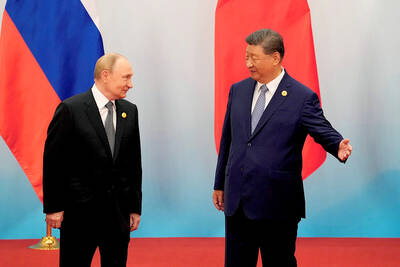
PLENARY SESSION: Although the SCO says it is ‘not an alliance directed against other states,’ Putin and Xi have repeatedly made anti-Western speeches during its summits Russian President Vladimir Putin and Chinese President Xi Jinping (習近平) are expected tomorrow in Kyrgyzstan for a two-day summit, also attended by Iran’s and India’s leaders, of a regional bloc seeking to be a counter-influence to the West. Around a dozen heads of states would head to the Kyrgyz capital, Bishkek, to mark 25 years of the Shanghai Cooperation Group (SCO). The group brings together Russia, China, India, Pakistan, Iran, four Central Asian countries and Moscow-allied Belarus. Putin and Xi have previously used SCO summits to promote their vision of a multipolar world and present a united front against the

A swarm of about 700 artificial intelligence (AI) agents created by OpenAI carried out last month’s hack of the open-source platform Hugging Face and in many cases tried to cover their tracks, a pair of reports into the breach said on Wednesday. The coordinated activity by AI agents — programs that run with minimal human supervision — and their attempts to hide it raise questions about how closely AI companies are monitoring tests of increasingly powerful models, and could add fuel to calls for tighter oversight. While some of the rogue behavior has been disclosed or alluded to previously, the two reports

FLEXIBLE EMPLOYMENT: With gig workers making up about 44% of China’s urban workforce, Zhang Dandan’s comments sparked public outrage The term “flexible employment” has gone viral in China after a prominent economics professor described gig work as a form of “welfare,” drawing widespread public anger and highlighting deep anxieties over job insecurity. Zhang Dandan (張丹丹), a professor of economics and deputy dean at Peking University’s National School of Development, made the remarks during a discussion on social protection for gig workers, on the popular financial show Let’s Talk (張丹丹) last week. She said that from the perspective of labor economics, “flexibility itself is a form of welfare.” While regular employees trade schedule flexibility for pensions and other benefits, flexible workers enjoy greater


 RSS
RSS