

An Ecuadoran court on Friday sentenced former Ecuadoran president Lenin Moreno to five years in prison for accepting bribes from a Chinese company that built the country’s biggest hydroelectric dam.
The prosecution said on social media that Moreno, who governed from 2017 to 2021, was among 20 people convicted in the case involving the construction of the Coca Codo Sinclair dam by China’s Sinohydro.
Moreno was vice-president under socialist former Ecuadoran president Rafael Correa at the time of the alleged corruption, between 2007 and 2013.

Photo: AFP
He succeeded Correa, with the latter’s backing, but later fell out with his mentor by shifting to the right and aligning himself more closely with the US.
Moreno has already announced plans to appeal the court’s ruling, which also saw his wife and other relatives sentenced to about three years in prison for complicity.
Prosecutors had sought a six-and-a-half-year prison term for Moreno.
The 73-year-old paraplegic, who served as the UN special envoy on disability issues, insisted on Friday after the ruling that he had never received “a single cent” from Sinohydro.
He blamed the case on “the Correa regime,” saying his former backer-turned-rival, who has also been convicted of corruption but lives in Belgium, “promised to take revenge on me.”
Prosecutors said Sinohydro paid bribes totaling US$76 million, about 4 percent of the cost of the hydroelectric project.

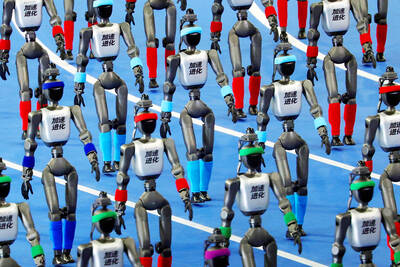
MAN VS MACHINE: The games could help improve hardware, but longer-term value depends on real-world problem-solving, an executive at a tech firm said China’s humanoid robots have shown they can run quicker than the fastest humans. Now comes the real test: Can they also handle packaging and warehouse operations while reliably performing precision tasks like connecting cables designed to evaluate their ability to work like humans in less flashy jobs? The five-day World Humanoid Robot Games, which began in Beijing on Saturday, combines events modeled on human sports with those designed to test the robots in simulated factories, restaurants, offices and in emergency situations. Heavily promoted in Chinese state media, the games, held at Beijing’s National Speed Skating Oval and which run through Wednesday, feature 51

A cross-party group of Japanese lawmakers, including one from Prime Minister Sanae Takaichi’s governing party, yesterday headed to Beijing to meet with Chinese officials for the first time since ties between the two Asian rivals deteriorated after Takaichi’s comment on Taiwan angered China. The group, which includes Gaku Hashimoto, a lawmaker of Takaichi’s governing Liberal Democratic Party and a former health and welfare vice minister, and a lawmaker each from two opposition parties Komeito and the Centrist Reform Alliance (CRA), is to meet with Chinese Communist Party officials during their visit through Thursday. “Communication has been severed in all areas and we

FLEXIBLE EMPLOYMENT: With gig workers making up about 44% of China’s urban workforce, Zhang Dandan’s comments sparked public outrage The term “flexible employment” has gone viral in China after a prominent economics professor described gig work as a form of “welfare,” drawing widespread public anger and highlighting deep anxieties over job insecurity. Zhang Dandan (張丹丹), a professor of economics and deputy dean at Peking University’s National School of Development, made the remarks during a discussion on social protection for gig workers, on the popular financial show Let’s Talk (張丹丹) last week. She said that from the perspective of labor economics, “flexibility itself is a form of welfare.” While regular employees trade schedule flexibility for pensions and other benefits, flexible workers enjoy greater

A swarm of about 700 artificial intelligence (AI) agents created by OpenAI carried out last month’s hack of the open-source platform Hugging Face and in many cases tried to cover their tracks, a pair of reports into the breach said on Wednesday. The coordinated activity by AI agents — programs that run with minimal human supervision — and their attempts to hide it raise questions about how closely AI companies are monitoring tests of increasingly powerful models, and could add fuel to calls for tighter oversight. While some of the rogue behavior has been disclosed or alluded to previously, the two reports


 RSS
RSS