

A few crumbling concrete blocks in an overgrown field are all that remains visible of what was once a sprawling Nazi forced labor complex around the Austrian town of Leobersdorf.
Now, plans to build a business park on the site, including a cold storage warehouse and branch of the discount supermarket chain Lidl, have sparked anger in the Alpine nation, which long neglected to address its Nazi past.
“For me, it’s a sad feeling, because a place burdened by history is being built over, sacrificed to the economy,” said Erich Strobl, head of a local campaign to preserve part of the site.

Photo: AFP
After Nazi Germany annexed Austria in 1938, the Weinberglager complex was used for thousands of prisoners of war and forced laborers. It later included the Hirtenberg subcamp of the Mauthausen concentration camp — Austria’s second-largest women’s camp.
About 400 women, mainly from the Soviet Union, but also from Italy and Poland, were imprisoned at the Hirtenberg subcamp between September 1944 and April 1945, and forced to manufacture infantry munitions at a nearby factory complex.
Although some factory ruins survive, the camp barracks and most other structures were gradually demolished, repurposed or destroyed after the war.
However, Bertrand Perz, a historian specializing in the Mauthausen camp, said the Hirtenberg site remains “historically important,” partly because female “prisoners in Mauthausen have been marginalized in the culture of remembrance.”
Plans to build a business park on the plot about 40km south of Vienna, including on land that once formed part of the concentration camp, were first revealed in 2024.
Archeological investigations have identified surviving traces of the former camp complex, but Austria’s Federal Monuments Office concluded that the remains were “not sufficient” for monument protection.
With the bulldozers now moving in, activists have renewed their calls for the site to be preserved.
“A former concentration camp must not be built over with new structures,” the International Mauthausen Committee said.
Standing in front of the site, where gray columns already rise from the ground, Mauthausen Committee Austria board member Josef Pumberger said he felt “grief, anger, rage, that something like this can happen in Austria in the year 2026.”
The project has also attracted controversy, because the land was previously owned by Leobersdorf Mayor Andreas Ramharter, who sold it in 2022 and 2023 for more than 15 million euros (US$17.46 million), according to local media reports.
Austrian company TRA LEO GmbH & Co KG, which bought the plot, said it had offered to support the creation of a memorial on the site.
Lidl confirmed plans to open a store in the planned business park, but said it would not be directly “on the site of the former concentration camp, but on an adjacent plot of land”.
In the aftermath of World War II, Austria presented itself as a victim of the Nazis, ignoring the complicity of many Austrians.
It was only from the late 1980s that the country where Adolf Hitler was born began to examine its responsibility in the Holocaust.
Perz said a debate like the one today around the Hirtenberg site “would have been impossible in the 1980s,” adding that there is now “more sensitivity” toward former Nazi sites.
However, in contemporary Austria, demands for remembrance are increasingly clashing with “the opposite tendency, namely to say: ‘Now this really has to stop,’” he said.
A stele monument was erected in 2024 to commemorate the victims of the Hirtenberg camp, but for Pumberger, that is not enough.
“It is very important to have tangible evidence of the buildings in which the Nazis imprisoned people, tortured them, killed them,” he said. “Otherwise it becomes a virtual act of remembrance, or one that exists only in books and photos and films.”

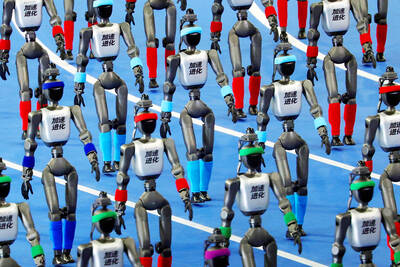
MAN VS MACHINE: The games could help improve hardware, but longer-term value depends on real-world problem-solving, an executive at a tech firm said China’s humanoid robots have shown they can run quicker than the fastest humans. Now comes the real test: Can they also handle packaging and warehouse operations while reliably performing precision tasks like connecting cables designed to evaluate their ability to work like humans in less flashy jobs? The five-day World Humanoid Robot Games, which began in Beijing on Saturday, combines events modeled on human sports with those designed to test the robots in simulated factories, restaurants, offices and in emergency situations. Heavily promoted in Chinese state media, the games, held at Beijing’s National Speed Skating Oval and which run through Wednesday, feature 51

A cross-party group of Japanese lawmakers, including one from Prime Minister Sanae Takaichi’s governing party, yesterday headed to Beijing to meet with Chinese officials for the first time since ties between the two Asian rivals deteriorated after Takaichi’s comment on Taiwan angered China. The group, which includes Gaku Hashimoto, a lawmaker of Takaichi’s governing Liberal Democratic Party and a former health and welfare vice minister, and a lawmaker each from two opposition parties Komeito and the Centrist Reform Alliance (CRA), is to meet with Chinese Communist Party officials during their visit through Thursday. “Communication has been severed in all areas and we

FLEXIBLE EMPLOYMENT: With gig workers making up about 44% of China’s urban workforce, Zhang Dandan’s comments sparked public outrage The term “flexible employment” has gone viral in China after a prominent economics professor described gig work as a form of “welfare,” drawing widespread public anger and highlighting deep anxieties over job insecurity. Zhang Dandan (張丹丹), a professor of economics and deputy dean at Peking University’s National School of Development, made the remarks during a discussion on social protection for gig workers, on the popular financial show Let’s Talk (張丹丹) last week. She said that from the perspective of labor economics, “flexibility itself is a form of welfare.” While regular employees trade schedule flexibility for pensions and other benefits, flexible workers enjoy greater

A swarm of about 700 artificial intelligence (AI) agents created by OpenAI carried out last month’s hack of the open-source platform Hugging Face and in many cases tried to cover their tracks, a pair of reports into the breach said on Wednesday. The coordinated activity by AI agents — programs that run with minimal human supervision — and their attempts to hide it raise questions about how closely AI companies are monitoring tests of increasingly powerful models, and could add fuel to calls for tighter oversight. While some of the rogue behavior has been disclosed or alluded to previously, the two reports


 RSS
RSS