

Iran and Oman are discussing a temporary transit corridor and mine-clearing effort for the Strait of Hormuz, but Tehran yesterday said the vital waterway would not be reopened unless the US ends the war.
Washington has announced fresh sanctions aimed at pressuring Iran into submission, with US Secretary of the Treasury Scott Bessent threatening the Islamic republic with “economic asphyxiation.”
During talks in Tehran, foreign ministers from Iran and Oman discussed a “phased framework” that included setting up a “joint temporary navigational corridor through the Strait of Hormuz and an agreement to implement a joint project to clear the Strait of mines,” according to a statement.
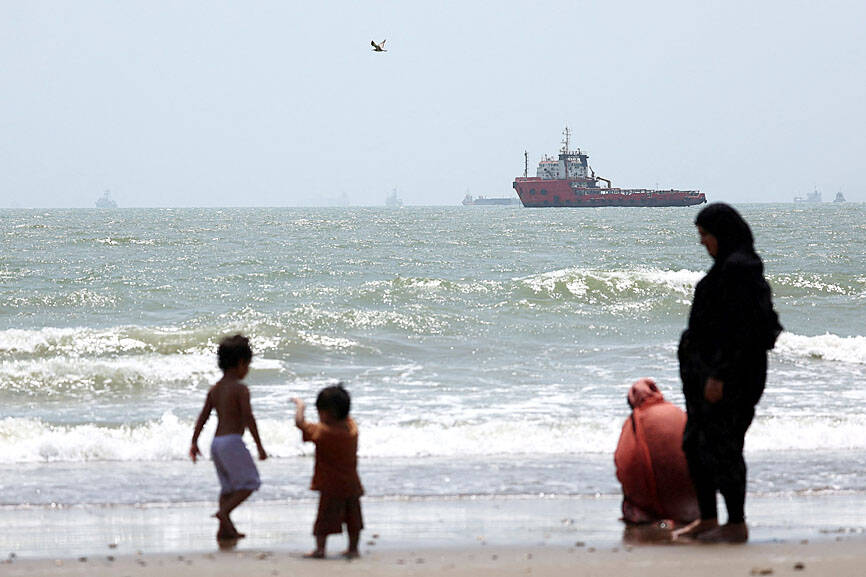
Photo: Majid Asgaripour, West Asia News Agency via Reuters
The two countries, both coastal states bordering the strait, have sought to hammer out a plan to regulate transit through it, as laid out in a June US-Iran memorandum of understanding.
Iranian Minister of Foreign Affairs Abbas Araghchi on Tuesday said that the proposed framework is “case in point” showing how his country’s “commitment to peace and stability is matched by steadfast diplomacy with our neighbors.”
Nearly six months after the US and Israel went to war against Iran, traffic through the Hormuz Strait remains largely paralyzed, disrupting global oil markets.
Tehran has blockaded the crucial waterway — which normally carries about one-fifth of the world’s oil and liquefied natural gas exports — while Washington imposed a naval counter-blockade on Iranian ports.
Iranian Deputy Minister of Foreign Affairs Kazem Gharibabadi yesterday said that no military vessel would be allowed to pass through the Hormuz Strait.
“We closed the Strait of Hormuz before the United States imposed an economic blockade because the United States failed to fulfil its commitments under the memorandum of understanding,” the state-run Islamic Republic News Agency quoted Gharibabadi as saying.
No military vessels from any country would be allowed through the strait, while Iranian authorities would monitor commercial vessels seeking to cross it, Gharibabadi said.
“Before any action is taken to reopen the Strait of Hormuz, the United States must fully implement all of the commitments it has violated,” he said, calling on the US to end the war, lift its blockade and resolve the situation in Yemen.
US President Donald Trump previously said on Truth Social that “all mines have been removed and/or detonated from within the International Waters of the Strait of Hormuz,” citing the US Navy.
However, Gharibabadi said such claims were “propaganda deception,” adding that Iran would target US minesweepers that entered the area.
Meanwhile, Israeli Prime Minister Benjamin Netanyahu late on Tuesday said a diplomatic deal was not possible with the “savages” who rule Iran as he hailed Trump’s new campaign of economic pressure.
Recounting a meeting with Trump, Netanyahu said they had discussed the possibility of diplomacy with the Islamic republic.
“I doubt, however, that an agreement can be reached with that group there, with those savages,” Netanyahu told an event at an Israeli settlement in the occupied West Bank.
Trump on Monday declared “economic D-Day” aimed at destroying Iran’s economy, which has already endured years of sanctions, but he has shown reluctance to resume a full-scale war even as he grows frustrated that Tehran would not accept his demands.
Netanyahu voiced support for Trump’s economic pressure campaign and said he had told Trump of this “third option,” while praising the US president for pursuing it in “a very, very, very strong way.”
Trump had chosen to target not just Iran itself, but decided on “tightening the siege on those who assist this regime, this terrible dictatorship. This is very important,” Netanyahu said.
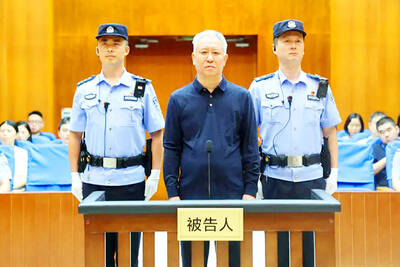
HELD ACCOUNTABLE: A total of 56 people were handed prison sentences, with terms for senior executives ranging from six to 18 years in jail, Xinhua reported China yesterday sentenced the founder of embattled property giant Evergrande to life in prison and fined the group more than US$2 billion for offenses including fraud, five years after a high-profile default. Evergrande Group was once the face of Chinese real estate, surfing a decades-long property boom as it peddled home-ownership dreams. However, its access to credit dramatically narrowed when the government introduced curbs on excessive borrowing and speculation. The company defaulted in 2021 after struggling to repay creditors. A court in southern China fined the firm and its real-estate arm a total of 15.82 billion yuan (US$2.35 billion). It issued a life sentence

MAN VS MACHINE: The games could help improve hardware, but longer-term value depends on real-world problem-solving, an executive at a tech firm said China’s humanoid robots have shown they can run quicker than the fastest humans. Now comes the real test: Can they also handle packaging and warehouse operations while reliably performing precision tasks like connecting cables designed to evaluate their ability to work like humans in less flashy jobs? The five-day World Humanoid Robot Games, which began in Beijing on Saturday, combines events modeled on human sports with those designed to test the robots in simulated factories, restaurants, offices and in emergency situations. Heavily promoted in Chinese state media, the games, held at Beijing’s National Speed Skating Oval and which run through Wednesday, feature 51

A cross-party group of Japanese lawmakers, including one from Prime Minister Sanae Takaichi’s governing party, yesterday headed to Beijing to meet with Chinese officials for the first time since ties between the two Asian rivals deteriorated after Takaichi’s comment on Taiwan angered China. The group, which includes Gaku Hashimoto, a lawmaker of Takaichi’s governing Liberal Democratic Party and a former health and welfare vice minister, and a lawmaker each from two opposition parties Komeito and the Centrist Reform Alliance (CRA), is to meet with Chinese Communist Party officials during their visit through Thursday. “Communication has been severed in all areas and we

FLEXIBLE EMPLOYMENT: With gig workers making up about 44% of China’s urban workforce, Zhang Dandan’s comments sparked public outrage The term “flexible employment” has gone viral in China after a prominent economics professor described gig work as a form of “welfare,” drawing widespread public anger and highlighting deep anxieties over job insecurity. Zhang Dandan (張丹丹), a professor of economics and deputy dean at Peking University’s National School of Development, made the remarks during a discussion on social protection for gig workers, on the popular financial show Let’s Talk (張丹丹) last week. She said that from the perspective of labor economics, “flexibility itself is a form of welfare.” While regular employees trade schedule flexibility for pensions and other benefits, flexible workers enjoy greater


 RSS
RSS