

Frail and malnourished children and women lay on rows of hospital beds, their bodies bearing the scars of six months of captivity deep in the Nigerian bush.
The patients were among 163 kidnapping victims rescued this month in the Kainji Lake National Park forest after their village, Woro, was attacked by suspected jihadists.
The government said that 308 people were freed in what it called the largest single-day rescue operation.
Photo: Reuters
However, at the Kwara State University Teaching Hospital in Ilorin, a long road to recovery lay ahead.
A child lay beneath a blue sheet, hooked to a respirator, with doctors and nurses clustered around the bed.
A sobbing girl, no more than six years old, sat alone on a bed, her family yet to visit.
“They are all responding to treatments,” a nurse said, holding the tiny hand of a young boy about four years old. “Some of them still need blood.”
Suspected jihadists attacked Woro, near the border with Benin, in February, killing at least 165 people and kidnapping scores.
Abductions have become a key moneymaker for criminal groups in Nigeria, especially among jihadists and non-ideological bandit groups across the north and center of the country.
The victims were kept at a camp along with more than 100 others seized from other villages, including Kasuwan Daji and Konkoso, both in Niger State, Woro village head Umar Bio Salihu told reporters.
Thirteen people from Woro died in captivity and 13 more remain in captivity, he said.
Interviews with victims in the hospital were brief and stymied by officials who repeatedly bounced journalists between different offices to seek approval.
The government has touted the rescue of the Woro villagers as a major success in its campaign, but it still faces a crisis, as kidnappings have become so rampant across the country that they have become a multi-million-dollar industry, according to SBM Intelligence, a Lagos-based consultancy.
“We thank God we are out,” one gaunt victim, Hajara, said. “I do not wish that on even my enemies. It was like we just came back from hellfire.”
While being held by the gunmen, the captives were fed tuwo, a thick, porridge-like meal made from guinea corn, and a “soup” made from a mixture of river water and salt. When they were lucky, their captors gave them seasoning cubes.
Occasionally they got beef, from cattle they assume was rustled.
“When they came they were quite bad ... severe malnutrition, lots of skin diseases, some had fractures, some mothers have just delivered,” the hospital chief medical director, Ahmed Bola Abdulkadir, told reporters, adding that many need care for “psychological trauma.”
While in captivity, those who went to relieve themselves without the guards’ permission were beaten, said 25-year-old nurse Amira Salihu, whose two brothers were killed during the February attack.
The daughter of the Woro village head’s gentle smile belied her harrowing experience as she spoke from a hotel — guarded by police — where some freed abductees were staying.
More than a dozen women went into labor while in captivity, Amira Salihu said.
With little visibility — battery-powered torches being the only sources of light — she helped to deliver the babies using her bare hands.
“I borrowed a razor blade to cut the placenta,” she said.
At the hotel, scores of the victims, mostly young children, noisily gathered around plastic tables in a hall for lunch.
“I am happy seeing them like this,” said Umar Bio Salihu, the village head.
He has been shuttling between Woro and Ilorin, about 200km away, to check on the victims while they recover under government care in the state capital.
Despite the scale of the tragedy, Woro is coming back to life, a resident Isah Mogaji told reporters, with the village market in full swing.
“The community is very happy now,” village head Salihu said. “They are waiting to receive their people.”
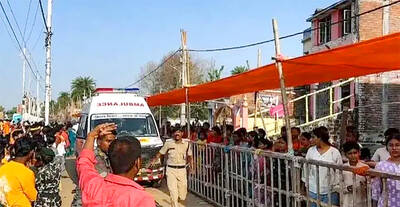
TWIN DISASTERS: Authorities are investigating the cause of the stampede in Bihar that killed seven people and the fire at a hotel in West Bengal that also killed seven A deadly stampede yesterday broke out at a Hindu temple in eastern India’s Bihar state, hours after a fire swept through a hotel housing pilgrims in West Bengal state. Seven people were killed and more than a dozen injured in the stampede, while the blaze left at least seven people dead and several others critically injured, police said. The incident in Bihar occurred near Ashok Dham Temple in Lakhisarai District, as thousands of devotees gathered to offer prayers on the third Monday of Shravan. The period, which usually falls between July and August, is dedicated to the worship of Hindu god Lord Shiva

US President Donald Trump’s war against Iran is stretching the limits of US aircraft carriers and leaving the western Pacific without one of the key US warships as China shows more signs of aggression. The USS George Washington is departing the Pacific and expected to replace the USS Abraham Lincoln in the Middle East amid growing concerns about mental health and supply issues aboard the long-deployed carrier. The Lincoln has had its time at sea extended from its original May return date to support operations against Iran. The lack of a US carrier in the Pacific might be short-lived if

‘KOKUSHOBI’: Japan has recorded its first-ever ‘cruelly hot day,’ a new category introduced this year by the Japan Meteorological Agency for temperatures above 40°C In a potato field in Yanggu County, 130km northeast of Seoul, Lee Sang-hyuk dug into the soil and found nothing worth saving. A week earlier the crop, in Gangwon Province, had looked fine. Now the potatoes came up soft and collapsing, “like boiled potatoes,” spoiled by heat that had turned the ground into something closer to an oven. “It’s not just one or two fields like this. How can I even put it into words? It’s so upsetting,” he told local Seoul Broadcasting System. His ruined harvest is one thread in a punishing summer across east Asia, as record heat

When food safety inspectors raided a Mumbai dessert parlor famed for its ice cream sandwiches last month, they found rats, houseflies and expired flavoring agents. At another beloved restaurant known for slow-cooked mutton and beef stews, they discovered meat stored in filthy containers, greasy floors and open windows that could let in insects and crows. Both eateries were ordered shut in the toughest crackdown in years on restaurants in the megacity of more than 20 million people. Residents of India’s financial capital are fiercely protective of their food culture, but many have welcomed the closure of some of the best-known establishments over


 RSS
RSS