

The Djidji Ayokwe, a sacred “talking drum” which was looted by French colonial troops in 1916 and taken to France, on Friday arrived back in its home village in Ivory Coast.
The ceremony, on Ivory Coast’s national independence day holiday, was the first time today’s Ivorians were able to see it.
The imposing wooden drum, more than 3m long and weighing 430kg, was used by the Ebrie tribe to transmit messages.
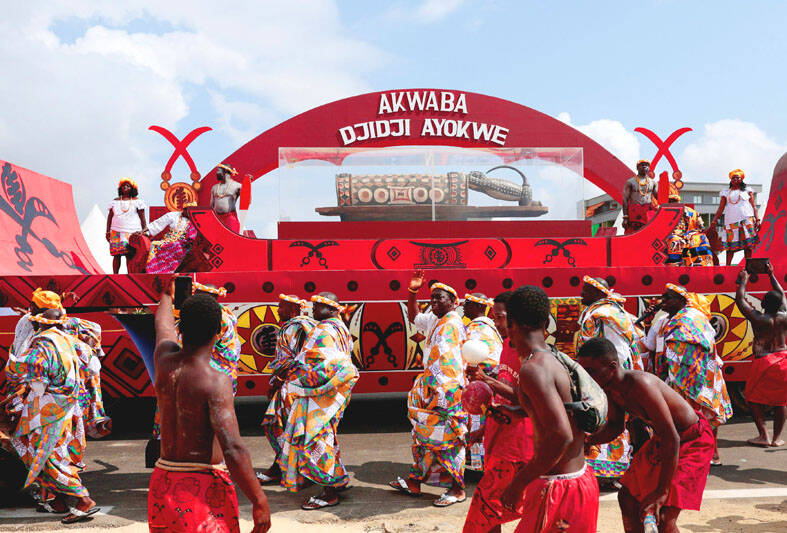
Photo: Reuters
It was officially handed over in February and arrived back in Ivory Coast in March aboard a specially chartered plane, but was not taken out of its huge wooden crate.
Ivory Coast had asked in late 2018 for the return of the Djidji Ayokwe among 148 works of art taken during the colonial period. It is one of hundreds of stolen artifacts Paris is preparing to send back to Africa, aided by the approval in May of a new French law.
On Friday, it was carried in a military parade through the Yopougon District of Abidjan, before continuing on to the village of Adjame, where it was made.
The black, white and red instrument was transported in a glass-fronted case on a large, decorated float and welcomed by Ivorian Minister of Culture Francoise Remarck, traditional leaders and hundreds of local residents.
A dozen people performed a libation ceremony, pouring a few drops of liquid onto the ground as an offering to their ancestors.
“A nation cannot develop if it doesn’t preserve its memory and promote its heritage,” Adjame Mayor Farikou Soumahoro said, adding that he felt “deep emotion and great pride.”
“We want to see the drum with our own eyes so we can truly believe it belongs to us,” 69-year-old villager Jacqueline Akrebie said.
Traditional leader Cyriaque Ahoure, 63, said he had come to share a moment of “great joy, when we remember our ancestors.”
The talking drum is much more than a musical instrument. It was used by the Ebrie community to warn of danger — particularly from colonialists, call to war or summon villagers to ceremonies.
It was seized by the French colonial authorities in 1916 before being shipped to Europe in 1929 and exhibited in Paris for decades.
It is due to go on display at the Museum of Civilizations in Abidjan, which has been specially renovated.
Senegal and Benin have also asked for the repatriation of their treasures.
The return of cultural artifacts taken from former colonies in Africa and elsewhere has become a sensitive issue, with museums, institutions and collectors in Europe and the US facing pressure to give them back.
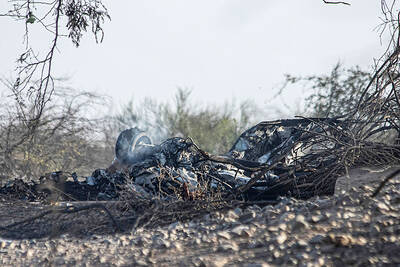
SIGHTSEEING GONE WRONG: The tourists were on their way to view the Nazca Lines’ mysterious geometric shapes and animal outlines, which are best viewed from the air A small plane carrying foreign tourists to view Peru’s famed Nazca Lines archeological site crashed on Saturday, killing all 13 people on board, police said. Seven Italians, two Germans and two Spaniards were killed, along with two crew members, a Peru Ministry of Transportation and Communications spokesperson said. The incident occurred shortly after 1pm after the Cessna 208 Caravan took off from the airport in Pisco, about 240km south of Lima. “We have information that 11 passengers and two crew members have died,” Police Major Jorge Andrade said. “Given the severity of the accident, there are no survivors. We have recovered four

Beijing has quietly confirmed the deaths of two Chinese sailors in a collision in the contested South China Sea, according to government statements nearly a year after the incident. In August last year, a China Coast Guard ship collided bow first with a Chinese naval destroyer while chasing a Philippine patrol boat near the disputed Scarborough Shoal (Huangyan Island, 黃岩島), video footage released by Manila showed. A China Coast Guard spokesperson confirmed at the time that there had been a confrontation, but did not mention the collision, nor injuries or deaths. The Chinese People’s Armed Police Force said on social media on Wednesday

MULTIPLE FACTORS: Infection worries or concerns about violence are fueling a secondary crisis as the already severe maternity mortality rate grows steeper Esther Lutula stopped going for prenatal checkups shortly after this year’s Ebola outbreak was declared in the eastern Democratic Republic of the Congo. Midway into her pregnancy, the 26-year-old feared being put into isolation simply for having a fever, a common misconception. “That’s why I’m waiting until the disease is no longer widespread,” she said from her home in Bunia, the epicenter of the outbreak declared in May. That could be a deadly mistake. Maternal mortality across Ituri province doubled as news of the outbreak spread, with about six women dying each week due to childbirth complications, said Noemi Dalmonte, deputy country representative

South Korean police yesterday raided the Starbucks national headquarters, the chain’s local operator told reporters, following allegations that an advertising campaign defamed activists slain in 1980 pro-democracy protests. Seoul-based Starbucks Korea caused an uproar this year when it launched a “Tank Day” promotion on May 18, touting a new line of capacious tumblers for its coffee beverages. The date marked the anniversary of the 1980 Gwangju pro-democracy uprising, when at least 165 civilians were killed as a military dictatorship rolled tanks out onto the streets. The chain was accused of trivializing the nation’s landmark protest movement and insulting the dead, remembered as martyrs


 RSS
RSS