

Deep inside the carcass of a disused turboprop aircraft, engineer Jonathan Beck squeezes between rows of tanks as he demonstrates how his French start-up plans to challenge aging Canadair water-bombers in combatting European wildfires.
From the birthplace of Concorde to the laptops of a retired general in southern France or an architect in Belgium, designs for new or converted water-bombers have gained momentum after nearly 500,000 hectares burned across Europe this year.
A parliamentary panel last year warned that France’s existing fleet of aerial firefighters faced a “major crisis” and called for European alternatives to the rugged water-scooping Canadairs, which have dominated the market for decades.
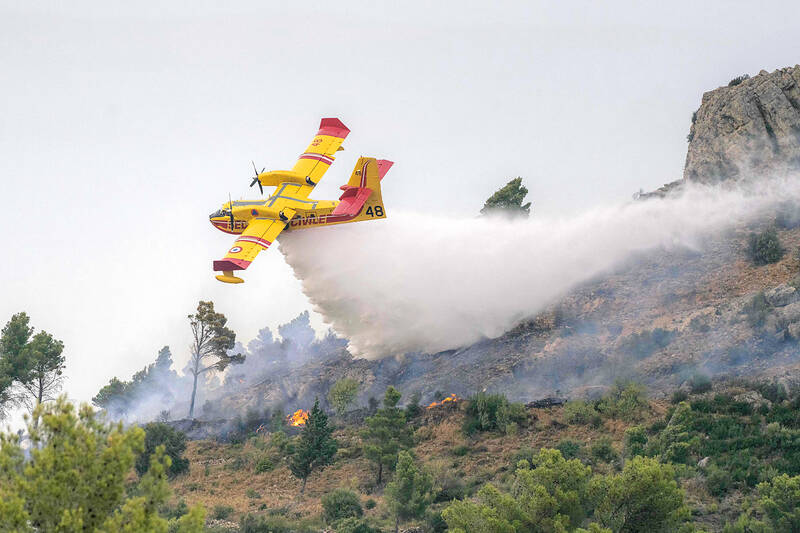
Photo: AFP
At first glance, the task looks daunting. A water-scooper is partly a seaplane, the art of which has eroded over the years.
“We will have 8 tonnes of water inside this aircraft,” said former Airbus engineer Beck, who heads design at Positive Aviation, pointing to Y-shaped pipes that would draw water from new floats designed to skim over lakes or sea.
The Toulouse-based start-up is using the dismembered ATR-72 fuselage as an early demonstrator or testbed, and giving a new lease of life to the historic Hangar 16 that spawned Concorde.
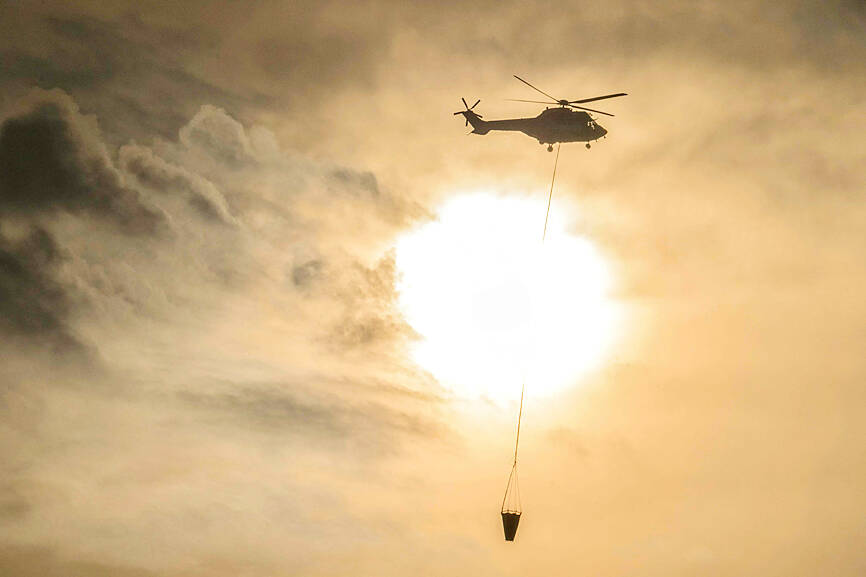
Photo: AFP
A few miles away, Kepplair is receiving an ATR-72 to test its vision of a ground-loaded tanker to replace Canada’s veteran Dash-8 on pre-emptive patrols to tackle initial outbreaks.
“It’s the difference between an uncontrollable fire and one that is halted quickly,” Kepplair founder David Joubert said.
Europe’s last serious effort to match Canadair by Germany’s Dornier and Italy’s Aeritalia in the 1980s, Advanced Amphibious Aircraft (AAA), never left the drawing board due to cost.
“Western nations ... have lost their skills in professional seaplane design since the 1950s or even World War II,” said former AAA project chief Elmar Welczek, a German professor widely seen as a leading expert in the mainly forgotten field of water flying.
Before they can quench a single flame, would-be water-bombers must scoop up significant amounts of capital to fund the research and development, certification tests and factories needed.
“What I think people underestimate is the time to go from design to delivery,” said John Boag, CEO of top private Canadair operator Avincis.
Estimates of development costs by entrepreneurs run from tens of millions for a simple conversion to US$1 billion for a new plane and analysts warn that could go far higher.
Positive Aviation hopes to tap a market for converting second-hand planes and be ready for 2028, company president Laurent Schmitt said.
It has a provisional order for 10 planes from US-based Bridger Aerospace.
Kepplair is raising a new round of funding and aims to start deliveries next year, Joubert said.
At least three other firms are touting even bolder plans to design and build planes from scratch, while so far giving few details in public about their backers.
The most prominent so far is French start-up HYNAERO, which announced Latecoere — a pioneer of early boat planes and now an aerostructures supplier — as a provisional partner last week.
It says its Fregate-F100 scooper plane would hold 10 tonnes of water and cost the same as a Canadair — about US$80 million with support — but be twice as efficient in fighting fires.
In Italy, 19-01 Holding has been promoting since 2011 what it calls an integrated firefighting and emergency-response system centered on a new amphibious plane, WF-X.
CEO Renato Sacchetti said assembly would start in Italy from 2031, adding that it would have entirely private funding worth 1.2 billion euros (US$1.38 billion), but declined to give details.
In Belgium, the amphibious Seagle is the brainchild of Gaetan du Four, an architect who aims to partner with industrial groups. He is candid about financial and industrial challenges.
“We are looking at the middle of next decade because we have to get funding. But I don’t think any other [new] plane will fly before then,” he said.
Start-ups must also compete with a new version of the Canadair, which resumed production this year subject to safety approval, after an 11-year gap.
Deliveries of the DHC-515 have been delayed three years to 2028, but owner De Havilland Canada said alternatives carry more risk.
“It’s a lot of years and a lot of engineering,” said Neil Sweeney, its corporate affairs vice president.
Even so, Europe’s aspiring water-bombers see a window of support as politicians debate firefighting capacity.
“What worries me is that in four weeks’ time, nobody will talk about it, either media or politicians,” Schmitt said.
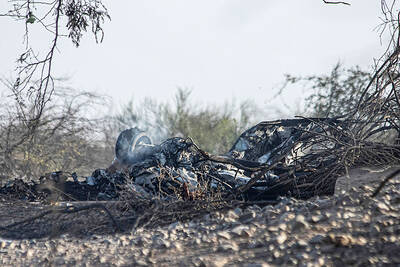
SIGHTSEEING GONE WRONG: The tourists were on their way to view the Nazca Lines’ mysterious geometric shapes and animal outlines, which are best viewed from the air A small plane carrying foreign tourists to view Peru’s famed Nazca Lines archeological site crashed on Saturday, killing all 13 people on board, police said. Seven Italians, two Germans and two Spaniards were killed, along with two crew members, a Peru Ministry of Transportation and Communications spokesperson said. The incident occurred shortly after 1pm after the Cessna 208 Caravan took off from the airport in Pisco, about 240km south of Lima. “We have information that 11 passengers and two crew members have died,” Police Major Jorge Andrade said. “Given the severity of the accident, there are no survivors. We have recovered four
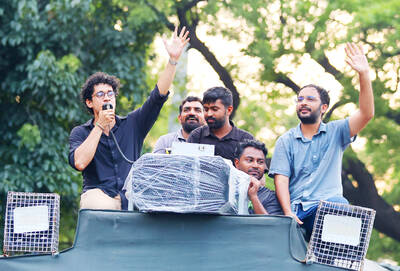
FOR ACCOUNTABILITY: It plans to travel across the country to hear young people’s concerns, as those ‘at the grassroots face a lot of issues and nobody hears them out’ The Cockroach Janta Party (CJP), which led India’s biggest student protests in years, wants to build a nationwide movement to hold the government accountable for its promises to young people, one of its senior members said. The group is seeking to create a grassroots organization with workers in every district, party spokesperson Saurav Das, 27, said on Friday. There are no immediate plans to register as a political party, Das said. Instead, it plans to travel across the country, hold public assemblies in villages to hear young people’s concerns, and demand greater government accountability on issues including unemployment, inflation and food security. “The

MULTIPLE FACTORS: Infection worries or concerns about violence are fueling a secondary crisis as the already severe maternity mortality rate grows steeper Esther Lutula stopped going for prenatal checkups shortly after this year’s Ebola outbreak was declared in the eastern Democratic Republic of the Congo. Midway into her pregnancy, the 26-year-old feared being put into isolation simply for having a fever, a common misconception. “That’s why I’m waiting until the disease is no longer widespread,” she said from her home in Bunia, the epicenter of the outbreak declared in May. That could be a deadly mistake. Maternal mortality across Ituri province doubled as news of the outbreak spread, with about six women dying each week due to childbirth complications, said Noemi Dalmonte, deputy country representative

South Korean police yesterday raided the Starbucks national headquarters, the chain’s local operator told reporters, following allegations that an advertising campaign defamed activists slain in 1980 pro-democracy protests. Seoul-based Starbucks Korea caused an uproar this year when it launched a “Tank Day” promotion on May 18, touting a new line of capacious tumblers for its coffee beverages. The date marked the anniversary of the 1980 Gwangju pro-democracy uprising, when at least 165 civilians were killed as a military dictatorship rolled tanks out onto the streets. The chain was accused of trivializing the nation’s landmark protest movement and insulting the dead, remembered as martyrs


 RSS
RSS