

A perfect result at a top mathematics contest used to be the preserve of a handful of bright young minds each year, but for the first time, artificial intelligence (AI) has also scored full marks.
Two Chinese tech companies, Huawei and Xiaohongshu, said that their AI models each achieved 100 percent on the questions given to human hopefuls at this month’s International Mathematical Olympiad (IMO).
They were the first AI labs to announce their scores, but others from around the world might follow suit in the next few days.
Photo: AFP
“We are delighted with this result, because achieving a perfect score at the IMO is extremely challenging,” Xiaohongshu said in a statement this week.
“Previously, no large language model had ever achieved a perfect score under the IMO’s official judging process,” the firm added, referring to the tech that underpins AI tools.
Last year, models made by the likes of Google and OpenAI reached gold-level scores for the first time, but could not match the abilities of five human contestants who got 100 percent.
This year, 666 contestants from different countries took part in Shanghai.
Just seven of them achieved full marks, according to the official IMO scoreboard.
Participants at the IMO, held in different locations each year, must be aged under 20.
Huawei on Wednesday said that its AI system Celia had shown “comprehensive problem-solving capabilities” across several mathematical fields.
Xiaohongshu, known as RedNote in English, said its model dots-note-3.0 had entered the IMO for the first time this year.
Tech firms were only provided with the IMO problems after human contestants had taken the exam, with their submissions required within a specified time limit.
“During testing, any form of human intervention was strictly prohibited,” and the AI solutions were submitted to IMO organizers for grading, Xiaohongshu said.
AI’s progress has been fast: At the 2024 IMO, Google achieved a silver-medal score, solving four of the six problems over two to three days.
Deedy Das, a partner at the US-based investment firm Menlo Ventures, said he had given this year’s IMO questions himself to four cutting-edge AI models.
All four — from leading US labs OpenAI and Anthropic, the start-up Axiom Math and Kimi K3 from China’s Moonshot AI — scored 42 points out of 42, he said on LinkedIn.
“The frontier of AI has officially moved well past IMO math,” Das wrote.

INVESTMENT: The train project was significantly more expensive than other conventional services, but costs are expected to fall as the technology matures, an official said India yesterday launched its first hydrogen-powered train, joining a small group of nations testing the technology as part of efforts to decarbonize rail transport and cut dependence on fossil fuels. The project is part of a broader push to modernize one of the world’s largest rail networks while reducing carbon emissions. The 10-coach train runs along an 89km route between Jind and Sonipat in Haryana, powered by a 1,200-kilowatt hydrogen fuel cell propulsion system. The system is the world’s most powerful for a train, officials said. Hydrogen trains use fuel cells to generate electricity by combining hydrogen and oxygen, emitting only water and steam. “This
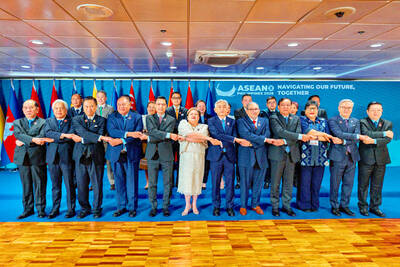
NEUTRALITY? China’s delivery of 39 T-39D battle tanks to Cambodia risks undermining a fragile truce between the two Southeast Asian countries, the Thai prime minister said Thailand has lodged concerns with China over its recent delivery of tanks to Cambodia, citing the fragility of a ceasefire between the Southeast Asian neighbors following last year’s deadly border clashes. Thai Prime Minister Anutin Charnvirakul raised the concerns with Chinese President Xi Jinping (習近平) in a meeting on Friday last week, Thai Minister of Foreign Affairs Sihasak Phuangketkeow told reporters yesterday during the Thai delegation’s visit to China. “Our concern lies in Cambodia’s reporting of the tank delivery. At this time, relations are delicate, and the ceasefire is fragile,” Sihasak said. “Presenting the tank delivery in a way that benefits Cambodia
Artificial intelligence (AI) should not be dominated by a single country, Chinese President Xi Jinping (習近平) said yesterday at a major technology conference in Shanghai, urging international cooperation on its development. Chinese AI models are catching up to the most powerful US offerings and attracting global users with lower costs, but how to govern the sector has become a key question, as concerns grow over military AI deployment or its use by hackers and terrorists. “AI development should not be a solo performance by a single country, but a symphony of international cooperation,” Xi said at the opening of the World Artificial
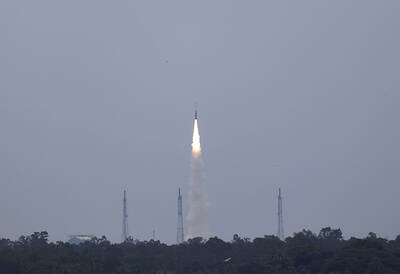
‘DEFINING MOMENT’: Indian Prime Minister Narendra Modi touted the achievement, saying that it would encourage the youth to ‘dream bigger and innovate fearlessly’ India’s first privately built orbital rocket took its maiden flight yesterday, Skyroot Aerospace said, marking a significant step for the South Asian giant as it eyes a bigger slice of the global space economy. The Vikram-1 rocket, designed to carry small satellites into low Earth orbit, took off from the Satish Dhawan Space Center in Sriharikota amid loud cheers. “Hello space, we have arrived!” Skyroot Aerospace wrote on X. “Vikram-1’s Test Flight-1 has completed its mission. The first ever Indian private sector launch has been successfully completed.” Vikram-1 is about as tall as a seven-story building and capable of carrying payloads weighing


 RSS
RSS