

Thailand has lodged concerns with China over its recent delivery of tanks to Cambodia, citing the fragility of a ceasefire between the Southeast Asian neighbors following last year’s deadly border clashes.
Thai Prime Minister Anutin Charnvirakul raised the concerns with Chinese President Xi Jinping (習近平) in a meeting on Friday last week, Thai Minister of Foreign Affairs Sihasak Phuangketkeow told reporters yesterday during the Thai delegation’s visit to China.
“Our concern lies in Cambodia’s reporting of the tank delivery. At this time, relations are delicate, and the ceasefire is fragile,” Sihasak said. “Presenting the tank delivery in a way that benefits Cambodia could not be beneficial for the current Thai-Cambodian situation.”
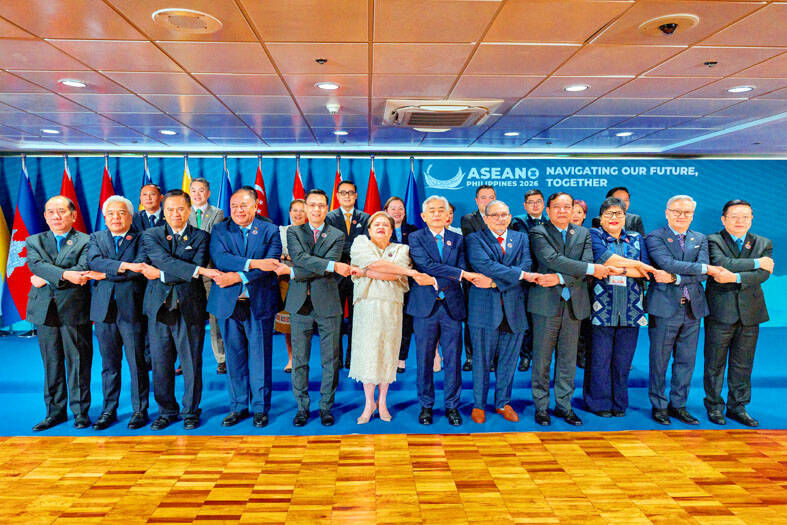
Photo: AP
The concerns came after Thai authorities last month said 39 Chinese T-59D battle tanks had been delivered to Cambodia as part of an existing joint military training agreement, adding that the hardware did not seem to have been moved to the border after.
Relations between Thailand and Cambodia have remained tense after a third ceasefire agreement at the end of last year, following days of clashes in July and December that ranked among the deadliest between the two countries.
A compulsory UN settlement process for maritime disputes, initiated by Cambodia earlier this year, has further strained relations. That has made talks on land border demarcation difficult and prompted a pause, Sihasak said.
Tensions between the two countries can be traced back to colonial-era maps and treaties that define the shared border. Historic rivalry and rising nationalist sentiment have fueled recent military attacks along the roughly 800km frontier.
Cambodia’s use of Chinese weapons came into focus during the border conflicts last year, following reports that the Thai military seized a large number of Chinese-made weapons from Cambodian soldiers.
China has said it maintains “normal defense cooperation” with both countries and that such ties do not target any third party. In April, it delivered the first Type 056 guided-missile corvette to Cambodia’s Ream Base. Thailand, which is a treaty ally of the US, has far larger and more sophisticated armed forces than Cambodia.
Sihasak added that Thailand appreciated that China recognized the importance of remaining neutral and not siding with either party.
He noted China’s goodwill in seeking to help ease ongoing tensions between Thailand and Cambodia, but said the matters have to be resolved bilaterally.
“We didn’t criticize them. We just stated the facts, and we asked that they consider these concerns,” Sihasak said.
Beyond the border issue, China and Thailand agreed to set up a dialogue mechanism involving their foreign and defense ministers. China is to host the first round of talks, which would prioritize joint efforts to crack down on scam operations, Sihasak said.

INVESTMENT: The train project was significantly more expensive than other conventional services, but costs are expected to fall as the technology matures, an official said India yesterday launched its first hydrogen-powered train, joining a small group of nations testing the technology as part of efforts to decarbonize rail transport and cut dependence on fossil fuels. The project is part of a broader push to modernize one of the world’s largest rail networks while reducing carbon emissions. The 10-coach train runs along an 89km route between Jind and Sonipat in Haryana, powered by a 1,200-kilowatt hydrogen fuel cell propulsion system. The system is the world’s most powerful for a train, officials said. Hydrogen trains use fuel cells to generate electricity by combining hydrogen and oxygen, emitting only water and steam. “This

KEY REVENUE SOURCE: An agreement to freeze the bloc’s floating price cap on Russian oil also appeared elusive, despite a looming deadline today to reset the limit The EU on Monday failed to endorse a 21st sanctions package against Russia, putting the bloc at risk of undermining one of its key tools to restrict the Kremlin’s oil revenue. The main points of contention were restrictions on the transport of Russian liquefied natural gas (LNG) and measures regarding Austria’s Raiffeisen Bank International AG, said people familiar with the matter who spoke anonymously to describe the private talks. An agreement to freeze the bloc’s floating price cap on Russian oil — a central element of the package — was also elusive, despite a looming deadline today to reset the limit. Without

‘WRONGFULLY DETAINED’: A security expert said that China wants to use Chen Youlin’s expertise to improve its ability to conceal underground nuclear weapons tests A Chinese-born American seismologist who has published US-funded work on detecting North Korean nuclear tests has been detained in China for nearly two years and faces trial on spying charges, his wife, US lawmakers and two hostage advocacy groups said. The case of Chen Youlin (陳有林) adds an irritant to the tense relationship between the nuclear-armed rivals and comes as US President Donald Trump seeks to keep the relationship steady following last year’s trade war. US Secretary of State Marco Rubio on March 19 designated Chen, 54, as “wrongfully detained,” making his release a top US priority. The Trump administration has withheld
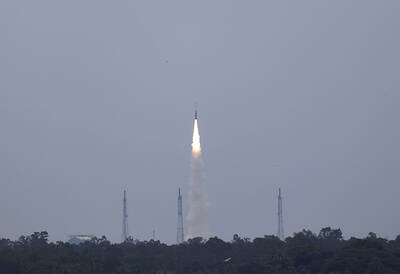
‘DEFINING MOMENT’: Indian Prime Minister Narendra Modi touted the achievement, saying that it would encourage the youth to ‘dream bigger and innovate fearlessly’ India’s first privately built orbital rocket took its maiden flight yesterday, Skyroot Aerospace said, marking a significant step for the South Asian giant as it eyes a bigger slice of the global space economy. The Vikram-1 rocket, designed to carry small satellites into low Earth orbit, took off from the Satish Dhawan Space Center in Sriharikota amid loud cheers. “Hello space, we have arrived!” Skyroot Aerospace wrote on X. “Vikram-1’s Test Flight-1 has completed its mission. The first ever Indian private sector launch has been successfully completed.” Vikram-1 is about as tall as a seven-story building and capable of carrying payloads weighing


 RSS
RSS