


Europe’s deadly heat wave on Sunday pushed east with hundreds of millions still sweltering across the continent despite fleeting relief from overnight storms, notably in France and Belgium.
The heat remained intense across central and eastern Europe, with the Czech Republic, Hungary and Poland hit hard as temperatures soared. At least 191 million Europeans were expected to face temperatures above 35°C during the day.
The WHO said it had recorded more than 1,300 excess deaths in Europe since June 21. Overall, about 381 million Europeans were set to see temperatures exceed 30°C, analysis based on forecasts from the German Meteorological Service and population data showed.

Photo: AFP
This heat wave is the most severe ever recorded in Europe, and would have been “virtually impossible” this early in the summer without climate change, the World Weather Attribution group of scientists said.
All-time temperature records have been broken in Germany, Poland and the Czech Republic, as well as for the month of June in the UK and in Switzerland.
“Right now, 150 million people are living under extreme heat, hundreds have died, schools are shut, grids are buckling,” WHO Director-General Tedros Adhanom Ghebreyesus said on social media.
“Europe is the fastest-warming continent on Earth, heating at twice the global average,” he said.
Storms brought some respite overnight, particularly in France after several days of temperatures close to 40°C. However, they also caused damage, as a man died near Brussels when a tree fell on his car, local media reported.
French authorities feared a rising death toll.
The country’s national health agency on Sunday said that it had tallied about 1,000 more deaths than expected from Wednesday lats week, and warned the figure was likely to increase further.
Many of those fatalities are among those aged 65 or more, it said.
French Minister of the Interior Laurent Nunez rejected criticism from opposition deputies over the response, saying: “This is not a fiasco — we were prepared.”
French Prime Minister Sebastien Lecornu has called a special Cabinet meeting to discuss how to learn the lessons from the recent heat waves and to prepare for the possibility of more, his office said.
French weather agency France-Meteo said on Sunday evening that it was already anticipating the possibility of another heat wave next month.
Temperatures soared above 40°C in several countries on Sunday as the heat wave shattered records across central and eastern Europe.
Poland recorded a new all-time high of 40.5°C in the western town of Slubice, the Polish Institute of Meteorology and Water Management said.
Poland’s long-distance rail operator PKP Intercity announced disruption to some of its services, with the public displays at Warsaw’s Central train station showing delays of more than four hours. Germany set a new national high of 41.7°C at Coschen, near the Polish border, surpassing a high set just a day earlier.
The Berlin police used water cannons to help residents of the capital cool off for a second day running Sunday — this time at the Olympia venue where singer Bruno Mars was performing.
One 32-year-old Berliner, Diane, said she had fainted from the heat once already, despite drinking 3 liters of water.
The Czech Republic also broke records for a second consecutive day, with 41.1°C recorded in Doksany, north of Prague. That was later revised upwards to 41.9°C.
The French National Center for Scientific Research (CNRS) said rising temperatures were clearly affecting marine life and biodiversity.
Speaking from a beach at Wimereux in northern France, CNRS research director Gregory Beaugrand said that the warming of the English Channel was disrupting the food chain, as “fish that like cold waters are disappearing.”
French paleoclimatologist Jean Jouzel told the Tribune newspaper he feared political attention would quickly shift once the heat wave ends.
Urging people to heed scientific warnings, he said: “People are closing their eyes — but it is extremely serious.”

The leader of a South Korean church was arrested on Wednesday on suspicion of election influence as authorities widened an investigation into allegations that he illegally recruited thousands of followers into the People Power Party. The Shincheonji Church has denied the accusations against Lee Man-hee, 95, a self-proclaimed messenger of Jesus who founded the congregation in the 1980s. The church says it has about 200,000 members. Since January, a special team of prosecutors and police has been investigating alleged ties between religious groups such as Shincheonji and the Unification Church, and politicians. The inquiry is part of broader investigations under South Korea’s government into
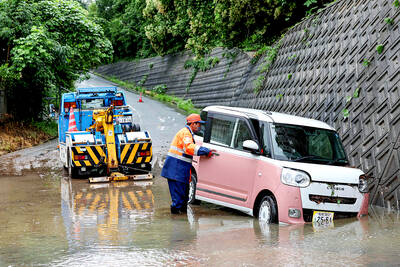
Japanese airlines canceled more than 100 flights yesterday, as two tropical storms barrelled toward the archipelago, with authorities advising evacuations in some areas because of possible flooding and landslides. Severe tropical storm Mekkhala was downgraded from a typhoon, but still carried gusts of up to 144kph, forecasters said, with heavy rain already pounding parts of southern and western Japan. The weather system was expected to skirt the islands of Kyushu and Shikoku over the weekend and potentially converge with tropical storm Higos, which was also swirling further out in the Pacific. That could result in the atmospheric phenomenon known as the

EXTREME HEAT WARNING: Across Europe, farms have suffered and hospitals have struggled to cope amid the heat wave, while dozens of people have died in France Germany and Italy yesterday endured sweltering conditions as a heatwave linked to dozens of deaths in Western Europe spread eastward after temperatures broke records above 40°C. The UK, France, Switzerland and Germany have experienced record heat this month, and the weather system could test more records as it rolls across Germany toward Poland. Scientists said the heatwave would have been virtually impossible without man-made climate change, which has made this week’s temperatures 100 times more likely than they would have been even two decades ago. On Friday, a new German record of 41.3°C was reached near the city of Saarbruecken close to the

SEVASTOPOL BLACKOUT: Forces struck a railway bridge, a power plant and other infrastructure targets in Crimea as Kyiv seeks to turn the peninsula into ‘an island’ Ukrainian strikes on Crimea triggered power outages in its largest city, Sevastopol, both sides reported yesterday, as Kyiv intensifies its attempts to cut off the peninsula, which Moscow annexed in 2014. Crimea has been forced to suspend fuel sales to the public as Ukraine’s army targets Russian logistics to the region, and has hit a series of oil refineries and depots across southern Russia that provide supplies. Sevastopol Governor Mikhail Razvozhayev urged residents to help neighbors, and reserve phones for emergency communication to save battery and avoid overloading the grid. “The enemy is once again striking treacherously, attempting to deprive us of normal


 RSS