


Germany and Italy yesterday endured sweltering conditions as a heatwave linked to dozens of deaths in Western Europe spread eastward after temperatures broke records above 40°C.
The UK, France, Switzerland and Germany have experienced record heat this month, and the weather system could test more records as it rolls across Germany toward Poland.
Scientists said the heatwave would have been virtually impossible without man-made climate change, which has made this week’s temperatures 100 times more likely than they would have been even two decades ago.
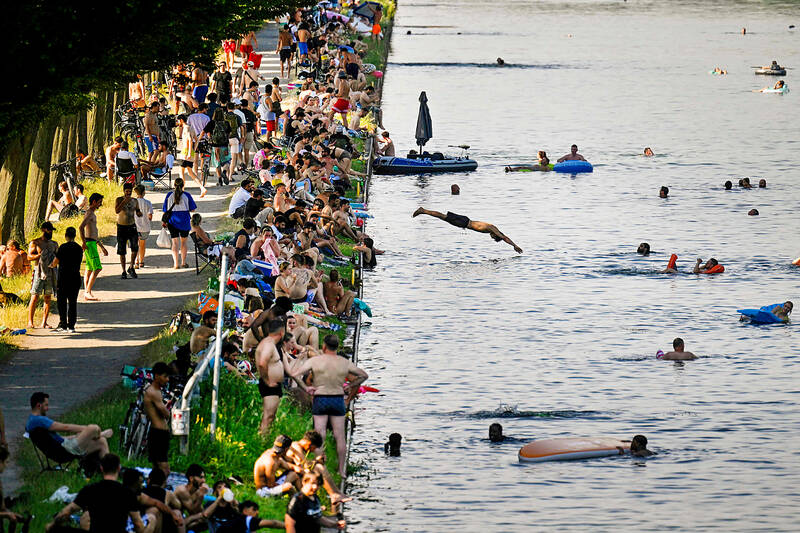
Photo: AFP
On Friday, a new German record of 41.3°C was reached near the city of Saarbruecken close to the French border, a German National Meteorological Service spokesperson said, adding that the reading was still preliminary.
The service issued extreme heat warnings for nearly all of Germany yesterday as authorities urged people to save water.
Temperatures of 36°C were expected across the board in the country, with local highs of 42°C possible, it said.
In France, dozens of people, young and old, have died during the heatwave. Temperatures above 40°C have disrupted rail travel and power generation, sparked alcohol bans, suspended schools and postponed outdoor events.
“The heatwave is going to peak at the weekend at well over 40° in some parts of Germany,” meteorologist Karsten Brandt said.
The Italian Ministry of Health issued a red alert for the heatwave in 18 Italian cities including Milan, Rome, Turin, Venice, Genoa, Florence and Bologna for yesterday and today, with temperatures expected to climb as high as 39°C in some areas.
Struggling with the prospect of damage to infrastructure, including buckling roads and swelling train tracks, some major public service providers have sought to reduce traffic.
German national rail operator Deutsche Bahn has given customers the option of canceling long-distance travel bookings into early next week without charge due to the heatwave.
The firm said its infrastructure is under strain, because of sun exposure and additional risk to signals, tracks and overhead wires stemming from thunderstorms and wildfires.
National Express said it would suspend trains on its Rhine-Ruhr-Express line yesterday afternoon in North Rhine-Westphalia, Germany’s most populous state, as a preventative measure in case services came to an unplanned halt.
The most extreme heat was forecast to begin fading at the weekend, with heavy thunderstorms expected today.
Across Europe, cultural landmarks have had to close, farming has suffered and some hospitals have struggled to cope.
The heatwave has pushed temperatures up to 18°C above their seasonal average, Reuters Climate Monitor showed, and is being driven by a phenomenon known as an “Omega block.”
This weather pattern traps a bulging ball of hot air over regions for extended periods, with cooler air on its fringes.
Most of the housing stock in Northern Europe is not built to withstand heat, but rather to keep it in.
The heatwave would begin shifting by the end of the month, hitting Central Europe and the Balkans, the World Meteorological Organization said.

NATO ALLIES: The Italian PM accused Trump of ‘constant, unprovoked ... senseless’ attacks and said ‘my popularity is none of your concern. I suggest you focus on yours’ Italian Prime Minister Giorgia Meloni on Saturday fired back at US President Donald Trump, saying his “constant, unprovoked attacks are senseless” after he escalated a diplomatic row by accusing her of repeatedly seeking a photograph with him. The clash has opened an unusually personal rift between Trump and one of Europe’s most prominent right-wing leaders, who had sought to cast herself as a bridge between Washington and the continent during Trump’s return to power. Trump had initially told Italian broadcaster La7 that Meloni “begged” him for a picture at last week’s G7 summit in France, saying he agreed only because
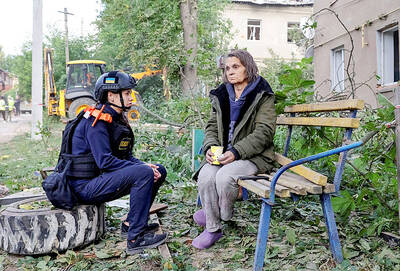
President Volodymyr Zelenskiy on Saturday said that Russian forces were preparing an impending massive attack on Ukraine and warned residents to take special care as Russian strikes in different regions killed at least six people. “Tonight and in the coming hours, it is especially important to pay close attention to air raid warnings,” Zelenskiy said in his nightly video address. “The Russians have prepared for a massive attack. Please take care of yourselves.” Russian forces have staged a series of heavy attacks on Kyiv in the past few weeks and in other major cities. Strikes on Monday last week killed

The leader of a South Korean church was arrested on Wednesday on suspicion of election influence as authorities widened an investigation into allegations that he illegally recruited thousands of followers into the People Power Party. The Shincheonji Church has denied the accusations against Lee Man-hee, 95, a self-proclaimed messenger of Jesus who founded the congregation in the 1980s. The church says it has about 200,000 members. Since January, a special team of prosecutors and police has been investigating alleged ties between religious groups such as Shincheonji and the Unification Church, and politicians. The inquiry is part of broader investigations under South Korea’s government into
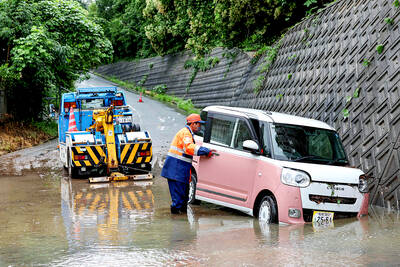
Japanese airlines canceled more than 100 flights yesterday, as two tropical storms barrelled toward the archipelago, with authorities advising evacuations in some areas because of possible flooding and landslides. Severe tropical storm Mekkhala was downgraded from a typhoon, but still carried gusts of up to 144kph, forecasters said, with heavy rain already pounding parts of southern and western Japan. The weather system was expected to skirt the islands of Kyushu and Shikoku over the weekend and potentially converge with tropical storm Higos, which was also swirling further out in the Pacific. That could result in the atmospheric phenomenon known as the


 RSS
RSS