


Polish President Karol Nawrocki on Friday stripped his Ukrainian counterpart Volodymyr Zelenskiy of Warsaw’s top award, escalating a row between the allies over the memory of World War II.
Zelenskiy had infuriated Warsaw this month by naming a military unit after an insurgent army that took part in massacres of Poles in WWII.
Poland has been one of Ukraine’s main allies during the Russian invasion, taking in hundreds of thousands of refugees and turning into a logistics hub for Western support for Kyiv, but spats over WWII memory have historically strained Kyiv-Warsaw relations.
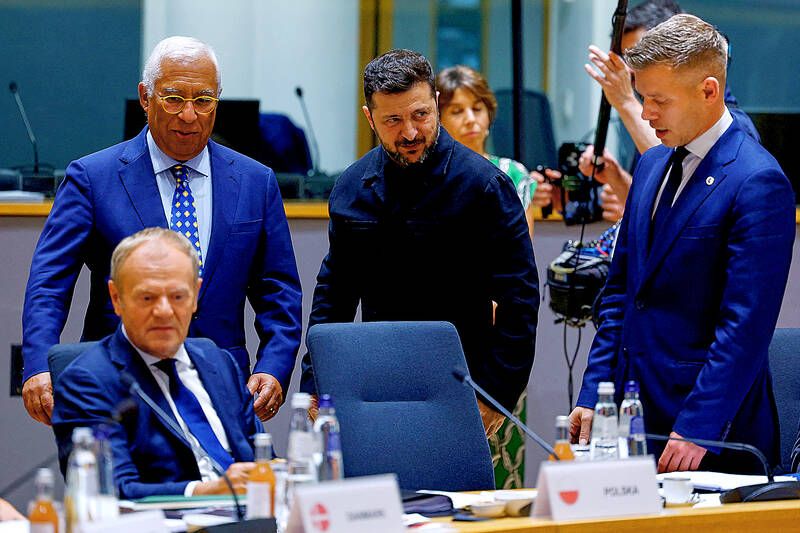
Photo: AFP
Nawrocki stripped Zelenskiy of the Order of the White Eagle — the highest honor in Poland. He did so despite Kyiv and Polish Prime Minister Donald Tusk asking him not to escalate the spat further — and less than a week before Poland is due to host the annual Ukraine Recovery Conference, with Zelenskiy’s attendance unclear for days amid the row.
“Historical truth is not, and can never be, a bargaining chip. Remembering the victims is a moral obligation of the Polish state,” Nawrocki, who became president last year, said in a statement.
He said that Poland had demanded Ukraine reverse its decision on the army unit, but Kyiv had not done so.
“Therefore, in light of President Volodymyr Zelensky’s consent to name one of the units of the Armed Forces of Ukraine ‘Heroes of the UPA’... I have decided to revoke the Order of the White Eagle from the President of Ukraine,” Nawrocki said.
Ukraine slammed the decision as a “strategic mistake” from which “only Moscow stands to gain.”
Ukrainian Minister of Foreign Affairs Andriy Sybiga said he plans to return an award he had received from Poland in 2022 after the “unjustified, impulsive and disrespectful” decision.
Between 1943 and 1945, thousands of Polish civilians were killed by UPA Ukrainian nationalist units in the Volhynia region — a Ukrainian region that was part of Poland before WWII.
Nawrocki said Kyiv’s “decision to glorify the UPA is not only outrageous,” but also “deeply disappointing,” hurting “reconciliation” between the two nations.
Tusk — whose government is at loggerheads with Nawrocki — has called Zelenskiy’s unit naming a “bad decision,” while saying the Ukrainian leader had told him “he did not have the slightest intention to offend Poles.”
Tusk had appealed to both nations “not to waste” the kind of solidarity between the two countries seen during the Russian invasion and “for history not to ruin our future.”
Poland, home to hundreds of thousands of Ukrainian refugees and migrants, has in the past few months seen a string of anti-Ukrainian incidents, with activists and critics of Nawrocki’s nationalist stance warning not to escalate rhetoric.
Poland has said it expects several thousand officials and business leaders in its Baltic port of Gdansk for the Ukraine Recovery Conference, an annual event to promote investment into Kyiv that Zelenskiy traditionally attends. Tusk did not give a clear answer on Friday on whether the Ukrainian leader would attend the conference, but said that “I hope nothing like that will undermine all the effort, mainly on Poland’s part, to organize this huge undertaking.”
Hours before the Polish president’s decision, Polish Ministry of Foreign Affairs spokesman Maciej Wiewor said, when asked about the Gdansk conference, that “what unites us is the future and ensuring both Ukraine and Poland are safe. I think that is the priority today.”
The event is due to start in Gdansk, Tusk’s and Nawrocki’s hometown, on Thursday. Poland has presented the conference — previously hosted by Rome, Berlin, London and Lugano, Switzerland — as a major economic and political win, and has been preparing it for weeks.
Zelenskiy has not yet commented on Poland’s decision.

Voters in Switzerland yesterday cast their ballots on an initiative championed by the top right-wing party to cap the Alpine country’s population at 10 million. As of press time last night, early results showed that Swiss voters were leaning against it. The populist Swiss People’s Party, which has the most seats in parliament, has stirred up and fostered anti-migration sentiment over the years, notably about an influx of workers from the neighboring EU. Critics called the bid a self-inflicted wound, saying the boom in migration over the past generation has brought foreign labor and skills to sectors such as healthcare, finance, pharmaceuticals
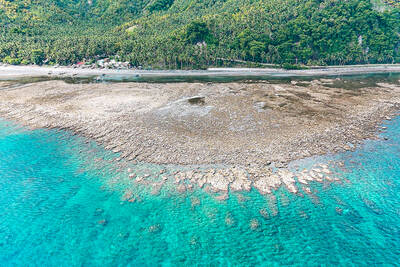
Arsenio Butil Jr fell to his knees and began to pray when last week’s deadly magnitude 7.8 earthquake began shaking his home on the coast of the southern Philippines. When he opened his eyes, he saw a once-familiar shoreline changing in real time, with swathes of previously submerged coral suddenly pushing above the waterline. The June 8 quake, driven by a shifting of the nearby Cotabato Trench, toppled buildings, triggered landslides and killed at least 76 people on the southern island of Mindanao. The tectonic forces at work also thrust chunks of the island’s coastline upward in a phenomenon known as “coastal uplift,”
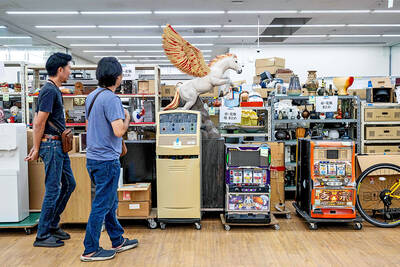
YUCK OR YUM? While it is difficult to sell second-hand goods that are more than seven years old in Japan, they are still popular in foreign markets, an executive said Under a scorching sun in a Bangkok suburb, a whistle blew, and shouts filled the air as dozens of shoppers rushed into a warehouse bearing the sign “Japanese Second-Hand Store.” From bags and bicycles to surfboards and suitcases, the Japanese second-hand market is booming, with quality-conscious buyers in other Asian countries increasingly tapping into the circular economy trend. “What is considered garbage for them can still be useful in Thailand,” said 36-year-old Lookpoo Sathitpanyapon, who runs an online store selling toy keychains. “That bag, that bag,” one shopper shouted while racing through the warehouse, filled with everything from colorful toys
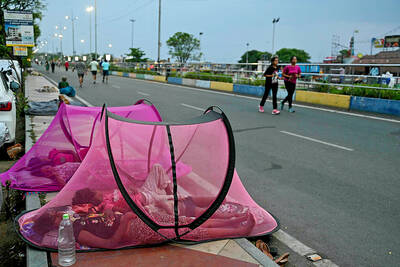
Growing up in Tahiti, Anna-Bella Failloux saw first-hand the threat posed by mosquitoes: Nearly one-third of adults on the picturesque island once had swollen limbs from elephantiasis caused by their bites. She has since dedicated her life to studying mosquitoes and the diseases they transmit — a concern that looms ever larger as climate change expands the area where the insects roam. “You have to accept being bitten by a mosquito from time to time,” the 63-year-old entomologist at France’s Pasteur Institute said. “But we have to avoid too many people getting sick and dying from the infections,” Failloux said, as she observed


 RSS
RSS