

Thai Princess Bajrakitiyabha Mahidol, a lawyer and the eldest of King Maha Vajiralongkorn’s children, has died at 47, the Bureau of the Royal Household said.
She died on Thursday evening at a Bangkok hospital where she had been cared for since falling unconscious due to illness three years ago, a statement issued yesterday said.
“This loss is not merely bad news announced to the people, but an immeasurable grief in the hearts of the entire nation,” Thai Prime Minister Anutin Charnvirakul said in a televised speech.
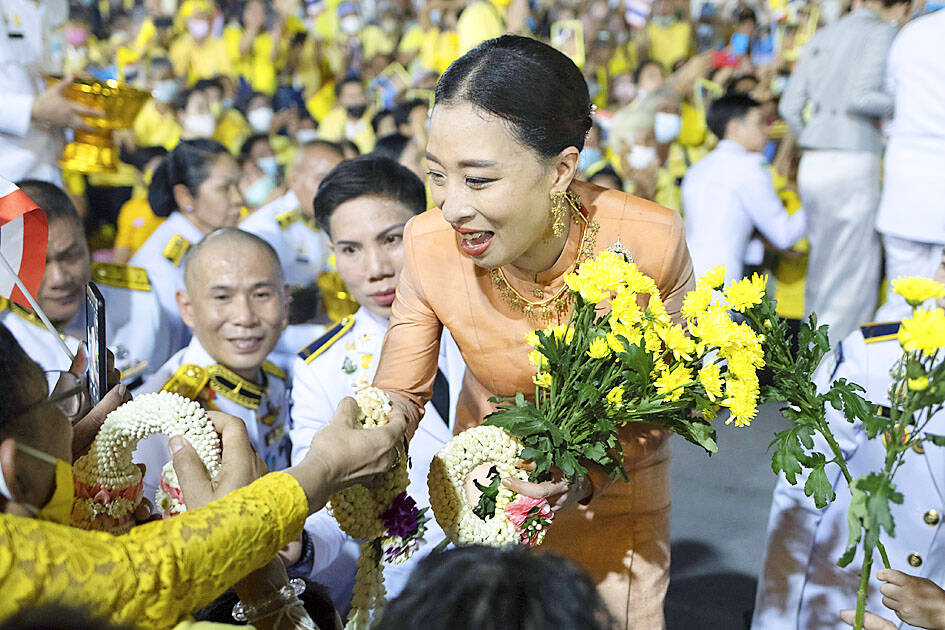
Photo: AP
The princess was “a pride of Thailand,” and “her commitment to building a society of kindness, justice and equality, will forever remain as a moral legacy for the nation, a guiding light for generations of Thais,” he said.
A small group of mourners gathered in an atrium at King Chulalongkorn Memorial Hospital, where the princess had been treated. Most held framed or laminated photos of her throughout the years.
Bajrakitiyabha was active in justice reform efforts and best known for her Kamlangjai, or “Inspire,” project to help rehabilitate incarcerated women ahead of their release.
Bajrakitiyabha was hospitalized in December 2022 after falling unconscious while training dogs for an army exhibition.
The palace said she had a mycoplasma infection, a bacterial infection usually associated with pneumonia.
The princess was born on Dec. 7, 1978, to Vajiralongkorn, who was the crown prince at the time, and his then-wife, Thai Princess Soamsawali.
Bajrakitiyabha was also known by the royal name Bajrakitiyabha Narendira Debyavati.
Prince Dipangkorn Rasmijoti, the youngest of the king’s children, is the presumptive heir, because sons take precedence in Thailand’s line of succession. However, Bajrakitiyabha’s experience in public service raised speculation she was set to hold an important role in any future succession, perhaps as regent to a youthful monarch.
Bajrakitiyabha studied law at Thammasat University then went to Cornell University in New York state, where she earned a master’s degree in law in 2002. She earned a doctorate at Cornell in 2005 with a dissertation concerning the protection of the rights of the accused. Scholarships to Cornell Law School and a program for the exchange of legal academics between Thailand and Cornell were later established in her name.
After working briefly at the Thai Mission to the UN in New York City, she returned home and worked as a public prosecutor. She renewed her diplomatic career with an appointment as Thai ambassador to Austria from 2012 to 2014 before returning to her homeland to concentrate on criminal justice issues. In 2017, she was appointed a goodwill ambassador for the UN Office on Drugs and Crime.
The princess was also involved in projects such as a campaign to enhance the living conditions of female prisoners and promoting efforts to stem violence against women as an honorary UN goodwill ambassador for women. Her efforts led to the UN General Assembly adopting the “Bangkok Rules” on care and conditions for female prisoners.
“Society cannot grow if there is instability and injustice,” Bajrakitiyabha said in 2013. “Without the rule of law, without a good justice system, it’s always chaos.”
“I think the rule of law is a very important pillar to development, to economic growth, and of course to human rights,” she said.

Philippine Secretary of National Defense Gilberto Teodoro Jr on Tuesday hit out at China at an international forum after a memo asserting Beijing’s position over their longstanding maritime dispute was delivered to him while he was speaking on stage. The unusual incident was captured on video at the Seoul Defense Dialogue as the secretary was responding to a question about “gray zone” coercion in the South China Sea. The video shows what appears to be a conference staffer placing it on the table next to him while speaking. “I have a note here, I think this is from China,” he said, describing

PAINSTAKING PROCESS: Ice makers freeze water for up to 72 hours, replace tainted water with a fresh batch once freezing begins, and are constantly stirring In the historic Japanese city of Kanazawa, craftsmen painstakingly shape and slice blocks of ice destined to chill negronis in some of the world’s trendiest bars. The men work for Kuramoto Ice, a century-old company in Ishikawa on the Sea of Japan coast and one of dozens of Japanese firms producing ultra-clear, premium ice. This luxury product, believed by those in the industry to melt more slowly than regular blocks, is a staple of Japan’s cocktail culture, but its popularity is also spilling over to bars abroad, from the US to Australia, who pay as much as ¥200 (US$1.28) per cube. Kuramoto Ice
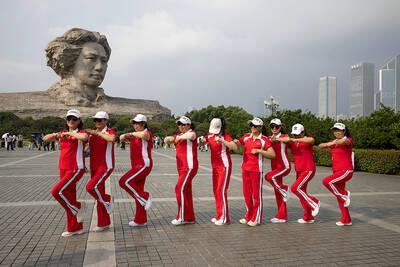
China yesterday marked half a century since the death of Mao Zedong (毛澤東), founder of the People’s Republic, who brought roughly one-quarter of the world’s population under communist rule and whose specter still haunts China’s future. Mao’s death on Sept. 9, 1976, at age 82, mourned by many and welcomed by some who suffered under his nearly three-decade rule, also hastened the end of the Cultural Revolution, a frenzied mass movement he launched in 1966. The party later condemned the Cultural Revolution as a grave error for which Mao bore primary responsibility, but still reveres him, saying his achievements outweigh his mistakes. Mao’s

COMMITMENT: China could view reduced US-Seoul exercises as an opportunity to reassert itself, but the US had reassured Manila of its resolve, the defense chief said China could see recent cuts to US-South Korean military exercises as an opportunity to reassert itself in the Indo-Pacific region, Philippine Secretary of Defense Gilberto Teodoro said yesterday, though he said Washington had assured Manila that its commitments to the Philippines remained unchanged. Speaking to Reuters on the sidelines of the Seoul Defense Dialogue, Teodoro said there had been no reduction in US-Philippine military activities, and that bilateral and multilateral cooperation involving Manila continued to expand. US President Donald Trump’s decision last month to scale back military exercises with South Korea has prompted debate among security analysts over the credibility of US


 RSS
RSS