


The two burly men stare straight ahead, hands intertwined on a pottery wheel, fingers buried in the clay. They sense each other’s presence through touch alone.
One is a veteran who lost his sight in combat and now teaches other blind veterans. Slowly, a piece resembling a cup takes form.
The instructor, Ivan Shostak, 37, said he has made more than 1,000 such pieces, but has never seen a single one. The craft came into his life only after he lost his sight during one of Ukraine’s bloodiest and longest battles.
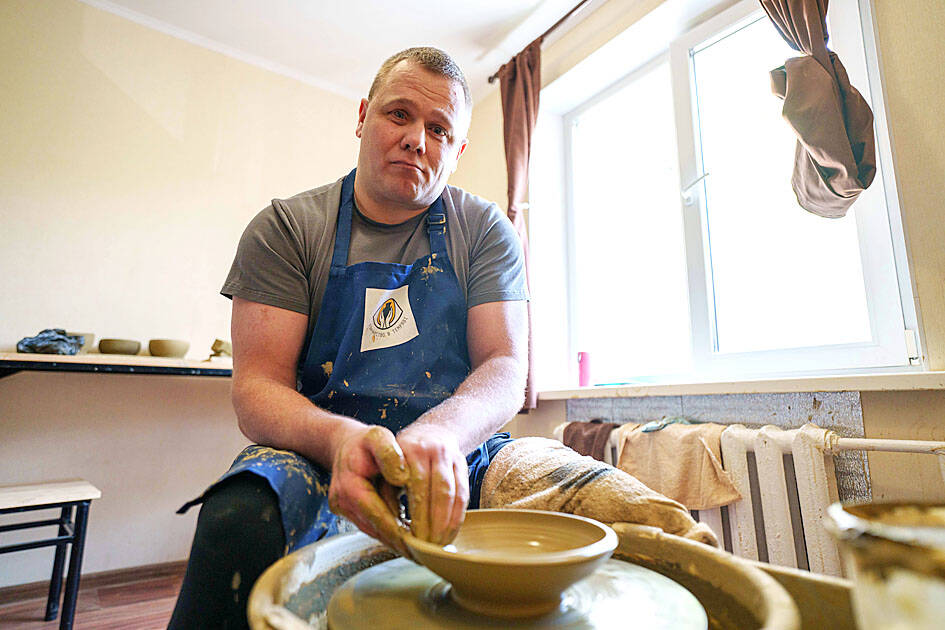
Photo: AP
Making plates, cups, mugs, candle holders and other objects helped him find new meaning in a life upended by trauma. What began as a rehabilitation exercise has grown into a business and a mentoring practice for veterans and others.
“I have two kids I have to help through life and show by my own example that you have to fight for your life,” Shostak said.
Shostak rejoined the army in the early years of Russia’s full-scale invasion. He previously fought in eastern Ukraine after the conflict broke out in 2014.
His second tour lasted a few months. While fighting in the battle of Bakhmut in March 2023, a rocket-propelled grenade exploded just above his head. The blast destroyed his eyes.
Besides blindness, he also had a concussion, a traumatic brain injury and displaced vertebrae in the neck.
The real ordeal began at home, he said. His wife at the time could not endure it and left him alone with his new challenges.
“There was a family, and after the injury there was no family,” Shostak said. However, his parents stayed close, supporting him.
He spent half a year bedridden, dulling the pain with medication. The despair was harder to manage. No pills could ease that.
A fellow soldier home on leave came to his aid, taking him to a local rehabilitation center for people who had lost their sight. Within a month, staff taught him to use a phone and a cane, and to handle daily life.
“It turned out you could live even in total darkness,” Shostak said.
One day, he and others from the center were invited to visit a pottery workshop, where he made his first plate.
“And after that came the thrill that I could still do something,” he said.
He began attending classes regularly and later sold his work. He became an instructor after the first “Pottery in the Dark” project, supported by Sweden and the UN Development Program, in Vinnytsia. The program helps veterans who lost their sight.
Then, he launched his business.
Shostak has three others on his team who help him sell his pottery, mostly through his Instagram page. He keeps no strict schedule, working according to his mood in a workshop that his older brother, also a soldier, set up for him in his apartment.
“Clay is that kind of material, and pottery is that kind of work, where if you feel bad, there’s nothing to do here. It won’t come out at all. Everything breaks, comes out crooked,” he said. “Only when you feel good, you sit down, you work, and it all turns out great.”
The later stages happen in another workshop, where he gets help with firing and glazing. He chooses every color himself, guided by his imagination.
Roman Shtohryn, director of the Podillia rehabilitation center in Vinnytsia, said six of the 11 project participants who completed the pottery training already earn an income from it. All but one are veterans.
“We planned all this so it would turn into a business,” he said.
Pottery serves multiple functions, Shtohryn said.
The first is psychological: A person concentrates on something, stops thinking about problems and stays in a kind of flow, in the moment. Second, working with clay yields an immediate result.
At the rehabilitation center, Shostak works with fellow veteran Viacheslav Sadovskyi.
“All good? Hands working?” Shostak asked before guiding Sadovskyi’s hands to the wheel.
“There, I can feel it,” said Sadovskyi, who had served in the military since the start of Russia’s invasion. In 2024, a drone exploded near him, damaging the left side of his face and forcing him to undergo five surgeries.
Shostak directed him, telling him how to press the clay and from which side, his hands never leaving Sadovskyi’s.
“It matters that a veteran teaches a veteran,” Shtohryn said. “We’re equals. We understand and support each other.”

Pope Leo XIV on Wednesday blessed a giant new tower at Barcelona’s famed Sagrada Familia Basilica after celebrating mass inside what is now the world’s tallest church. A fireworks and light show illuminated the exterior of the temple at the end of the ceremony, bathing the unfinished basilica in shifting colours that highlighted its towering spires. A choir of 600 singers performed at the service which lasted around 90 minutes and was attended by Spanish Prime Minister Pedro Sanchez as well as King Felipe VI and Queen Letizia. The stained-glass windows in various colours shone brightly in between the tree-like
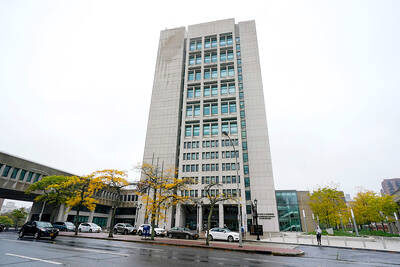
A coalition of civil rights groups on Tuesday asked a New York State judge to order one of its largest suburban counties to stop its deployment of nearly 600 license plate readers, calling it a warrantless and “indiscriminate surveillance system” that violates the state constitution. The class action lawsuit also alleged that Westchester County never got proper authorization to launch the program, which has amassed a database of 1.6 billion plate scans that has been shared with more than 50 outside law enforcement agencies. The complaint said the network “records the long-term travel patterns, daily habits, and intimate information of millions of
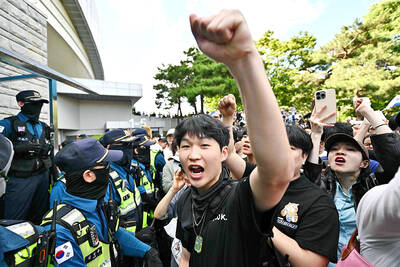
‘ABSURD MISTAKE’: The election commission said that there had been a failure to anticipate turnout after 14 polling stations ran short of ballot papers South Korean riot police yesterday cleared protesters from a Seoul polling station after a 35-hour blockade sparked by a shortage of ballot papers during local elections earlier this week. Wednesday’s election was the first nationwide vote since South Korean President Lee Jae-myung took office following the ouster of Yoon Suk-yeol over his short-lived martial law declaration. Lee’s ruling Democratic Party swept most races, but failed to flip the crucial Seoul mayoral seat. The South Korean National Election Commission apologized, blaming a failure to anticipate turnout after 14 polling stations in Seoul ran short of ballot papers. Some polling stations stayed open until 10pm to
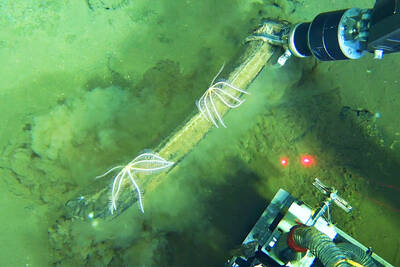
Scientists have discovered communities of marine life — including jellyfish, tubeworms and brittle stars — thriving on a whale graveyard. The graveyards form when whale carcasses fall to the sea floor, becoming a sustaining snack for nearby critters. This one, which is up to 7km below the surface of the southeastern Indian Ocean, spans the largest area, and is so far the deepest found. A whale’s sheer size and the unique chemistry of its bones are the keys to forming these unique underwater neighborhoods, said Song Xikun (宋希坤), a biologist with the Chinese Academy of Sciences’ Institute of Deep-sea Science and Engineering


 RSS
RSS